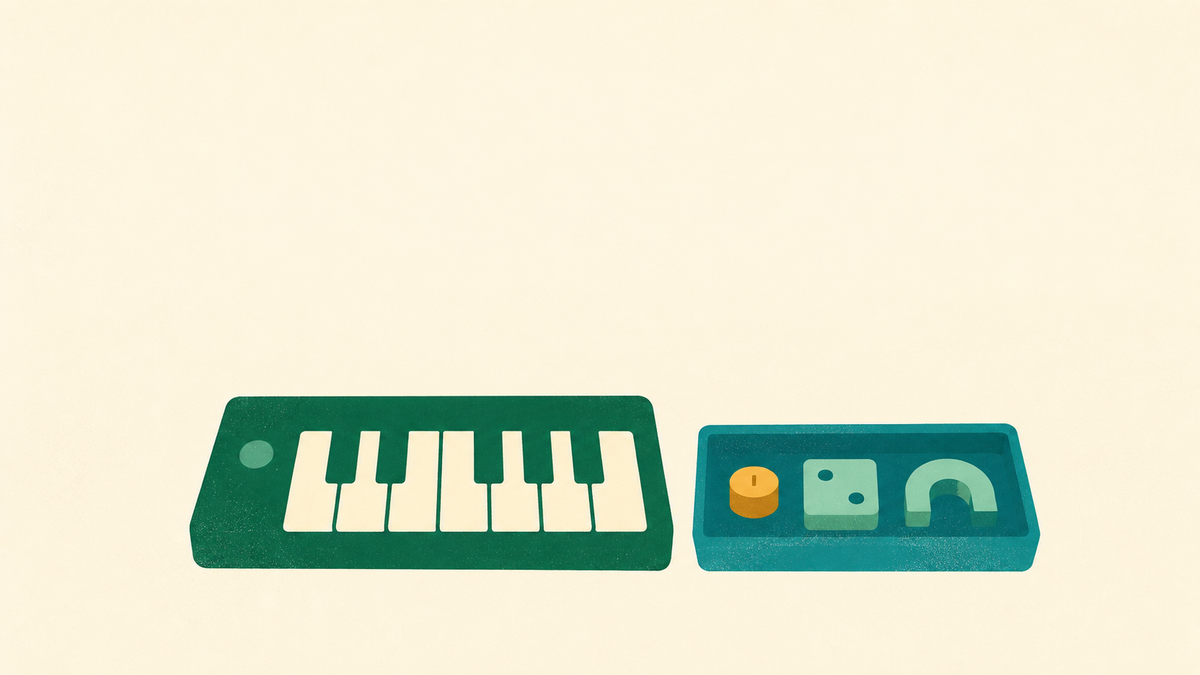
Oskitone makes small electronic musical instruments, including the Scout, a kit aimed at people learning electronics. Its designer, Tommy, deliberately omitted controls and musical features that experienced synthesizer users might expect, so the buyer's first project could remain manageable.
The lesson for a kit business is to choose the first successful outcome before choosing the longest specification list. Every added function can create more parts, assembly work, printed geometry and explanation. Evaluate those costs against the customer you intend to serve, while making the missing capability clear before purchase.
A simpler instrument served a different builder
In his Scout design account, Tommy contrasts the instrument with a more complex earlier Oskitone synthesizer. He identifies novice electronics users, parents and educators as intended audiences. That choice led him to reduce physical controls, avoid manual tuning and keep the design compatible with relatively small 3D printers.
He describes prototyping octave and glide controls, then leaving them out of the finished hardware while placing the corresponding settings in code for later experimentation. The choice preserved an expansion path without making every beginner assemble and understand those controls first.
The maker's public repository identifies a 17-key, Arduino-compatible instrument with through-hole components, a speaker and battery power. Through-hole parts have leads inserted through holes in the circuit board, making the assembly method different from soldering tiny components onto its surface.
Hackaday's September 2021 coverage highlights the connection between restrained features, simpler assembly and fewer opportunities for printed parts to fail. It reviews the design account; it does not provide an independent completion-rate study or a company profit figure.
Write a customer success condition that can fail
For a beginner kit, "educational" is too vague to determine whether a knob belongs. A more useful condition might be that a buyer with the stated prior skills assembles the kit, powers it and produces the intended output using the supplied guide.
State the required prior skills honestly. Scout's designer recommends some soldering experience and basic familiarity with electricity. A novice-friendly product is not necessarily suitable for someone with no tools or training. Removing that context from the offer can create preventable support and disappointment.
Define the customer's first outcome separately from advanced modification. A product can be easy to complete and open to later exploration, but the two activities need different instructions. Mixing them in the main guide can bury the essential sequence under optional possibilities.
For each proposed feature, ask whether it helps the first outcome, a later outcome or neither. Keep a reason for the decision. An attractive upgrade for existing enthusiasts may distract from the beginner product's central job.
A feature has more than a parts price
Use illustrative arithmetic for a hypothetical US-dollar kit. Assume a new control adds US$1.80 of components, ninety seconds of packing and inspection at an assumed US$24 hourly labor cost, and an expected US$0.70 of additional support cost per kit.
The labor component is US$0.60 because ninety seconds is one fortieth of an hour. Total incremental cost is US$3.10 per kit. Over 300 kits, that is US$930 before redesign, documentation and any extra printed-part failures.
Suppose engineering and documentation require another US$1,200. The first 300-kit batch then carries US$2,130 of extra cost, equivalent to US$7.10 per kit. A US$5 price increase adds only US$1,500 of gross revenue across those 300 units, leaving the feature US$630 behind before other selling costs.
This is not an argument that features must finance themselves immediately. They may improve learning, retention or future product demand. It is a requirement to name the benefit and test it rather than call a US$1.80 component a cheap addition.
Include print time and acceptance yield where the feature changes geometry. A small opening, thin hinge or extra enclosure piece may occupy little material but add substantial failure or finishing work. The maker's own design notes describe experiments with enclosure joints and details that proved less suitable for printing.
Compare builds, not just finished products
A useful feature trial observes assembly. Give comparable participants the same task with two versions, using the tools and instructions customers will receive. Record where they stop, what they misunderstand and what requires intervention.
Keep completion time and completion quality together. A faster build with reversed parts or a fragile enclosure has not necessarily improved. Likewise, a product that works after its designer fixes it has not demonstrated independent completion.
A simple scorecard can contain five columns: step, expected result, participant action, assistance required and recovery time. Add photographs of the work only with permission. The most useful observation is often an instruction or physical orientation that the designer assumed was obvious.
Separate guide failures from hardware failures. An unclear drawing may need a clearer guide rather than another component. A part that can be installed incorrectly may need a physical constraint. Repeated confusion across otherwise competent builders deserves investigation, not blame.
Use the scorecard to set a release condition before seeing favorable results. For example, a hypothetical team might require each participant to reach the first output without designer intervention at a specified critical step. Record the sample and prior experience alongside the result. This is a proposed evaluation method, not a study of Scout. Its value is making a beginner claim observable enough to revise.
Leave an honest route to the advanced version
Open design files can let an interested customer modify the instrument. They do not eliminate the seller's obligation to make the supplied version understandable. A beginner should not need to inspect a repository to discover that a programming cable or tool is absent from the kit.
Describe the base package, required tools and optional additions at the purchase decision. Keep advanced instructions beside the modification path rather than in the first-build sequence. This allows a simple commercial offer to coexist with a more ambitious project.
Opulo's small-batch assembly case connects product design to the work of producing electronics. U-Turn Audio's tooling decisions show how manufacturing investment should follow consequential performance. Scout asks a distinct question: which functionality helps a learner finish the first build?
Use an hour to examine the three features that generate the most assembly steps or support questions in your kit. Write the first successful outcome beside each. Identify one feature that can move to an optional extension without changing the base promise.
Oskitone's published account does not prove the stripped-down design outsold an expert instrument or reduced support costs by a measured percentage. It does make the choice inspectable. The best beginner kit is complete when the beginner achieves the intended result, not when the product borrows every control from the expert's bench.
Discussion
Sign in with Google or just a name. No email link, no password to remember.