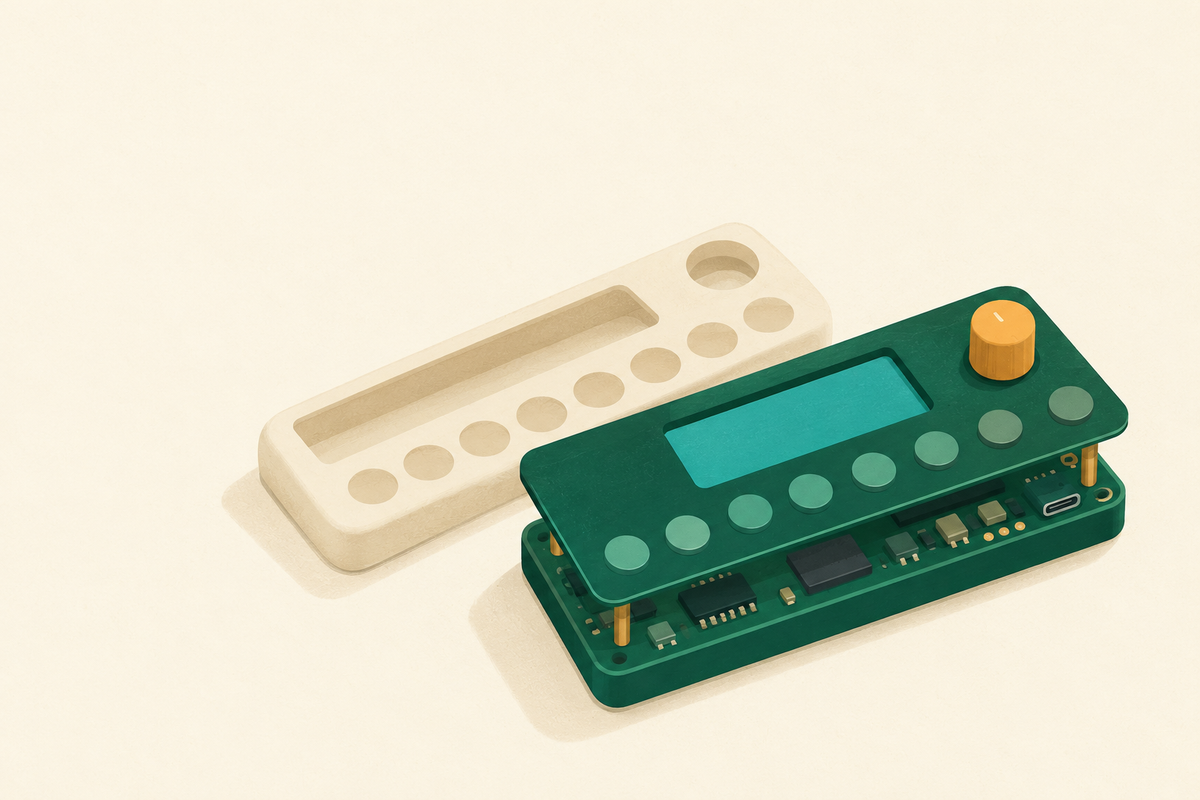
Teenage Engineering makes Pocket Operators, small electronic musical instruments sold as exposed circuit boards with screens, buttons and knobs. The company says it places sensitive components beneath the display so the instrument does not need a conventional outer case.
For a hardware founder, the useful lesson is to price the functions of an enclosure before deleting it. Protection, acoustics and handling still need a home. A bare board can be a finished product when the rest of the architecture carries those duties, but the absence of a shell is not itself proof of a lower complete cost.
The screen was doing another job
The manufacturer's product explanation describes placing vital and sensitive components beneath the LCD. It also says that space doubles as a speaker box. The display and its surrounding layout therefore contribute to physical packaging as well as presenting information.
This is the company's design account, not a teardown performed for this article. It does not establish a universal durability level or prove that an exposed-board product will suit every environment.
The company's retrospective dates the PO-10 series' trade-show debut with clothing brand Cheap Monday to 2015 and gives a historical US$59 price. That price belongs to the launch story, not a current buying recommendation.
The interesting product choice is visible without relying on sales superlatives. The board is the object the customer holds. The display is part of how vulnerable components are arranged. The architecture makes the missing shell comprehensible.
The PO-33 guide begins with inserting two AAA batteries and using the controls. It is a finished instrument, rather than a board that every buyer must solder into a kit before making sound.
Delete a component only after assigning its duties
An enclosure can perform several jobs at once. It may keep fingers away from a component, locate buttons, contain a speaker's air volume, support connectors or provide a surface for identification.
Those jobs do not all require the same solution. A low-voltage desk instrument, a dusty workshop controller and an outdoor sensor have different demands. The product's actual use conditions should determine the required evidence.
Start with a function ledger for your own design. Ask the responsible engineering team to name how each necessary duty is performed after the proposed enclosure change.
- Component protection. Board layout or another structural part. Is protection adequate for the intended handling?
- Acoustics. A defined cavity or separate assembly. Does the actual finished arrangement meet the brief?
- Control support. Board mounts or a dedicated frame. Where do repeated user forces go?
- Connector support. Mounting and strain management. What happens during ordinary cable use?
- Identification. Durable marking on a retained surface. Can service identify the model later?
This is a planning template, not a set of verified Pocket Operator failure modes. Its purpose is to prevent a bill-of-materials saving from concealing a function nobody has yet reassigned.
U-Turn Audio's tooling choices offer related context for spending selectively on the parts that define a product. The corresponding question for removal is which part must now do more.
The case saving has a support allowance
Here is illustrative US-dollar arithmetic for a fictional 500-unit instrument run. All inputs are invented and are unrelated to Teenage Engineering's manufacturing or support accounts.
In a conventional route, assume US$31 of electronics, US$7 of enclosure parts, US$3 of enclosure assembly and US$4 of routine packaging and handling. Total variable cost is US$45 per instrument.
In a proposed exposed-board route, keep the US$31 electronics baseline, add US$4 for a changed protective display arrangement and US$3 for revised board features, and allow US$2 for packaging and handling. The total is US$40.
The apparent saving is US$5 per unit, or US$2,500 across 500 units. That is also the maximum additional support and failure expense the exposed route can absorb before losing the assumed cost advantage.
Suppose the revised design creates 20 additional service cases at US$60 each in total incremental cost. That consumes US$1,200, leaving US$1,300 of the initial advantage. At 50 additional cases, US$3,000 of extra expense exceeds it.
Those case counts are sensitivity scenarios, not predicted defect rates. They show why the engineering trial should connect to a service budget. A lower factory invoice cannot answer whether the object remains economical after customers handle it.
The calculation also excludes development cost, tooling, inspection changes and any selling-price difference. Add those before making an investment decision. When the volumes are small, a modest extra design bill can dominate the per-unit saving.
An optional case changes the offer again
Teenage Engineering also offers the CA-X silicone case. Its product description names features including battery protection, feet and buttons. The existence of an accessory does not establish that the original instrument is incomplete.
It does create a question for another maker: which protection belongs in the standard product, and which genuinely serves an optional use preference? Keep essential intended-use requirements in the base design rather than assuming every customer will buy an add-on.
Likewise, do not finance the base product with speculative accessory conversion. Model it as a standalone purchase first. Add accessory contribution when actual customer behavior supports it.
Oskitone's Scout takes a different route to a manageable instrument by reducing the beginner's assembly burden. Both designs show why a hardware brief needs an intended user, not simply the fewest parts.
Packaging deserves a separate entry in the ledger. Removing an outer shell can change how a product is supported inside its shipping box. Price that arrangement using actual packing trials and the intended distribution route. A design passed directly to a customer across a counter faces a different journey from one traveling through parcel networks. Neither route supplies evidence for the other automatically.
Inspect the product as something held, not merely powered
For a one-hour design review, print a board-and-enclosure drawing and mark every place a customer touches, pushes, plugs or carries it. Match each contact to the part taking that force and the evidence required for release.
Then give support the same drawing. Ask which components can be identified and replaced when something goes wrong, and what packaging protects the product during its return journey.
Public community teardowns can suggest useful questions, but undocumented modifications and disputed attributions do not establish the manufacturer's design intent. Use approved drawings and direct product evidence for your own release decisions.
Pocket Operators are a surviving design family, not evidence that removing shells is a universal manufacturing tactic. Their transferable choice is more precise: make the parts you keep perform the jobs of the part you remove.
Discussion
Sign in with Google or just a name. No email link, no password to remember.