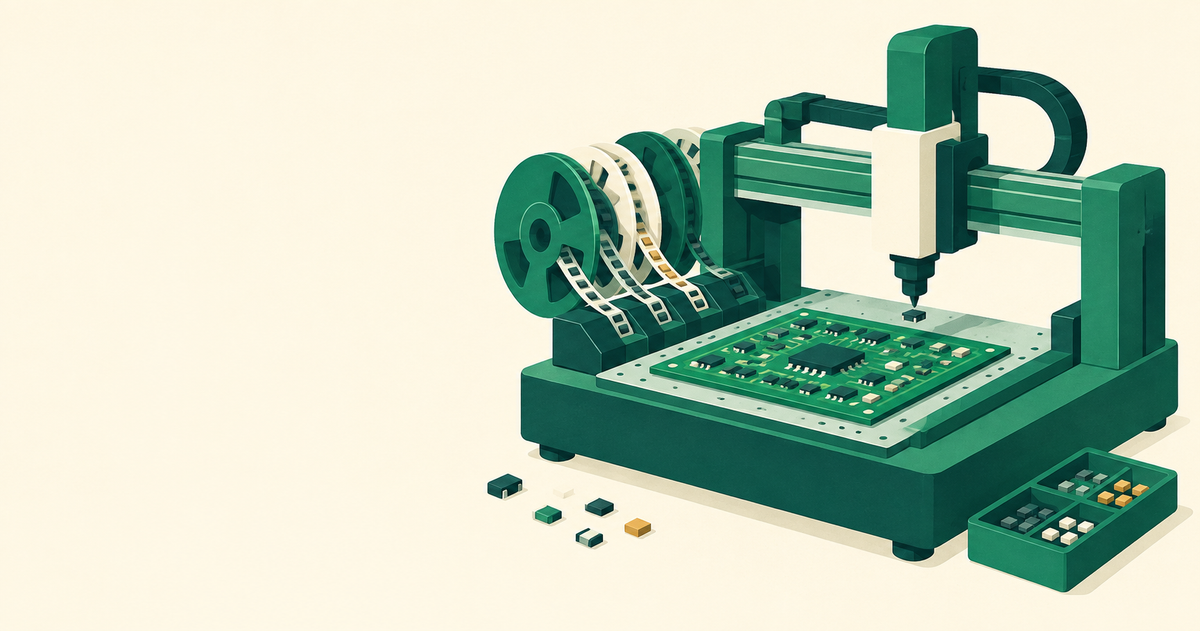
A hardware founder does not have to choose only between hand-soldering every board and sending a large order to a contract manufacturer. Opulo's LumenPnP makes a third option tangible: spend $1,995 on a desktop pick-and-place machine, bring the repetitive placement work inside, and use the faster feedback loop to learn before committing to volume. Founder Stephen Hawes arrived at that product by suffering through the problem himself. His first hundred kits sold out in less than an hour. The useful lesson is not that every workshop needs this particular machine. It is that the cost of a production tool should be compared with avoided setup charges, labor, delay, and trapped inventory, not with the price of a hobby tool.
The product began with thousands of placements by hand
In 2019 Hawes ran a Kickstarter for Glowtie, a Wi-Fi-controlled illuminated bow tie. The campaign left him soldering thousands of components and finishing printed plastic parts at night and on weekends. Board-assembly shops offered an escape, but small orders carried high per-unit costs and remote production reduced control. Industrial pick-and-place equipment could cost more than $100,000. That gap became the product.
Hawes began prototyping LumenPnP in early 2020 and documented the work on YouTube. The audience was not decorative. By his account, the channel grew past 40,000 subscribers and the Discord community past 4,000 members before the first commercial batch. He left Formlabs in December 2020, founded Opulo in April 2021, and launched the kit on February 12, 2022. His project history says the first 100 machines sold out in under an hour.
That sequence matters. A complex machine arrived after two years of public development, not after a launch video invented demand. The build log recruited the exact people likely to understand the product's rough edges. It also let prospects see what the mechanism could and could not do before paying.
The first version taught Opulo what buyers were buying
The first LumenPnP was a kit. Hawes interviewed dozens of customers after delivery and heard three consistent complaints: assembly took too long, simple strip feeders needed intervention, and the OpenPnP control software was difficult to learn. These were not requests for a faster motor or a prettier frame. Customers wanted a production tool rather than another project.
The current machine reflects that distinction. Opulo lists the LumenPnP v4 at $1,995, says it ships in under three weeks, and sells feeder bundles around it. The product page specifies support for 0402 passives, 0.4 mm-pitch integrated circuits, and 0.35 mm-pitch ball-grid arrays. Those are seller claims, not an independent benchmark, but they define the intended job: prototypes and small or medium batches, before a contract manufacturer becomes the better answer.
The hardware files, bill of materials, software, and feeder designs are public. The project's GitHub repository describes machines running in daily production and provides exported design files with releases. Open source does not remove the need to sell a finished product. It changes the buyer's risk: a customer can inspect, repair, modify, or rebuild the machine even if the vendor later changes direction.
A break-even calculation for a 200-board year
Here is illustrative arithmetic, not a quote from Opulo. Suppose a founder expects four revisions in a year, each followed by 50 boards. A contract manufacturer charges a hypothetical $300 setup fee for each run plus $9 per assembled board. The annual assembly bill is:
4 runs x $300 + 200 boards x $9 = $3,000.
Now suppose internal production requires the $1,995 machine, $600 of feeders and basic accessories, and 45 operator hours in the first year at an internal value of $25 per hour. Ignore solder paste, stencil, reflow, component waste, maintenance, and taxes for the moment:
$1,995 + $600 + 45 x $25 = $3,720.
On cash cost alone, outsourcing wins in year one. But add two avoided weeks for each of the last three revisions. If one earlier design correction prevents 100 obsolete boards at $18 of components and assembly each, it avoids $1,800 of inventory. The tool can then be economically useful even before its direct placement cost wins.
The reverse is also true. If a founder makes one stable batch a year, has no trained operator, or lacks inspection and reflow equipment, the machine price is the smallest part of the decision. A desktop placer moves components. It does not automatically control moisture, paste deposition, thermal profiles, inspection, rework, or component traceability.
Use a four-line decision gate
Before buying any production machine, write four numbers on one page:
- Revision frequency: how many board spins will need populated samples in the next 12 months?
- Delay cost: what does each calendar week between design and tested board delay?
- Loaded internal cost: machine, feeders, stencil and paste equipment, reflow, inspection, floor space, training, scrap, and operator time.
- Exit threshold: at what stable monthly volume will a contract manufacturer become cheaper or safer?
The last line prevents a common founder error: treating insourcing as an identity. The aim is not to manufacture forever. The aim is to own the high-learning, low-volume stage where waiting is expensive and mistakes are still likely.
What transfers from Opulo
First, build demand while building the machine. Hawes's videos explained an expensive problem to people already living with it. That is a stronger distribution asset than a launch-day audience rented from an ad platform.
Second, interview delivered customers about the whole job. Opulo learned that kit assembly and feeder handling were part of the product, even though neither was the central technical achievement. In physical goods, setup time, packaging, calibration, documentation, and repair are not support details. They are product features.
Third, use open design as a durability promise rather than a free giveaway. The files make the product inspectable, while Opulo sells procurement, assembly, testing, support, and time saved. It is a physical version of the principle behind a platform dependency audit: buyers value a route out of vendor lock-in.
Within an hour, a founder can request the last three assembly invoices, list every setup charge and calendar delay, and calculate the annual cost of learning. If that number is below the loaded cost of in-house production, keep outsourcing. If it is above, test one internal batch and measure actual operator time and yield before buying a production identity along with a machine.
Measure that test with three rates: placements attempted per operator hour, first-pass board yield, and minutes of rework per board. A machine can place components quickly while creating expensive inspection work. Record setup separately from runtime because a 20-board job and a 2,000-board job spread feeder loading across very different volumes. After the pilot, compare the real loaded cost with the original quotation and include the value of calendar time saved. That evidence turns the next outsource-or-insource decision into an operating rule instead of a debate about control.
The right production tool does more than lower unit cost; it buys faster learning before inventory hardens a mistake.
Discussion
Sign in with Google or just a name. No email link, no password to remember.