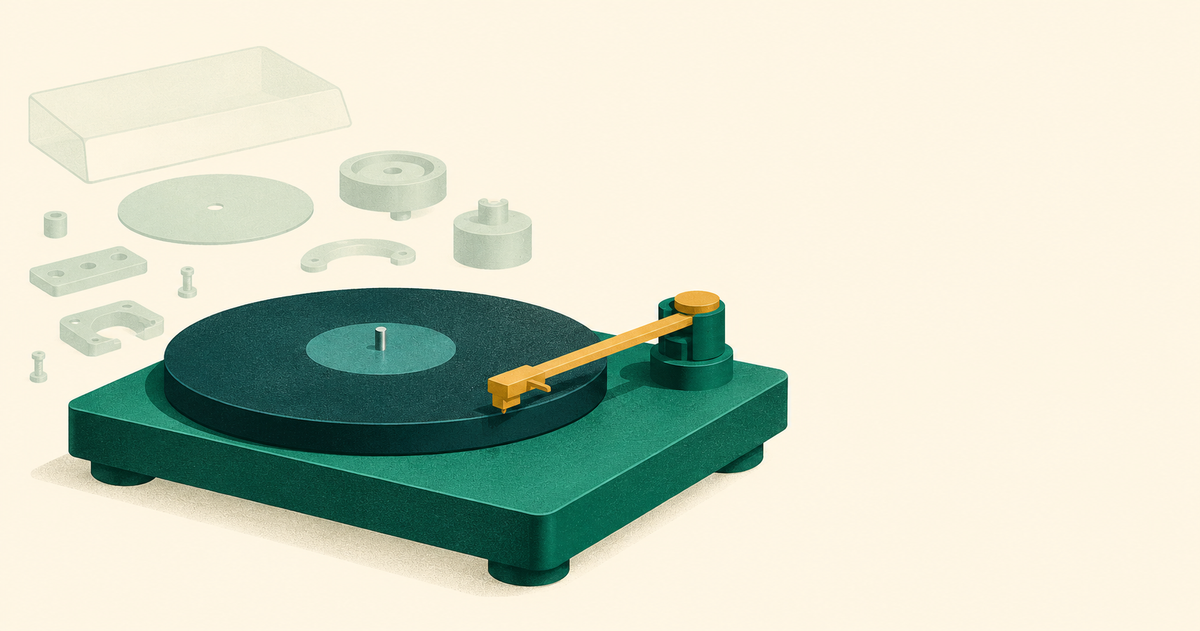
U-Turn Audio began by removing features from the turntable, not by inventing a more elaborate one. Its 2012 Kickstarter offered the Orbit at $150 plus shipping, attracted roughly 1,000 early customers, and funded a factory in Woburn, Massachusetts. Years later, the company selectively redesigned the tonearm, the component it describes as central to sound performance, and found a specialist able to cast its complex magnesium part. The useful manufacturing lesson is sequencing: simplify enough to deliver the first product, keep customer contact close, then spend tooling money where a component changes performance or assembly. Vertical integration does not require making every part.
The first constraint created the design
Founders Bob Hertig, Ben Carter, and Pete Maltzan were students who wanted better sound than cheap players provided without paying audiophile prices. U-Turn's company history says the team did its own design and engineering, kept manufacturing in-house, and sold directly to customers. The first Orbit was deliberately simple and all-analog.
Contemporary coverage shows the price architecture. Boston.com reported a $150 entry pledge and a $250 special edition as the campaign passed $100,000. A later supplier case study says the Kickstarter produced about 1,000 first customers. These are not the same thing as 1,000 profitable units. Crowdfunding fees, underestimated labor, rejects, shipping, tools, and warranty work all sit between revenue and profit.
The initial product nevertheless did two jobs. It financed a production start and forced the founders to build for a real price. Optional accessories and configurations could follow, but the base machine needed to play records reliably without every possible feature.
In-house assembly can be the information system
U-Turn says it builds in Woburn and engages customers directly. That arrangement can cost more per labor hour than a distant turnkey factory, but it shortens the path from a support problem to the person who can change a fixture, instruction, or tolerance. For a young electromechanical product, the information can be worth more than the labor saving offered elsewhere.
This does not mean raw materials and specialized processes all happen under one roof. The tonearm case shows the boundary. In a Phillips-Medisize manufacturing case study, Hertig explains that the company wanted to combine multiple tonearm components into one rigid magnesium piece to reduce resonance. The supplier describes a difficult mold with a hydraulic core pull and thin walls. U-Turn owned the performance requirement and design intent; a specialist owned the unusual production capability.
That is selective integration. Keep the learning loop and final quality responsibility close. Buy a process when another company has deeper skill and the interface can be specified.
A tooling decision should price assembly too
Suppose a tonearm built from six purchased parts costs $19 in material and takes 14 minutes to assemble. At a loaded assembly cost of $30 an hour, labor is $7, making the direct total $26. A one-piece casting hypothetically costs $14, takes four minutes of finishing and assembly, and requires a $75,000 tool. Labor falls to $2, so the recurring saving is $10 per unit:
Old recurring cost: $19 + $7 = $26.
New recurring cost: $14 + $2 = $16.
Simple tooling break-even: $75,000 / $10 = 7,500 units.
This illustrative model omits financing, engineering, qualification, scrap, maintenance, and the residual value of the tool. It also ignores a benefit that may dominate the arithmetic: improved sound or more consistent alignment could support demand and reduce returns. Conversely, one-piece construction can make a defect more expensive and a supplier harder to replace.
Use three filters before combining parts
- Customer filter: does the proposed change improve a result a buyer can hear, feel, measure, or avoid? A cheaper hidden bracket may matter only to margin. A rigid tonearm can affect the promised experience.
- Factory filter: does part consolidation remove adjustment, fasteners, inspection points, or common assembly errors? Record the current minutes and defect codes first.
- Volume filter: can conservative demand repay engineering and tooling before the design changes again? Use the low case, not the campaign peak.
A founder should also specify tool ownership, storage, maintenance, insurance, usable life, and release on termination. Those questions echo the failure planning in Trunki's licensing and tooling history. A custom part is not controlled merely because the startup paid an invoice.
The first thousand customers are a production sample
About 1,000 Kickstarter orders were large enough to reveal recurring work and small enough that founders could still see individual failures. That is a valuable range. If the team classifies every return and support request, it can distinguish a supplier defect from an unclear setup step or a design tolerance.
For a 1,000-unit run, one extra six-minute adjustment consumes 100 hours. At $30 an hour, that is $3,000. A 3 percent failure requiring $25 outbound and return shipping adds $750 before replacement parts and support. Small frictions become tooling candidates only after they repeat.
The discipline is to keep a defect ledger with five columns: unit serial or batch, symptom, root cause, minutes spent, and permanent correction. Rank the total cost, not the emotional annoyance. A rare dramatic failure may deserve safety attention, while a tiny alignment task repeated on every unit may justify the first fixture.
A one-hour make-or-buy map
Draw the product as a row of modules. Under each, write the performance knowledge required, current supplier, replacement lead time, assembly minutes, defect rate, and tooling ownership. Circle modules where performance knowledge is unique to the company. Box modules where an outside process is genuinely specialized. The circles are candidates for close design control. The boxes are candidates for explicit supplier interfaces and second-source planning.
Then select one repeated assembly step and time ten cycles. Do not buy a machine or commission a mold yet. Ten observations can reveal whether the expense attacks a real constraint. This complements the Opulo break-even test, which compares a production tool with outsourcing and delay.
U-Turn's story is not a universal case for domestic production. Turntables are relatively repairable, configurable products with customers who value craftsmanship. Wage rates, component ecosystems, and shipping economics differ elsewhere. The transferable choice is narrower: own the work that produces learning and customer value; specify the work that requires outside expertise; and tool only after the repeated cost is visible. Simplicity got the first product built. Selective complexity improved the part that mattered.
Configuration control matters after the tool arrives. Keep a signed first-article sample, measurement report, alloy specification, finishing standard, and acceptance fixture. When a supplier adjusts a process, the team needs an objective comparison with the approved part. Otherwise, gradual drift may appear first as customer complaints, long after inventory and assembly labor have been committed.
The best custom part is often the one chosen after a simple product reveals what customers truly value.
Discussion
Sign in with Google or just a name. No email link, no password to remember.