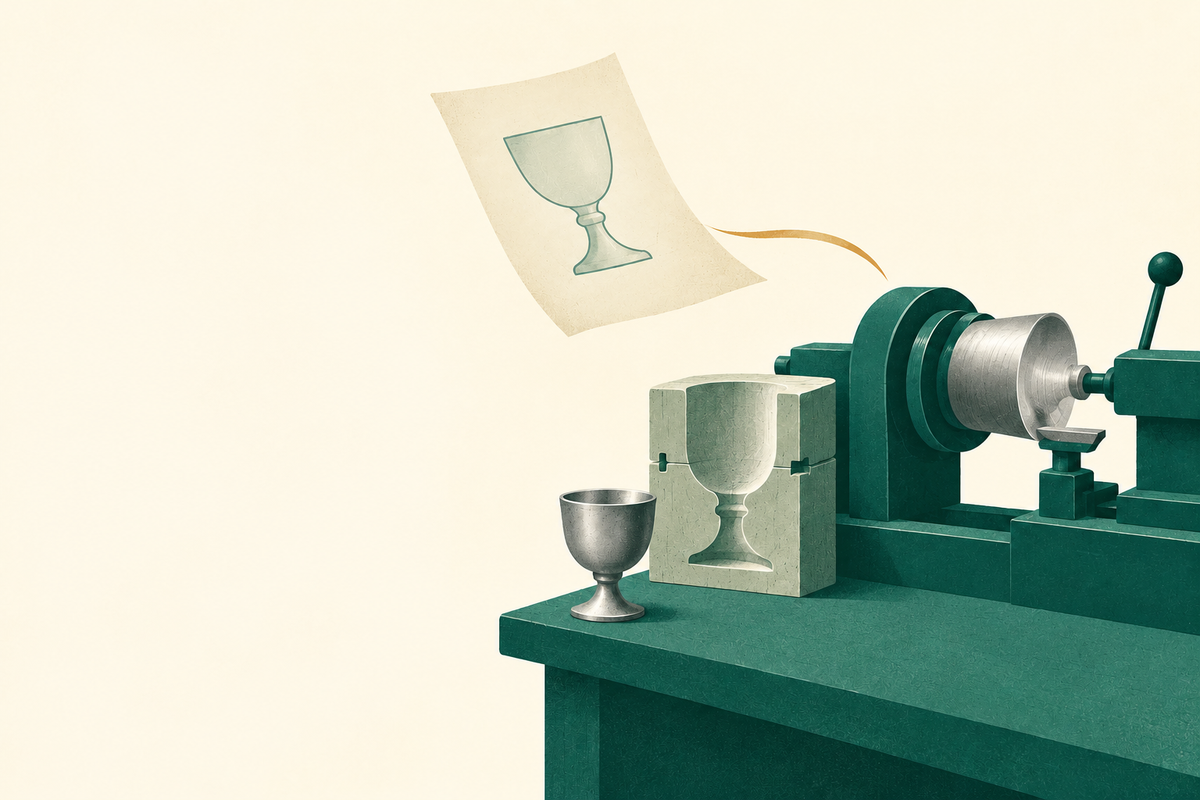
Danforth Pewter makes metal gifts and housewares in Vermont. When the company added Shirley Pewter's colonial designs in 2009, the company planned new equipment and training for its workshop.
That makes this a useful acquisition story for small manufacturers. Buying an established product line can bring designs and customers, but the asking price is only part of the capital required to earn from them. Before calling a deal affordable, calculate the cash needed to turn the acquired assets into reliable deliveries.
More designs required more capability
Fred and Judi Danforth founded their modern pewter business in 1975. A 2012 Seven Days workshop report described a company combining casting with metal spinning, the process of shaping metal on a rotating form. Its reporter observed substantial hand finishing even where molds allowed designs to be repeated.
The same report described the Shirley Pewter acquisition in 2009 and the addition of WT Wilson in 2012. Production of the acquired lines came into Danforth's workshop. The acquired lines included tangible designs that could be manufactured and sold through the expanded business.
The 2009 announcement reproduced by Vermont Business Magazine said Danforth would make and market Shirley products. It identified economic development loans as part of the transaction's funding and said equipment additions and staff training would accompany the work.
That announcement is a company statement, not an independently audited account of acquisition costs. It does not disclose the purchase price, interest costs or realized return. It does reveal that manufacturing expansion was part of the financing problem.
VTDigger's 2018 reporting corroborated the earlier acquisitions and reported the addition of Vilmain Pewter that year. It provides evidence of continued acquisition activity, not proof that each transaction produced a particular profit margin.
The price of making the acquired product
For a manufacturer, an acquired design is valuable only if the buyer can reproduce it to the required standard at a saleable cost. An existing workshop may help, but “we already manufacture things” is not a complete integration plan.
A new line may use a different mold, finish or technique. It may fit the same sales channel while needing a different production rhythm. A shared category does not guarantee shared machinery or interchangeable workers.
Start with one representative product from the proposed acquisition. Follow its materials, tooling, preparation, production, inspection, finishing and packing. Ask which steps your shop can perform today, which require training and which depend on a person or supplier outside the deal.
This is a practical diligence exercise, not legal or transaction advice. Qualified advisers still need to assess contracts, liabilities, financing and tax treatment. The owner can nevertheless arrive with a clearer operating question: what must we spend before these assets can generate cash for us?
A purchase can be cheap and still consume cash
Use a fictional product-line acquisition to see the difference. Assume a US$200,000 purchase price, $40,000 of additional equipment, $15,000 of training and trial production, and $45,000 for initial materials and other working capital. The initial cash requirement is $300,000 before fees, contingencies or any taxes.
Suppose the line is expected to generate $120,000 of annual contribution after direct manufacturing and fulfillment costs. Then assume $50,000 of extra recurring payroll and overhead. That leaves $70,000 before financing, taxes and later capital spending.
Dividing the $200,000 purchase price by $70,000 suggests a simple payback of about 2.9 years. Dividing the fuller $300,000 initial cash requirement by the same amount gives about 4.3 years. Neither is a discounted valuation or a recommendation to buy. Both depend on forecasts that could be wrong.
| Input in the fictional deal | Amount | Why it matters |
|---|---|---|
| Asset purchase | $200,000 | Acquires the agreed assets |
| Equipment | $40,000 | Makes production possible |
| Training and trials | $15,000 | Prepares repeatable work |
| Initial working capital | $45,000 | Funds the gap before customers pay |
| Total initial cash | $300,000 | Shows the starting exposure |
The working capital is not necessarily a permanent expense. Some may return as inventory sells and receivables are collected. It still has to be financed during the transition. Ignoring it makes a cash-intensive deal appear easier to own than it is.
Now assume the first year's contribution is only $90,000 while the added overhead remains $50,000. The $40,000 remainder makes the same simple payback 7.5 years. A small change in sales can have a large effect after fixed costs are committed.
See's Candies and owner cash offers the complementary question: how much of a business's earnings can its owner actually redeploy? Acquisition value depends partly on what remains after sustaining the productive asset.
Inspect the assets in the order they earn
A buyer can organize the operating review around five handoffs. Each needs evidence rather than a reassuring category description:
- Design to tooling: identify which drawings, molds and production instructions transfer, and whether they can be used in your equipment.
- Tooling to good units: examine representative production and the labor needed to meet the required finish.
- Good units to orders: distinguish repeat customer demand from a seller's final clearance or seasonal spike.
- Orders to collections: record payment timing, returns and the stock required to support buyers.
- Collections to owner cash: allow for maintenance, overhead, financing and the next production cycle.
Do not replace this chain with revenue growth. Revenue can increase while the workshop consumes more cash, particularly if larger orders require more stock or longer customer payment terms.
Also distinguish transferable assets from relationships that remain personal. A design can travel; a customer who always calls the departing founder may need a careful introduction. The production instructions should explain what a new worker must do, rather than silently depending on the seller's memory.
One product can test the whole thesis
Within an hour, choose a representative item and sketch its path from mold to collected payment. Put an estimated cost and delay beside each step you cannot currently perform. Leave uncertain values visibly uncertain. Those blanks become questions for the seller, workshop manager and advisers.
The exercise can also reveal a less capital-intensive option to investigate, such as a narrower line or a phased production transfer. That is an operating possibility, not a claim that Danforth used a particular deal structure.
Maine Grains' regional mill provides another view of productive capacity: physical assets create value when they fill a workable place in the market. Owning machinery alone does not establish demand, just as owning demand does not establish the capacity to serve it.
Danforth's history shows an established craft manufacturer taking on additional lines and making room to produce them. It does not disclose enough to reconstruct investor returns. The earned lesson is the one its equipment and training plans make visible: buy the earning asset, and budget for the work that lets it earn.
Discussion
Sign in with Google or just a name. No email link, no password to remember.