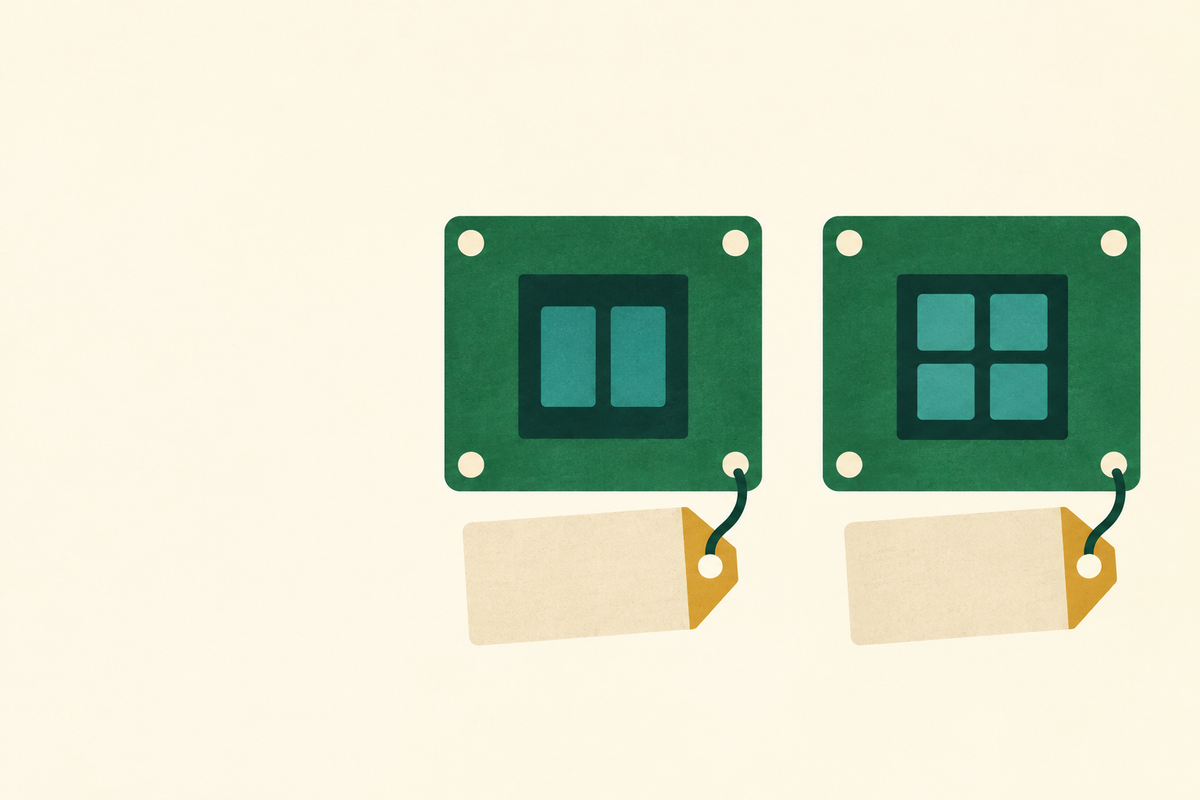
PocketBeagle 2 is a small Linux computer board from BeagleBoard.org for embedded projects and prototypes. Its official product page says the first revision shipped with a dual-core processor, while a later revision shipped with a quad-core processor and graphics capability at no extra cost.
That is welcome additional hardware, but it leaves a practical purchasing question: which board did your product actually qualify? A founder building devices around a development board should keep the revision, operating-system image and acceptance test together. A familiar product name cannot identify the complete production configuration.
The upgrade kept the same name
The official PocketBeagle 2 page, checked October 15, 2026, distinguishes Rev A0, using Texas Instruments' AM6232 processor, from Rev A1, using AM6254. It describes the move from dual-core without a graphics processor to quad-core with one.
The page says the later revision shipped at no additional cost. That statement concerns the board offer. It does not establish that an existing application requires no checking, that all distributors hold the same revision or that every replacement will be identical to a founder's prototype.
The Crowd Supply listing identifies AM6254, 512 MB of memory, microSD storage and a 55 by 35 millimeter board. It lists the board at US$40, with US$8 US shipping or US$18 worldwide shipping. Those are the checked listing amounts, before any other applicable costs, rather than a finished-device budget.
The change is interesting precisely because the price does not signal it. Two orders described using the same everyday product name can belong to different configurations. An upgrade can be good and still need to be recorded.
Describe the board you received
Start a configuration record when the first unit arrives. Record the revision shown on the board, the purchasing source, order date, image version and application version. Preserve the identification evidence rather than relying on a memory that it was the newer one.
Add the peripherals the application actually uses. A board specification can list many functions, while a particular product depends on only a few connectors, signals and startup behaviors. The acceptance plan should follow those dependencies.
| Record | Question it answers | Useful evidence |
|---|---|---|
| Board revision | Which physical configuration arrived? | Board marking and purchasing record |
| System image | Which prepared operating environment runs? | Named image and retained version identifier |
| Peripheral set | What must work with the board? | Actual connector and device list |
| Acceptance result | Did the intended product work? | Dated test with named endpoints |
A development board is a starting platform, not a promise about your finished product. Keep evidence for the configuration that earned acceptance, then use it to assess a proposed replacement or later batch.
Do not reduce the record to processor speed. A product might depend more on boot behavior, an attached device or a supported system image than on the maximum computing power available. More cores do not answer those questions automatically.
The host computer is part of the first experiment
BeagleBoard's quick-start guide describes preparing an operating-system image on a microSD card and connecting through USB. It also separates the steps for different host operating systems. Its listed Windows network-sharing route requires Windows 11.
This is development documentation, not a manufacturing qualification report. It shows why a prototype should record how it was prepared and accessed. An engineer's laptop can quietly supply a service that the final device will not have.
Write two setup descriptions: development and deployed use. In the first, say what the host computer does. In the second, say how the product starts, communicates and recovers without that host, or clearly retain the host as a requirement if that is the intended product.
For example, if the demonstration receives network access through a laptop, do not treat that connection as built-in connectivity in the finished device. Identify what replaces it, who supplies it and which failure the customer will be able to recognize.
A cheaper substitute can create an expensive mixed batch
Consider an illustrative US device run using fifty purchased boards. Assume a supplier offers an alternate revision at US$5 less per board. The apparent saving is US$250. All quantities and differences in this example are invented.
Suppose qualifying that additional configuration requires six engineering hours at an assumed US$60 per hour, plus US$40 for additional test materials. Qualification costs US$400. Before considering later support, the proposed saving is already US$150 short.
That does not mean the alternate revision is bad. It means fifty units may be too small a run to pay for a second supported configuration through purchase savings alone. With the same assumptions, eighty boards save US$400, matching the qualification cost before any continuing burden.
Now add the work of identifying which configuration a customer owns. If the business cannot do that from its build record, a future support question can become a new investigation. Keep mixed stock visibly separated and make the assembly record point to the actual unit used.
This calculation is not a price comparison between PocketBeagle revisions. The official page says the processor upgrade involved no extra board cost. The invented discount tests the broader purchasing habit of accepting a cheaper apparently equivalent component.
Give purchasing a rule for substitutions before the next order. A supplier can offer a different revision helpfully without knowing which feature your product depends on. Route that proposal to the person responsible for acceptance, and retain the answer with the order. The goal is a deliberate change, not a silent one.
Approve a use, then approve a change
Create a short acceptance set for the product, including startup, the important input and output, expected workload and recovery from an ordinary interrupted session. Choose tests relevant to the actual device. A general processor benchmark cannot demonstrate that the product's connection works.
For each proposed configuration change, mark which acceptance results remain supported and which must be repeated. When in doubt, leave the result unapproved until the responsible engineer has evidence. Do not label a new configuration compatible just because the board fits inside the enclosure.
MNT Reform's manufacturing map tracks dependencies among suppliers and parts. Add a version column to that kind of map so purchasing knows which configuration the product depends on.
The Light Phone production-system analysis adds the assembly perspective: a working prototype must become an object that other people can repeatedly prepare and verify. A controlled configuration record makes that handoff less dependent on its original builder.
The PocketBeagle upgrade does not prove that earlier boards were unsuitable or that later ones will disrupt a particular device. The notice does not qualify the reader’s finished device. Before the next order, identify the board, image and peripherals in your existing prototype. The next purchase should reproduce a known configuration, or arrive as an explicit engineering change.
Discussion
Sign in with Google or just a name. No email link, no password to remember.