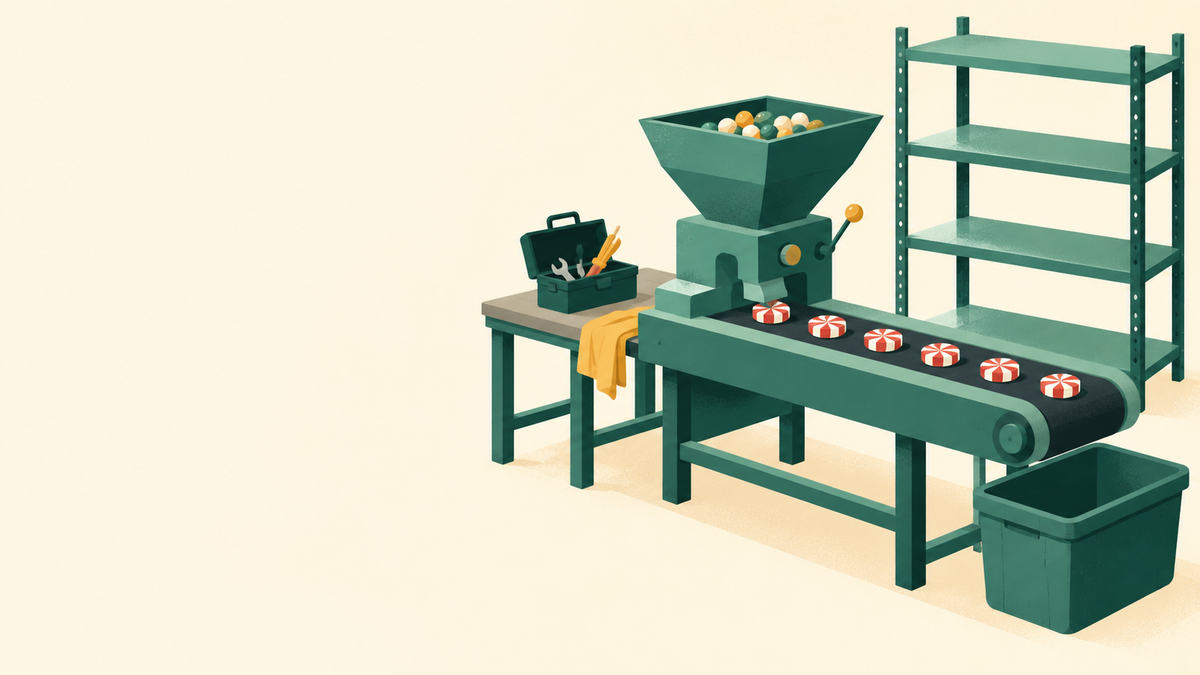
See's Candies manufactures and sells boxed chocolates, and Berkshire Hathaway kept owning it while using cash from the business to build elsewhere. That is a different route to entrepreneurial wealth from selling a company: retain the operating asset, fund its needs, then put surplus cash into another business.
The useful question is when an owner can fund the next business without weakening the first. See's is an exceptional historical case, not a forecast. Its records show why that decision needs two tests: verify the source of surplus cash, then examine what the proposed second business will ask of the owner.
The acquisition bought more than a factory
Berkshire's 1991 shareholder letter describes Blue Chip Stamps buying control of See's in January 1972, before Blue Chip was later merged into Berkshire. Warren Buffett and Charlie Munger recognized pricing power, and Chuck Huggins took charge of operations.
That combination is more informative than the familiar purchase-price anecdote. A candy factory supplies production capacity. A trusted name, customer habits and competent operation determine whether that capacity can earn an attractive return. Buying the equipment alone would not reproduce the business.
The same letter describes a sharply seasonal profit pattern in 1991. A large share of annual profit arrived late in the year. A business can therefore distribute money over time while still needing careful seasonal liquidity. Low reinvestment requirements do not mean no cash planning.
Keep those details historical. They describe the business and period discussed by Berkshire, not today's precise economics, sales mix or working-capital requirements.
Revenue growth is not the owner's final unit
The 2007 shareholder letter provides the clearest long-run comparison. Buffett reported that See's operating capital requirement rose from US$8 million at acquisition to US$40 million, while 2007 sales were US$383 million and pre-tax profit US$82 million.
He reported cumulative pre-tax earnings of US$1.35 billion over the ownership period, with US$32 million reinvested to support growth. Berkshire used proceeds after corporate taxes for other businesses. These are historical figures disclosed by the owner; pre-tax earnings are not the founder's personal proceeds or an after-tax cash distribution.
The additional capital requirement was about 2.4 percent of cumulative pre-tax earnings: US$32 million divided by US$1.35 billion. That is a descriptive ratio for the period, not an annual payout rate and not a forecast. It excludes the tax and accounting details needed for a complete cash-flow statement.
The important mechanism is that the operating business did not consume most of its earnings to support expansion. That gave its owner choices outside the candy business. A growing revenue line alone would not reveal those choices.
Build a cash bridge before naming a distribution
For a small business, start with operating profit and work toward available owner cash. Use a consistent period and keep taxes, interest and borrowing visible. A practical bridge lists profit, noncash charges, changes in inventory and receivables, equipment spending, debt payments and required reserves.
Do not assume that adding back depreciation creates spendable cash. Depreciation spreads the recorded cost of equipment across time. The machine may still need replacement. A useful bridge includes a realistic replacement budget, even when the replacement will occur after the current year.
RXBAR's sale arithmetic answers a different ownership question: how a transaction headline relates to proceeds. See's asks what ownership can produce without selling the operating business. Both require separating the company's numbers from the money ultimately received by an individual owner.
Two businesses with the same starting cash
Consider an illustrative comparison in US dollars, not See's accounts. Business A and Business B each produce US$300,000 of annual operating cash after ordinary operating expenses and taxes, before the investment and financing items below.
Business A needs US$40,000 of maintenance equipment spending, US$20,000 of additional working capital, US$30,000 of debt principal payments and US$25,000 added to reserves. That leaves US$185,000 before any discretionary expansion.
Business B needs US$90,000 of maintenance equipment spending, US$100,000 of working capital for growth, the same US$30,000 of principal payments and US$25,000 for reserves. It leaves US$55,000. The starting cash result is identical; available cash differs by US$130,000.
Neither business is automatically better. Business B may be funding profitable future capacity, while Business A may face a shrinking market. The comparison simply prevents the owner from treating the same reported result as the same wealth mechanism.
Next, calculate the consequence of slower customer payment. If Business A must hold another US$60,000 in receivables, available cash falls to US$125,000. Customers paying promptly can matter as much as a higher headline margin.
A second business needs more than a cash source
The two illustrative cash results produce different paths to another owned business. Suppose, for planning only, that an acquisition would need US$600,000 of buyer cash including its initial operating reserve. If the owner could safely accumulate US$185,000 annually from Business A, the amount takes about 3.2 years. At Business B's US$55,000, it takes about 10.9 years. Neither is an acquisition forecast; prices, earnings and available cash can change during the wait.
Do not let that funding timetable choose the target. Compare three uses of surplus: strengthen the existing business, acquire another operation, or hold cash until a suitable project appears. Give each proposed use an operating owner, a cost, a downside case and a clear explanation of how it improves earning capacity.
For an acquisition, ask who will run both businesses after closing. A second company can add revenue while creating a shortage of management attention. Keep its working capital and debt obligations separate, and model the first company's survival if the second needs extra cash. A dependable cash source should not become an unlimited rescue account.
Do not copy an exceptional payout pattern
Buffett's historical explanation included cash sales and a short production-and-distribution cycle as reasons See's needed relatively little operating capital. An entrepreneur can study those mechanisms without assuming the same result is available in another category.
A manufacturer selling on long payment terms may need substantially more receivables. A business importing a seasonal harvest may need months of stock. A maker with rapidly changing equipment may need frequent reinvestment. Those are operating characteristics, not defects that can be removed by deciding to distribute more money.
Diaspora's harvest financing provides a useful published contrast. Cash has to reach producers according to a crop cycle. The founder should design around that cycle rather than force a candy-business cash pattern onto an unrelated supply chain.
Survivorship bias matters here. See's is widely discussed because it worked unusually well over decades. A failed candy maker would not provide the same reassuring evidence. Use the case to generate questions about your own business, then answer them with its actual records.
Give retained cash a named job
Berkshire's 1983 shareholder letter sets out an owner-oriented approach to capital allocation. Its transferable principle is to evaluate what retained earnings accomplish, rather than treat retention as automatically prudent or distribution as automatically desirable.
For an operating company, assign each retained amount a job: replace equipment, finance inventory, cover a seasonal shortfall, reduce financing risk or fund a specific growth project. Write the amount, expected timing and evidence that will show whether the job was completed.
An unnamed cash pile can conceal poor decisions, while an aggressive distribution can starve a sound business. The record should make both errors easier to see. This is a business-planning framework, not personalized tax, legal or investment advice.
Read one year differently this afternoon
Take one completed financial year and list the cash required to keep the existing business operating. Separate that from discretionary expansion. Then identify the peak cash requirement during the year, since a year-end balance can hide the hardest month.
Prepare the bridge with the person responsible for the accounts, leaving uncertain replacement costs and tax items for proper verification. Ask which retained expenditure improved future earning capacity and which merely repaired a neglected obligation.
The memorable part of See's history is not a candy company becoming a large revenue number. It is an operating asset that kept earning while leaving its owner room to build elsewhere. Before committing to the next business, learn what the first must keep and who will make the second work.
Discussion
Sign in with Google or just a name. No email link, no password to remember.