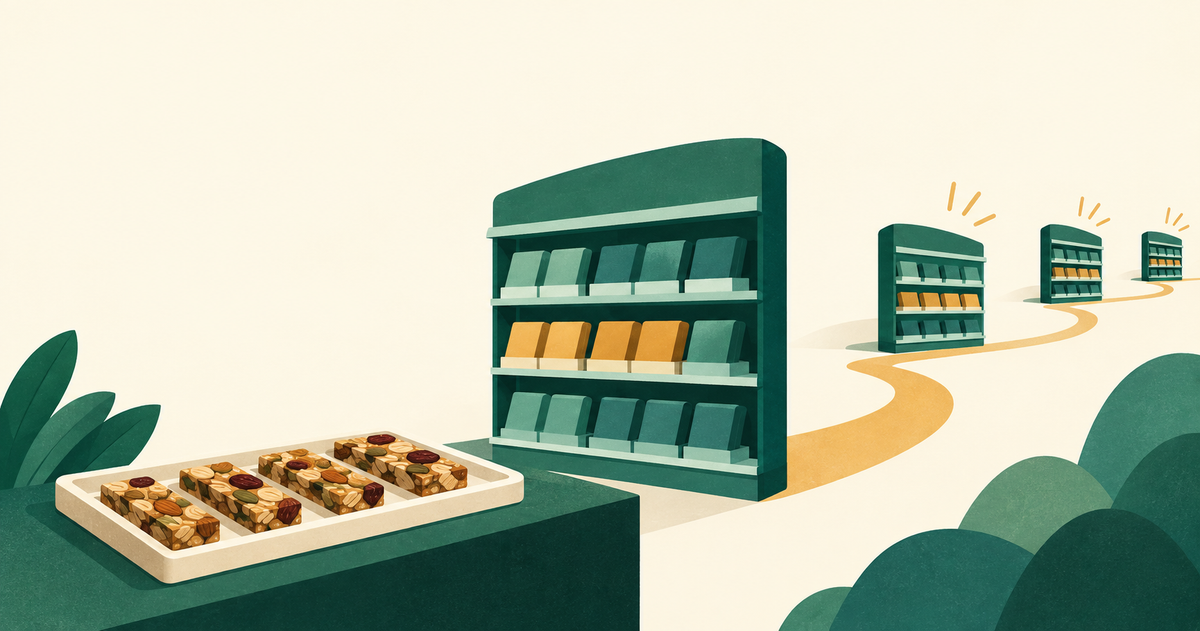
LARABAR is a fruit-and-nut snack bar, and founder Lara Merriken found her first decisive customer before she had a finished product. She took a job at Whole Foods to learn how natural-food retail worked, met a regional buyer on the loading dock, then turned one Denver placement into evidence by demonstrating the bars herself. The transferable lesson is precise: a store saying yes is not distribution. A product earning repeat movement from the shelf is.
That difference matters to any founder staring at a first retail order. The order feels like validation, but it can be a retailer's inexpensive experiment. Merriken's early sequence shows how to convert access into a measured test, learn why shoppers buy, and earn the next doors without guessing.
A paid education inside the channel
Merriken's idea began around 2000, but she did not know packaging, ingredients procurement, or manufacturing. In her account to How I Built This, she described taking a job in a Whole Foods nutrition department as a paid education. LARABAR's own short origin account also places the idea in 2000. Inside the store, she could watch what vendors did, how shoppers reacted, and what a product needed before a buyer could put it on a shelf.
The choice created access, but access was not the same as favoritism. When a regional buyer crossed her path on the back dock, he initially tried to end the conversation. Merriken had samples nearby, retrieved them, and earned a promise that Colorado stores would consider the product when it was ready. The product still had to survive manufacturing and sell.
Those constraints arrived quickly. A trademark problem forced a name change. Several manufacturing arrangements failed. Packaging for five flavors required a large minimum run, and interested friends and family pulled back while delays accumulated. Merriken eventually raised about $150,000, according to the interview, but the launch batch was still startlingly manual: 500 bars, made and wrapped by hand over roughly 15 hours with help from her father and friends.
The first store was a laboratory
Merriken did not place the bars and wait for a reorder. She used what she had learned as an employee: samples remove the shopper's risk, and the person behind the table can explain a product that does not fit familiar expectations. In 2003, fruit and nuts sat awkwardly beside low-carbohydrate diet messaging. The product's simplicity needed translation at the shelf.
She demonstrated at lunch and dinner, watched reactions, and answered questions. Within two weeks, a former colleague told her the five flavors occupied the store's top five positions on its movement report. That number is a founder's self-reported recollection, not an audited sales record. The important mechanism is stronger than the anecdote: the retailer had transaction data, the founder had direct customer language, and both could see whether sampling converted into purchases.
General Mills' retrospective confirms the ground game: Merriken made early bars in a blender, sampled at a Denver Whole Foods, and built through direct personal connections. General Mills later acquired LARABAR in 2008. The corporate history is interested in a successful origin story, so it should not be treated as independent proof of every number. It does, however, corroborate the launch channel and demonstration method.
Build a movement sheet before asking for door two
A small brand rarely gets the retailer's full reporting system. It can still build a useful weekly sheet. Track units delivered, units sold, units sampled, hours spent demonstrating, returns or damage, and the next reorder date. Add notes on the three objections heard most often.
| Measure | Question it answers |
|---|---|
| Weekly unit sell-through | Is product leaving the shelf, not merely entering the store? |
| Sales per demonstration hour | Does education change conversion enough to justify founder time? |
| Repeat sales after sampling | Does demand persist when the table disappears? |
| Reorder interval | How much working capital and production time must the next door support? |
Illustrative arithmetic makes the decision concrete. Suppose a shop receives 120 units, sells 72 in two weeks, and 45 of those sell during six demonstration hours. Raw two-week sell-through is 60 percent. Demonstration productivity is 7.5 sales per hour. The harder test comes next: if the following two weeks sell only 18 units without a table, the product may have a demonstration engine rather than durable shelf demand.
Set the expansion gate before excitement changes it. One reasonable rule is: open the next five stores only after the first store reorders twice, unsampled weekly sales cover the retailer's minimum movement requirement, and contribution after wholesale discount, samples, travel, and spoilage remains positive.
Count the real cost of a free bite
Sampling is not free marketing. If a bar costs $0.70 landed, is cut into four tastes, and 120 bars are used during a six-hour event, product cost is $84. Add $120 of labor, $30 of travel and display supplies, and the session costs $234. If it produces 90 incremental retail sales and wholesale contribution is $0.80 per bar, immediate contribution is only $72.
That session loses $162 on immediate transactions. It can still be rational if it creates enough repeat purchases or secures a reorder that opens more distribution. The break-even repeat requirement is $162 divided by $0.80, or about 203 additional bar sales. Label this arithmetic illustrative, then replace every input with your own.
This is where the LARABAR story improves on vague advice to "do demos." The founder should learn which sentence moves a hesitant shopper, whether taste changes the decision, and how many later sales the session must create. The same logic sits behind Partake's focused first-store list, but LARABAR adds a sell-through instrument after the placement.
A one-hour first-door plan
- Choose one store where the target customer already shops and where you can visit repeatedly.
- Ask the buyer which movement measure determines a reorder and write down the review date.
- Prepare one sentence for the problem, one for the product difference, and one question that reveals the shopper's objection.
- Create a four-week sheet for deliveries, sales, samples, demonstration hours, returns, and reorders.
- Schedule two demonstration windows, then compare sampled and unsampled periods.
- Do not pitch door two until the contribution and reorder gate is met.
Retail is harder than shipping a case to a receiving door. Packaging must scan, inventory must arrive, and the margin must support two businesses. The capacity discipline in Bokksu's first 40 subscribers applies here too: acquisition must stay below the operation's reliable limit. The channel staircase in Nightingale's path to national retail shows why regional proof should precede national promises.
LARABAR eventually became a large brand, and that outcome carries survivorship bias. A founder cannot reproduce a favorable buyer encounter or the category timing of 2003. What can be reproduced is smaller: work close enough to the channel to understand its rules, bring a product ready for a real test, and stay beside the shelf long enough to learn why it moves. The first store is not a trophy. It is the cheapest place to discover whether the second store deserves your inventory.
Discussion
Sign in with Google or just a name. No email link, no password to remember.