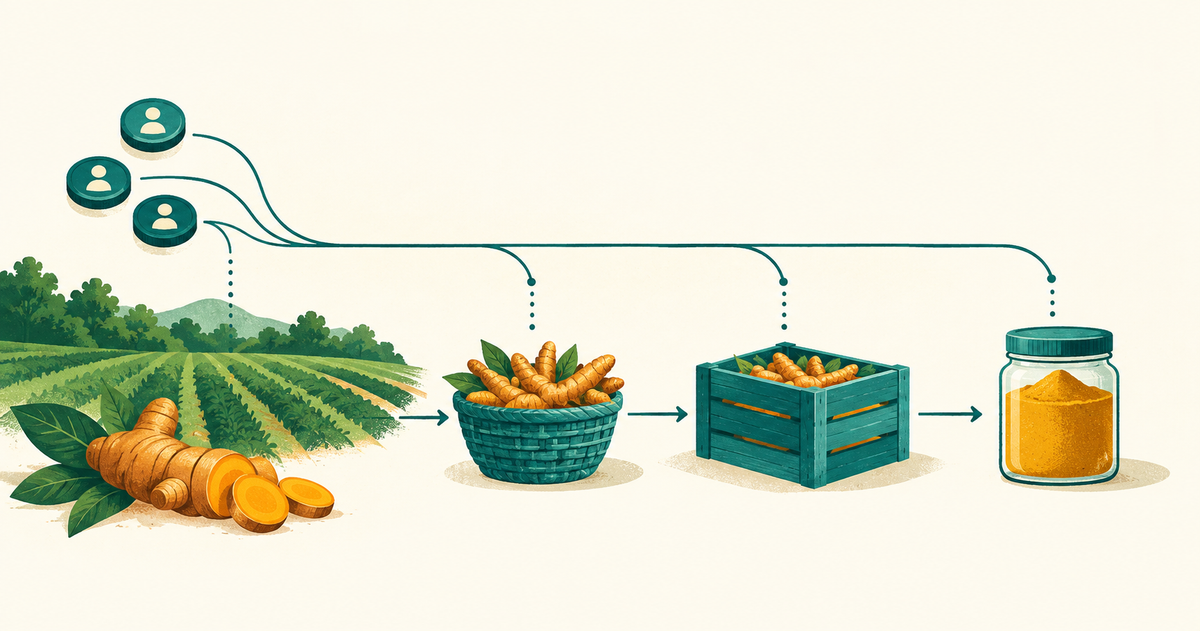
Diaspora Co. financed its first year with pre-orders while founder Sana Javeri Kadri built a spice supply chain around one turmeric and one farm partner. Early customers sometimes waited as long as three months. The delay was not a growth trick. It reflected a product tied to harvest, quality selection, export, and direct relationships. The model is useful for founders selling seasonal physical goods: pre-orders can align cash with a slow supply chain, but only when the batch is specific, the delivery window is honest, and customers understand what the wait preserves. Otherwise, pre-order cash merely transfers forecasting and financing risk to buyers.
One spice made the promise inspectable
Diaspora's company history says Kadri started the business in 2017 at age 23 with Pragati turmeric from the Kasaraneni family farm. It now describes a much broader network, but the initial offer was narrow enough to explain where the spice came from and why it differed from an anonymous commodity blend.
An ICA Fund investment profile reports that Kadri launched with $3,000 from a tax refund and a family loan and that the first year was funded entirely by pre-orders. Demand exceeded supply and early buyers waited up to three months. ICA also says Diaspora created a trading subsidiary to streamline export and, by its account, move spices as soon as two weeks after harvest. These are reported company milestones, not audited logistics records.
The product scope reduced uncertainty. Forecasting one turmeric from one partner is still difficult, but it is simpler than promising a pantry of dozens of seasonal crops. Every additional origin adds harvest timing, quality checks, export paperwork, packaging, and inventory that may not turn at the same rate.
Higher farm prices change working capital
Diaspora's current impact page says it pays farm partners an average 2.5 times commodity price across its supply chain, has 603 smallholding farms in that chain, and has paid $1.6 million to regenerative farm partners since 2019. Elsewhere on the company's sites and in ICA's profile, higher or differently scoped averages appear. The about page, for example, says six times commodity across 150 farms. These figures should not be collapsed because the period, partner count, crop mix, and methodology may differ.
The stable business lesson does not depend on choosing the largest multiplier. Paying more and sometimes advancing harvest money requires cash earlier than a conventional buyer might. Pre-orders can help bridge that timing. They do not create gross margin. Retail price still has to cover spice, farm premium, sorting, loss, export, freight, duties, packaging, fulfillment, payment fees, and customer support.
Illustrative batch arithmetic
Suppose a founder offers 1,000 jars at $18. Customers pay $18,000 at order. Payment fees of 3 percent remove $540. The founder pays growers and processors $5 per jar equivalent, packaging costs $2, international freight and import costs $1.50, and domestic fulfillment costs $4. Total variable cost is $12.50 per delivered jar, or $12,500.
Cash collected after fees: $18,000 - $540 = $17,460.
Illustrative contribution before overhead: $17,460 - $12,500 = $4,960.
If the harvest yields only 850 saleable jar equivalents, the founder must refund or replace 150 orders. Refunding $18 each costs $2,700, and the remaining contribution falls to $2,260 before extra support or air freight. A 15 percent yield miss consumes more than half the initial contribution.
These inputs are illustrative, not Diaspora's costs. They show why every pre-order batch needs a yield buffer, refund reserve, and a promise tied to a range rather than the most optimistic date.
Use a harvest-backed pre-order contract with customers
| Promise | What the page should state |
|---|---|
| Batch identity | Origin, harvest, format, and quantity covered |
| Use of cash | Which production, purchase, or freight milestone it funds |
| Delivery window | Earliest and latest reasonable ship date |
| Update cadence | When buyers hear from you even if nothing changes |
| Failure remedy | Refund, substitute choice, or later batch |
| Known variables | Harvest, inspection, export, transit, and customs risks |
This is not a legal contract template. It is an operating checklist for a truthful offer. Consumer laws and payment-platform rules vary, so founders should obtain appropriate advice for their markets.
The supply chain became part of the asset
Diaspora did more than pay a premium through existing auctions. It built direct sourcing relationships and later a trading entity. That can improve freshness, traceability, and communication while adding complexity the company must own. Export documents, quality disputes, foreign exchange, and shipment consolidation become internal capabilities.
The decision resembles the control question in Trunki's license-to-manufacturing path. Own a layer when it carries the product's essential learning or promise. Keep it external when a partner can perform it transparently and reliably. Direct trade is not automatically ethical or efficient; evidence about price, labor, and quality still matters.
What pre-orders prove, and what they do not
A paid order proves willingness to wait under a stated offer. It is stronger than an email signup. It does not prove that customers will reorder after novelty, that retail margins work, or that the founder can deliver on time. Early adopters may tolerate delays that a grocery buyer will not.
The three-month waits in Diaspora's early history should therefore be read as both demand evidence and an operational warning. The company needed a faster, more robust route as it expanded. Pre-orders can fund learning at small scale; they should not excuse permanent uncertainty.
A one-hour batch model
- Name one harvest or production batch and its conservative saleable yield.
- List every cash payment by date, from producer advance to final delivery.
- Set aside payment fees, refunds, and a 10 to 20 percent yield or delay buffer.
- Write a delivery range based on the slow case.
- Calculate contribution if only 85 percent of the batch ships on the first attempt.
Then compare the batch with the inventory discipline in Who Gives A Crap's first production run. Both use customer money before large-scale fulfillment, but a seasonal crop adds biological and cross-border variation.
Diaspora's first product worked because the narrow offer connected money, source, and waiting time. The broader principle is not "fund inventory with pre-orders." It is to make the exact batch legible enough that customers can decide whether its timetable and purpose are worth financing.
Communication cadence protects more than goodwill. A dated harvest note, inspection result, departure notice, and customs update create an evidence trail the team can use when support volume rises. Send updates on the promised date even when the shipment has not moved. Silence makes customers invent a forecast, and that forecast is usually more optimistic than the supply chain.
After delivery, close the batch ledger. Record actual yield, days at every stage, landed cost, refunds, and repeat orders. Compare them with the pre-order page. That makes the next window more accurate and reveals whether waiting created lasting preference or only a one-time story.
Preorders work best when customers can see the real harvest, people and waiting time their cash makes possible.
Discussion
Sign in with Google or just a name. No email link, no password to remember.