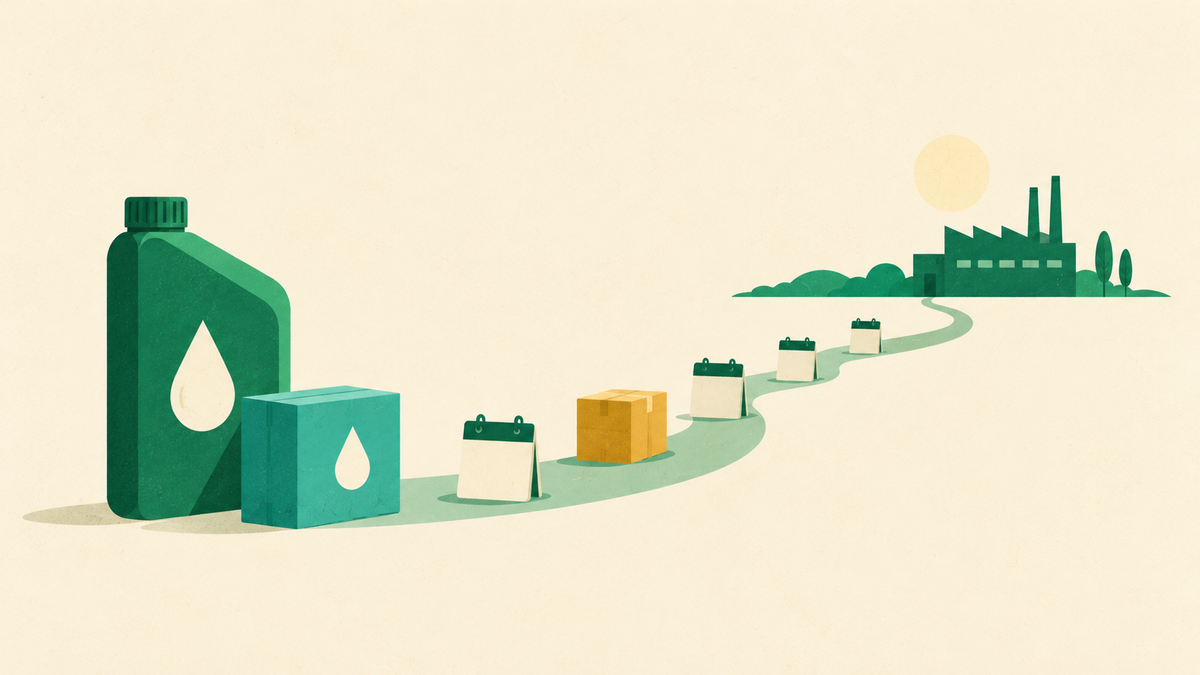
WD-40 Company sells lubricants and maintenance products, while outside manufacturers make its finished goods. Its disclosures show why owning a brand can create a durable business without owning every factory, but still leave the owner committed to years of factory-related cash payments.
The practical question is what your business must pay to secure reliable capacity. A supplier's building may stay off your balance sheet while your commitments still reduce the cash available for dividends, acquisitions or a difficult trading year. WD-40's example gives a smaller business owner a useful exercise: put future supplier promises on a calendar before deciding how much cash is free.
The brand stays involved after the product leaves its hands
WD-40 is familiar enough that it can look like a business built around one can. The company still develops the product and its presentation. Its history describes the 2005 Smart Straw, a permanently attached straw introduced to address the problem of losing the loose one. Improving how a customer uses an established product can be an ownership asset in its own right.
Manufacturing responsibility is more distributed. The annual report for the year ended August 31, 2025 says finished goods are produced by third-party manufacturers. Concentrate production uses company facilities and contractors. The company also discloses reliance on a limited number of suppliers and purchase commitments.
That arrangement separates the ownership of a customer relationship from the ownership of all the equipment serving it. It can allow management to focus on product, demand and distribution. It also means the manufacturer's decisions, available capacity and continuity matter to the brand's ability to sell.
Calling the arrangement light on owned assets is therefore only the beginning of the analysis. Owners need to know which resources they can replace quickly and which they have effectively reserved for years. A supplier can be outside the company and still shape its future cash flow.
Capacity can be bought without buying the building
A later disclosure makes the distinction concrete. In its quarterly report for the period ended May 31, 2026, WD-40 described a $5 million contribution toward construction of a third-party manufacturer's logistics facility. The contribution was intended to reserve capacity for seven years after completion, which the company expected in fiscal 2028.
It also described approximately $8.4 million of fixed warehousing fees over seven years, expected to begin in the third quarter of fiscal 2028. These are company disclosures, and the quarterly financial statements are unaudited. Completion and timing are expectations, not events this article can declare finished.
The two amounts add to $13.4 million, but that total does not mean an immediate payment of $13.4 million. It combines a construction contribution with fees over time. Nor does it establish a factory ownership stake, a saving versus another arrangement or a return on investment.
As illustrative smoothing, $8.4 million divided by 84 months is $100,000 a month. The calculation helps readers see the scale of a seven-year obligation; it is not a statement that the contract bills identical monthly amounts. The actual agreement and payment schedule govern cash timing.
The annual filing also explains how production forecasts can turn into purchase obligations. A forecast is not merely an optimistic sales estimate once a supplier has made committed goods. The owner needs to connect demand planning to the cash and inventory consequences of those instructions.
Build a cash calendar rather than one reassuring ratio
A balance-sheet ratio is a snapshot. A capacity agreement is a sequence of future events. A founder considering a similar arrangement should make a simple calendar with three separate lines: money paid before capacity exists, recurring fees once it is available, and production purchases needed to use it.
| Commitment | Question for the owner | Why it changes available cash |
|---|---|---|
| Setup or construction contribution | When is payment due, and what performance triggers it? | Cash leaves before or during the supplier's investment |
| Recurring capacity or storage fee | Does the fee continue when orders fall? | Low demand may not reduce the obligation |
| Committed production | Which forecasts authorize actual inventory? | Unsold goods can consume cash and storage |
| Exit or replacement work | What equipment, documentation and inventory can transfer? | Switching may require another investment |
This is an operating checklist, not an interpretation of WD-40's contracts. A smaller owner's terms may be entirely different. Get the specific agreement reviewed by an appropriate adviser, and ask the supplier for a plain schedule of milestones, payments and deliverables.
The calendar also makes an ownership distinction visible. A payment may purchase access to a resource rather than an asset you can resell. Both can be valuable. They behave differently when you stop using the resource.
What happens when demand falls by a third?
Consider a fictional consumer-products business, using US dollars. It pays $30,000 to prepare a supplier's line and $2,000 a month to reserve capacity. It expects to sell 3,000 units a month, with a $12 selling price and $7 variable cost per unit. These are planning assumptions, not WD-40 economics.
The expected monthly contribution before the reservation fee is 3,000 times $5, or $15,000. After the $2,000 fee, $13,000 remains for other overhead, tax, reinvestment and owner returns. If volume falls to 2,000 units, the same calculation leaves $8,000. A one-third volume decline reduces that available amount by about 38.5%.
The $30,000 preparation payment has already consumed cash. Spreading it over 24 months for an internal comparison adds $1,250 a month to the planning burden, but does not change when the bank account paid it. Keep that distinction between economic allocation and actual cash movement.
Now ask whether the supplier requires minimum production purchases. If it does, the model needs an inventory line as well: unit orders may exceed sales. This example assumes no such minimum, so it cannot describe a business that has one. A useful stress test names that assumption rather than quietly leaving it out.
This connects with the difference between reinvestment and cash an owner can withdraw. A business's value and its distributable cash are related, but a year's apparent surplus can already have a job assigned to it.
Keep the asset you are actually building in view
For a brand owner, the durable asset may include repeat demand, reliable distribution, product knowledge and the ability to coordinate suppliers. The factory relationship supports those assets. It does not automatically replace them, and the arrangement works only if the customer still wants the product.
The comparison with Trunki's move from licensing toward manufacturing responsibility is useful here. Changing who makes a product changes the owner's obligations. It does not remove the need to understand them.
WD-40 is an established surviving company with decades of demand behind it. A new brand cannot assume the same bargaining position, forecasting accuracy or resilience. The filings demonstrate a mechanism, not a promised route to wealth or a recommendation to buy shares.
Start with the largest supplier payment your business expects in the next twelve months. Write down what it buys, when the cash leaves and what continues if sales disappoint. Then repeat for the commitments just beyond that year. The exercise can fit on one page and begin in an hour.
Ownership creates choices only when the owner can see the promises already made. A factory does not have to belong to you for its capacity to have a claim on your cash.
Discussion
Sign in with Google or just a name. No email link, no password to remember.