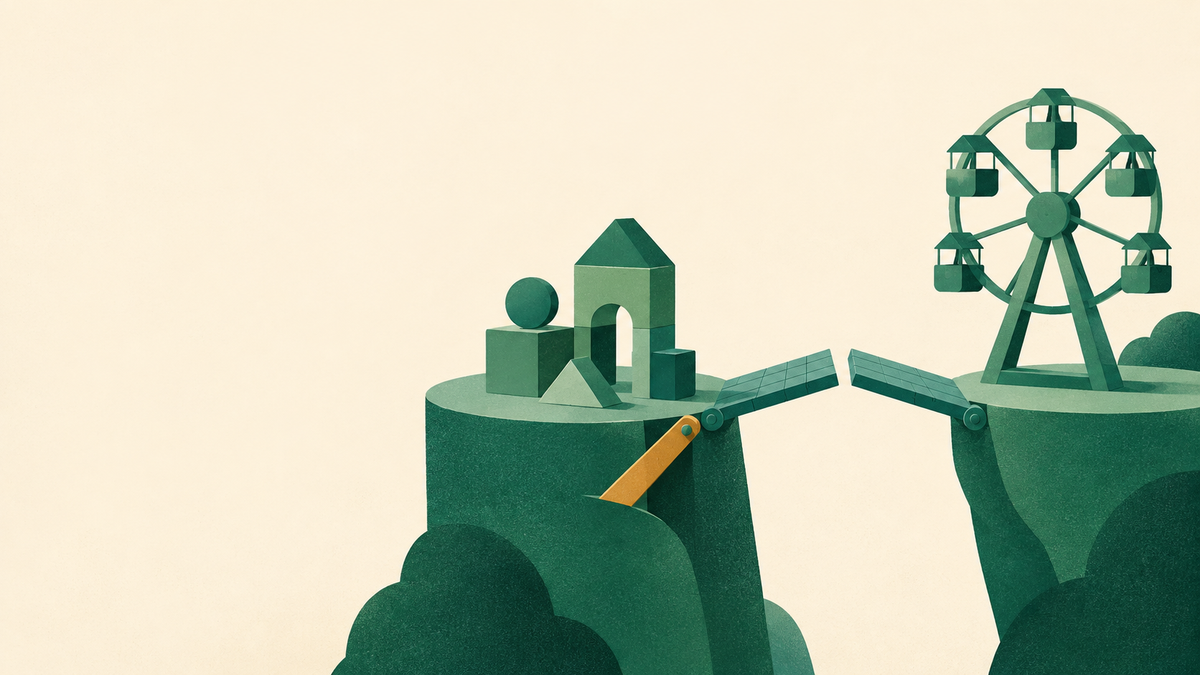
LEGO makes construction toys, but it once also operated the LEGOLAND theme parks. In 2005, owner Kjeld Kirk Kristiansen supported selling control of the parks so the toy business could concentrate resources on its core products and customers.
The wealth lesson concerns assets already owned. An adjacent business can share a name, customers and emotional history while competing with the core company for capital. Before asking what that asset might sell for, calculate what keeping it will require. A sale may preserve the business an owner most wants to retain, but only if the remaining company can actually stand without it.
The same brand contained different operating obligations
In Blackstone's July 13, 2005 announcement, the buyer announced a EUR375 million acquisition of the four parks and were to be combined with Merlin Entertainments. The parks were in England, Germany, California and Denmark. Kristiansen described focusing the LEGO Group on customers, marketing and core products.
LEGO's history of the first park connects the sale to the company's economic crisis and the resources needed to reverse the negative results of 2003 and 2004. That is a historical company account, not proof that the disposal alone produced the subsequent recovery.
The 2005 annual report provides a more exact ownership detail than the simple phrase “LEGO kept 30 percent.” It records 15 percent of the new jointly owned company for the LEGO Group and 15 percent for KIRKBI, alongside a 70 percent Blackstone holding. The distinction identifies which entity held each interest.
Do not convert the EUR375 million headline into a personal payout or mechanically divide it by 70 percent to infer the whole group's equity value. The transaction combined businesses and retained interests. A deal announcement is not a complete seller-cash reconciliation.
Brand affinity cannot approve a capital budget
A toy and a theme park can reinforce one another in a customer's imagination. Their operating bills still arrive separately. The fact that an adjacent asset helps the brand does not establish that the current owner should finance and operate it.
For a smaller manufacturer, imagine the corresponding choice as a factory plus a visitor attraction, a shop plus a delivery fleet, or a food business plus a property. The exercise is not to label the second asset a distraction. It is to identify which obligations belong to which business.
Make three columns: cash contributed by the adjacent operation, cash it needs to remain viable, and benefits delivered to the core company. Keep direct payments separate from benefits such as awareness that have not been measured.
If an attraction is said to generate customers for a shop, ask what evidence supports that claim. Record identifiable purchases where possible and avoid crediting the attraction with every nearby sale. If it provides shared space or staff, price the replacement arrangement the remaining business would need.
See's Candies and reinvestment cash examines an owner's ability to move surplus from one business into another. An asset disposal presents the reverse question: what cash and attention does the owner stop committing, and what productive benefit disappears with them?
A keep-or-sell sheet needs two time horizons
Consider a fictional business with an adjacent operation. All inputs below are illustrative US dollars, unrelated to LEGO's accounts. Assume the adjacent operation produces $120,000 of annual operating cash before owner distributions and capital spending. It needs $300,000 of immediate renewal work plus $40,000 of annual maintenance investment.
Over three years, keeping it generates $360,000 before the stated capital spending. Subtract the $300,000 renewal and $120,000 maintenance total, leaving negative $60,000 over the period. This simple undiscounted model excludes financing, taxes, changes in working capital and any later sale value.
Now assume a sale would provide $700,000 after the transaction costs and obligations included in the hypothetical offer. The core company would need $25,000 a year to replace shared services. Over three years, the sale route retains $625,000 before other uses of the proceeds.
That does not mean selling creates $685,000 of wealth. Keeping the asset leaves ownership of an asset at the end, while selling exchanges it for cash. Without a defensible terminal value, the model compares funding capacity, not complete economic value.
Run the longer horizon separately. If the renewal is genuinely unusual and later cash generation improves, keeping could be attractive. If renewal repeats sooner than expected or cash contribution falls, the initial three-year problem may understate the burden.
The purpose is to reveal an approaching cash requirement before a sentimental argument or an attractive offer obscures it. A business can own something valuable and still lack the resources to keep owning it well.
What remains must be able to function
Draw the operating boundary before drawing conclusions about proceeds. Which employees, facilities, customer relationships and contracts are shared? Which activities can transfer, and which must be rebuilt? An asset that looks separable on a chart may still supply essential work to the retained company.
| Dependency | Question for the remaining business |
|---|---|
| Shared people | Who performs their essential work after separation? |
| Shared premises or equipment | What access or replacement capacity is required? |
| Brand and customer connections | Which permissions and commercial relationships need definition? |
| Cash collection and payments | Which entity receives and pays each outstanding amount? |
This table organizes questions for the people handling a real transaction. It does not determine legal terms or tax treatment. Public operating history can explain the commercial choice without supplying a contract template.
Retained ownership deserves its own row. The annual report's entity split illustrates why a family-level percentage should not be casually assigned to the operating company. Different holders can have different cash needs and obligations.
The RXBAR sale arithmetic likewise separates a headline transaction amount from what a particular owner can receive. Here the first distinction comes even earlier: a company can dispose of one business while continuing to own and build another.
Give every asset a reason to stay
Within an hour, select one material asset outside your core operation. List its last twelve months of observable cash contribution, the next three years of necessary spending and the dependencies it supplies. Leave unknowns visible rather than filling them with hopeful estimates.
Then write one sentence explaining why your company is the right owner. “It shares our brand” is a hypothesis to investigate. A stronger answer specifies a capability, customer relationship or return that depends on your ownership and outweighs its demands.
LEGO's survival and later success create obvious hindsight bias. An owner in difficulty cannot assume a buyer will appear on attractive terms or that the remaining business will recover. The parks' sale is evidence of a choice, not a universal turnaround formula.
A useful asset review protects the ability to choose while the business still has time. The name on the gate can stay familiar even when the capital behind it needs a different owner.
Discussion
Sign in with Google or just a name. No email link, no password to remember.