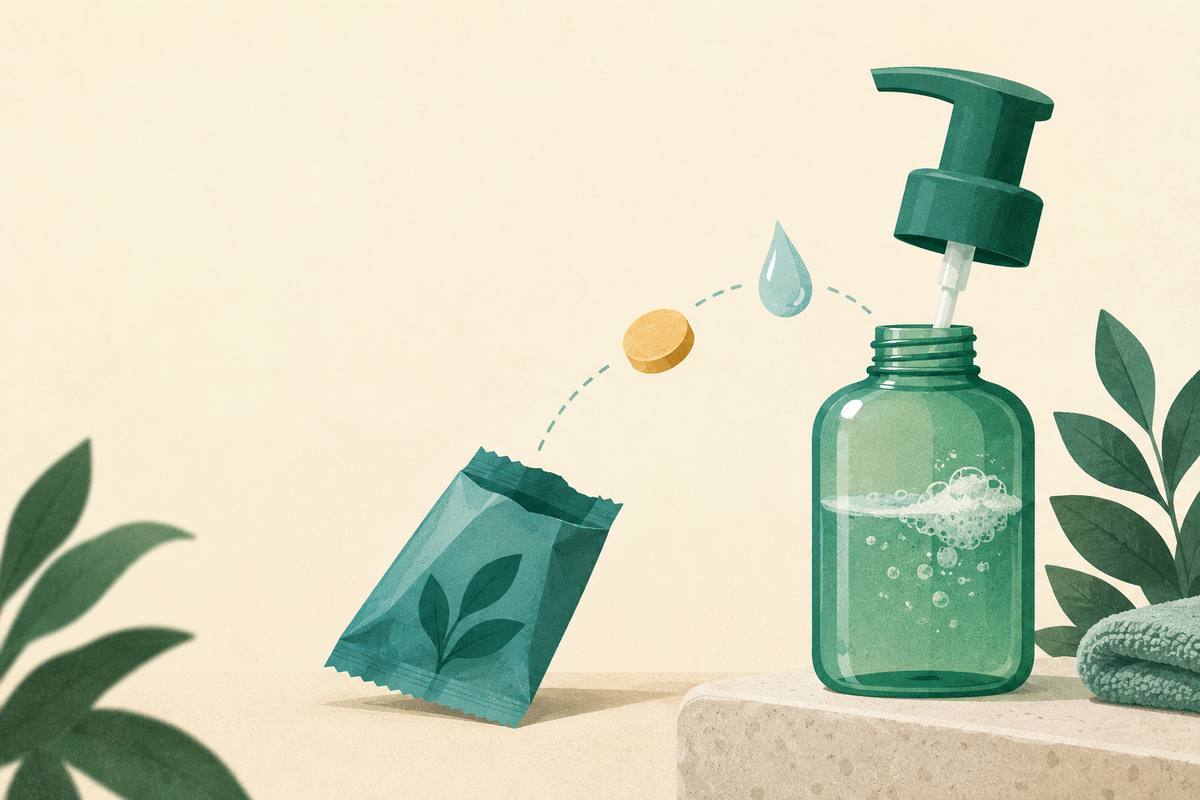
Blueland sells foaming hand soap as tablets that customers dissolve in a reusable dispenser. Co-founder Sarah Paiji Yoo has described the difficulty this creates: the company is asking people to prepare the finished product in their own homes.
For a founder, the opportunity and the obligation arrive together. A dry refill can avoid shipping the water used in the final mixture, but the customer inherits a preparation job. Evaluate the whole journey, including comprehension, waiting and support, before assigning all the benefit to a smaller package.
A bottle of soap became a sequence of actions
The manufacturer's current instructions, checked October 15, 2026, specify warm water, a tablet and complete dissolution before replacing the pump. The company says one tablet makes one full bottle of its foaming soap.
That sequence is part of what the customer buys. A delivered tablet is not yet a dispenser ready for ordinary use. The company still has to make the preparation understandable to somebody who may be replacing soap between other household tasks.
In a BeautyMatter account, Yoo identifies home preparation as a development challenge. This is a founder's explanation of the product work, not an independent assessment of every household's results.
The interesting choice is what the business asks the customer to do in exchange for the new format. The instruction card becomes an interface between the factory's concentrated product and the customer's usable soap.
The waiting time customers accepted was a research question
A January 2021 PM Network report says Blueland initially pursued almost instant dissolution. It attributes to Yoo the discovery that focus-group participants did not mind waiting when early formulations took ten minutes or more.
The same account describes development cycles of roughly a year. Those are historical, attributed reporting details. They do not establish the current hand-soap tablet's dissolution time, a representative household acceptance rate or today's development schedule.
They do reveal a useful product-development distinction. The team feared that waiting itself would defeat the idea. The relevant question was whether the wait disrupted the customer's actual routine.
Public discussions about undissolved tablets and pump difficulties make that distinction worth revisiting. Anonymous posts cannot establish a defect rate or prove a cause. They can suggest questions to observe with the company's stated instructions in view.
Nikwax's staged aftercare instructions show a related commercial dependence on using a product in the right sequence. Here the sequence begins before the first ordinary use.
Observe three moments, rather than asking “was it easy?”
A useful first-use trial separates instruction comprehension, preparation completion and later use. Asking only whether someone liked the idea can miss the point where the process stopped.
| Moment | Question to observe | Record |
|---|---|---|
| Before preparation | Can the user explain the supplied sequence? | Which step was missed or misunderstood |
| During preparation | Does the user follow the product's instructions? | Water choice, order and completion as specified |
| Returning to use | Is the product ready when the user expects it? | Interruption, uncertainty or request for help |
This is a proposed observation protocol for a maker's own suitable product. It is not a test conducted on Blueland. Use the approved instructions; the experiment should investigate communication rather than invite improvised mixing or changed concentrations.
Observe without coaching on the first attempt. If the researcher supplies the missing step, the product team learns that a coached person can succeed, while the package may remain confusing.
Then interview the participant about the inconvenience. Waiting while doing another task is different from standing beside an empty dispenser. A person may accept a longer elapsed time if very little attention is required.
Keep those two measurements separate: time until ready and active preparation time. A shorter process that needs constant attention may be less convenient than a longer process the customer can leave alone.
The format has an allowance for extra support
Consider illustrative arithmetic for a fictional refill maker using US dollars. These are invented inputs, not Blueland's prices, manufacturing costs or financial results.
Assume the maker receives US$8 per refill after discounts. A ready-to-use format costs US$4.80 in product, packaging and variable dispatch. A dry format costs US$3.60 across the same categories. Before support and overhead, their respective contributions are US$3.20 and US$4.40.
The dry format therefore has a US$1.20 advantage per refill under these assumptions. If each additional assisted preparation costs US$6 of staff time and handling, one additional case in every five refills consumes that advantage: 20% multiplied by US$6 equals US$1.20.
For 1,000 refills, the initial US$1,200 advantage disappears with 200 additional cases. If only 50 additional cases arise, the extra support costs US$300, leaving US$900 of the assumed advantage.
This is a threshold calculation, not a forecast. Real support costs may vary by case, and one household may buy several refills without needing help again. Count assisted households, affected orders and affected refills separately before choosing a denominator.
Do not present the calculation as an environmental assessment. Weight, packaging, transport and repeated use need their own evidence. A contribution advantage also says nothing by itself about whether customers prefer the product.
Also separate a household that forgot a step from one that understood the sequence but found it inconvenient. Repeating the instruction may help the first. The second may need a different format, clearer readiness feedback or an honest explanation before buying. Record the distinction in the trial notes so a communication problem does not automatically become a formulation project.
The second refill can answer a different question
The first order includes learning. The next refill can reveal whether that learning was retained and whether the household wants to repeat the routine. Compare first-use contacts with contacts after repeat purchases.
A lower repeat-contact rate might indicate that customers learned the sequence. It might also reflect frustrated customers leaving. Include buyers who did not return, rather than studying only the cohort that became comfortable.
Cometeer's frozen coffee format presents another version of the trade: work removed from the customer's kitchen can create new storage and delivery requirements. Product formats distribute jobs between business and household.
Within an hour, map your own product's journey from opening the package to ordinary use. Circle every action the customer must perform because of your format choice. Put the necessary explanation at that moment rather than hiding all preparation in a long help page.
Blueland's survival does not prove that every concentrated product will earn repeat orders. The product instructions and founder accounts supply neither a complete support ledger nor a current representative dissolution study. Those gaps should remain gaps.
The practical ambition is more specific than making the package smaller. Deliver a preparation job the customer understands, can fit into an ordinary day and willingly performs again when the refill arrives.
Discussion
Sign in with Google or just a name. No email link, no password to remember.