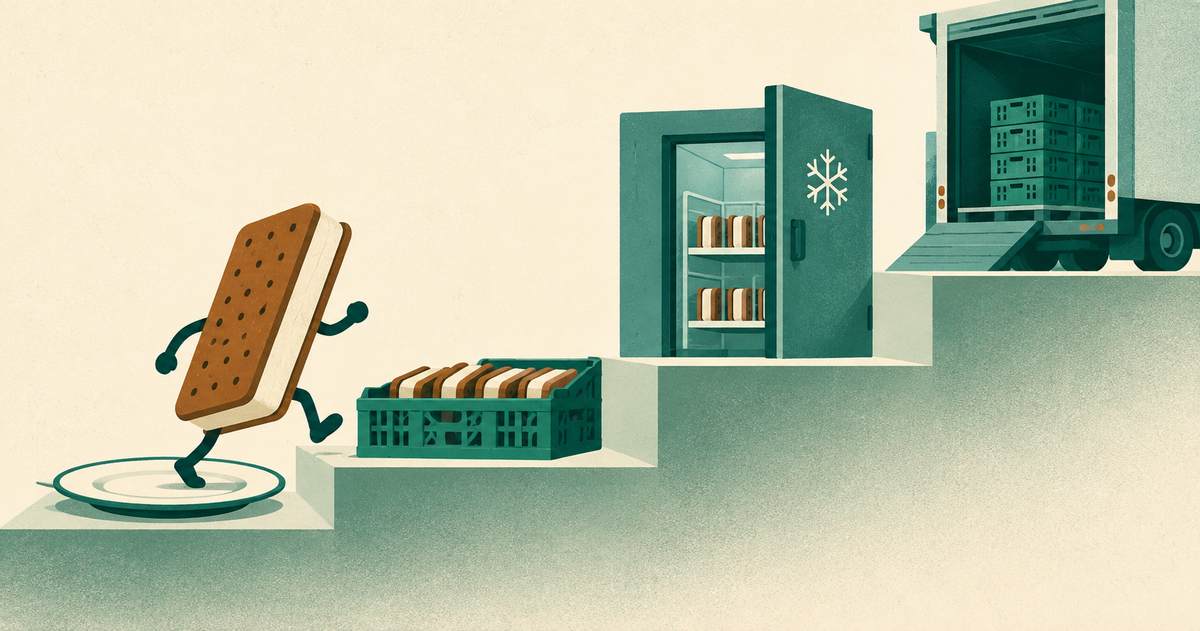
Nightingale Ice Cream did not jump from a restaurant kitchen to 5,500 grocery stores. Hannah Pollack and Xavier Meers first sold a dessert in their Richmond restaurant, then filled orders for nearby restaurants, markets, and events, moved into a commissary kitchen, entered specialty retail, and only later added national chains such as Kroger and Target. That staircase matters because frozen food punishes premature distribution. Every larger account increases production, cold storage, transport, labeling, forecasting, and chargeback exposure. A food founder should qualify one channel tier at a time with sell-through and service data, then fund the capacity required for the next tier before accepting it.
The product earned its first order at a table
Pollack developed the ice cream sandwich as a restaurant dessert while working with Meers. Nightingale's company history says local popularity led to orders from markets, restaurants, and events around Richmond. The founders eventually left the restaurant operation to focus on the product.
That origin supplied a powerful first test. Restaurant guests experienced the sandwich at serving temperature, after a meal, with immediate feedback available to the chef. Wholesale orders from other local operators then tested whether the product could survive storage and service without the founders controlling every plate.
The sequence moved evidence outward. A good dessert became repeat local demand. Repeat local demand became a production routine. The routine then became credible enough for larger retail buyers.
Every channel tier asks a different question
Virginia's economic development agency reported that Nightingale began with two people producing about 100 sandwiches a week. It now employs more than 100 people and reaches more than 5,500 grocery locations. A January 2025 Kroger rollout added more than 2,000 stores, followed by Target, and distribution locations reportedly grew 190 percent from 2024 to 2025.
Those are company and agency figures, not audited statements. The mechanism remains visible. Local restaurants ask whether chefs reorder. Independent grocers ask whether a case sells through before freezer space is needed for something else. A regional chain asks whether production and delivery remain consistent across stores. A national account asks whether the supplier can fill promotions, labels, deductions, forecasting, and food-safety requirements at scale.
| Tier | Evidence to collect | New risk |
|---|---|---|
| Restaurant and event | Repeat order and feedback | Founder-dependent selling |
| Independent retail | Units per store per week | Freezer placement and spoilage |
| Regional chain | Fill rate and consistent sell-through | Forecast and distributor terms |
| National chain | Service level by region | Promotions, deductions, and capacity |
Model doors as obligations, not reach
A common pitch celebrates store count. The operational model should start with cases. Suppose 400 stores each sell 18 sandwiches a week and each case contains 12. Demand is 600 cases weekly. At a 95 percent required fill rate, the producer must deliver at least 570 cases while carrying enough buffer for variability.
If contribution to the manufacturer is an illustrative $14 per case, weekly contribution is $8,400 before fixed manufacturing overhead and sales costs. Now assume the chain promotion adds 250 stores for eight weeks but requires a 10 percent discount and $18,000 of setup, samples, and compliance expense. The founder should calculate whether expected incremental case contribution repays that cost, not accept because the door count sounds national.
Write the model as:
Incremental account value = cases sold x net contribution per case minus setup, promotion, deductions, spoilage, and added fixed capacity.
Use retailer sell-through where available, not shipment into a distributor. Product moved into the channel can still return, expire, or sit unsold.
Capacity should follow a signed demand step
Richmond Magazine reported that Nightingale employed about 80 people, was making more than two million sandwiches a month, and began a $5.8 million, 28,000-square-foot facility project. Pollack expected more than $25 million of revenue that year. These are management expectations and reported figures, not an audited forecast.
The important connection is between distribution and capital. Frozen products need production rooms, hardening and storage capacity, loading docks, sanitation systems, and reliable refrigerated transport. The founders expanded through commissary space before committing to a dedicated facility. Flexible capacity is expensive per unit but reduces irreversible risk while demand is local and uncertain. Dedicated capacity becomes rational after signed accounts and sell-through create a base load.
This resembles the make-or-buy trade in Trunki's manufacturing case. The correct answer changes with volume, quality control, freight, and learning. Food adds temperature and shelf-life constraints.
A retail staircase founders can use
- Choose ten nearby doors. Make weekly observation possible and keep replenishment simple.
- Define the reorder test. Require a minimum units-per-store-per-week rate across at least two reorder cycles.
- Measure service. Track complete and on-time cases, damage, spoilage, credits, and time spent per account.
- Price the next tier. Add distributor margin, promotional allowances, broker commission, compliance, samples, and working capital.
- Secure capacity. Obtain written supplier, cold-storage, and transport capacity before approving the rollout date.
Within an hour, create a sheet with stores as rows and weekly units, stockouts, credits, sampling, and reorder dates as columns. Rank stores by contribution after service cost, not gross orders. Call the bottom two and top two to understand placement and buyer behavior.
The early-customer map in Where First Customers Actually Come From helps find the first local accounts. The demand-proof discipline in Who Gives A Crap's first production run helps separate real money from compliments.
Nightingale's growth is compelling because it links a tiny origin to industrial scale without pretending the middle disappeared. A restaurant dessert became a manufacturer through successive channel proofs. Founders should copy that staircase, not the current store count. The next account is valuable when its volume pays for the complexity it introduces and the operation can keep the promise already made to every smaller customer.
Watch working capital between shipment and payment
A national order can be profitable and still create a cash crisis. Ingredients, labor, packaging, freezing, and freight may be paid weeks before the retailer or distributor pays. Model the cash conversion period for each proposed account. If 40,000 cases require $18 of cash cost each and payment arrives 45 days after shipment, the company may need $720,000 before collecting the first dollar.
Add promotional deductions and disputed invoices to the timing case. Assign one owner to reconcile purchase orders, receipts, deductions, and payment. Revenue booked into a channel is not usable cash, and unexplained deductions can quietly erase the margin that justified expansion.
Preserve a small direct feedback route as chains grow. Restaurant partners, a factory shop, or structured tastings can reveal texture and flavor problems earlier than aggregate sales reports. Large accounts provide scale but often place several intermediaries between the eater and the maker. The founders' original advantage came from seeing reactions at the table. A scaled manufacturer needs an intentional substitute for that proximity.
The strongest retail staircase keeps one step close enough to customers that the product can still speak back.
Discussion
Sign in with Google or just a name. No email link, no password to remember.