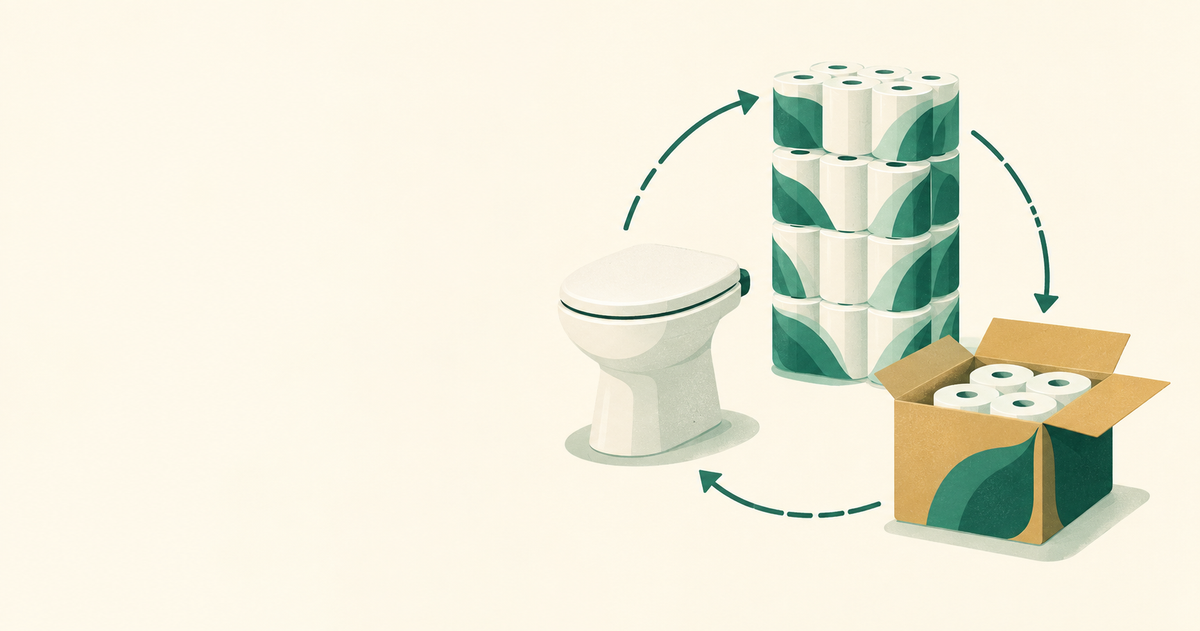
Who Gives A Crap needed $50,000 for its first toilet-paper production run and roughly 1,000 households willing to store and test the result. The founders solved both problems with one constrained public event: Simon Griffiths would sit on a toilet in a cold warehouse until preorders reached the target. It took about 50 hours. The stunt worked because the stopping condition, product, founder discomfort, and funding need were the same story. A founder can copy that architecture without copying the toilet: turn a necessary business milestone into a public event whose progress is visible and whose completion produces the first customer cohort.
The target came from inventory, not vanity
Griffiths, Danny Alexander, and Jehan Ratnatunga founded Who Gives A Crap around a plain product and a social promise: sell toilet paper and direct 50 percent of profits to sanitation work. The obstacle was the first production minimum. Griffiths later explained that $50,000 bought enough paper to fill a house from floor to ceiling. Funding without customers would simply replace a cash problem with a warehouse problem.
In a founder interview, Griffiths said crowdfunding was meant to find the first 1,000 customers as well as finance the run. They would use the product, report whether it worked, and potentially tell other people. That is a better launch objective than maximizing impressions. The business needed distributed storage, product feedback, and cash deposits.
The live stream began in July 2012. Contemporary coverage described the rule while the campaign was running: Griffiths would stay seated until the first $50,000 was raised. Later accounts put the duration at 50 hours and the first delivery in March 2013. The long delay between money and product is a reminder that the campaign funded manufacturing; it did not mean finished stock already existed.
Why the stunt was legible
Most publicity stunts create attention that must then be translated back into a product. This one required no translation. The visual was a person on a toilet. The product was toilet paper. The cause was access to toilets. The countdown ended only when customers financed the production run.
Four design choices made it work:
- A binary finish: either the campaign had raised $50,000 or Griffiths remained seated.
- Visible sacrifice: every hour made the founder's commitment easier to understand.
- A useful purchase: supporters preordered something they already consumed.
- A reason to share: the name, visual joke, and sanitation mission gave buyers a story beyond price.
The joke attracted attention, but a cause and a repeat-use product gave the attention somewhere to go. A stunt with no credible product behind it can win an audience and still fail commercially.
The 1,000-customer arithmetic
If $50,000 in preorders came from approximately 1,000 first customers, the simple average is about $50 per customer. That is an inference from the founder's rounded figures, not an audited order value. It gives a useful design constraint: the offer needed to move a household-sized quantity, not one novelty roll.
Now test the cash with illustrative numbers. Suppose the company collected $50,000, lost 7 percent to platform and payment costs, spent $32,000 on product, $8,000 on inbound freight and fulfillment, and held $3,000 for replacements:
$50,000 - $3,500 - $32,000 - $8,000 - $3,000 = $3,500.
That leaves only $3.50 per customer before overhead and tax. Crowdfunding can remove the need to finance inventory, but it does not guarantee profit. A founder must separately calculate whether the order makes money and whether the campaign unlocks the next production cycle.
Who Gives A Crap stayed self-funded for nine years. In a 2021 letter announcing its first outside investment, Griffiths wrote that the company had prioritized profitability because it could donate only when profit existed. That is a founder's account, not audited financial reporting, but it explains why the first campaign's constraint mattered: the business could not treat losses as impact.
Build a milestone event, not a costume
A reusable version fits on one card:
- Name the operational milestone: a mold deposit, minimum production run, first truck, or retail test.
- Set a number tied to a dated quote.
- Create a visible founder action that continues until the number is reached.
- Make the purchase the mechanism that ends the event.
- Explain delivery timing and risk before the event starts.
A local food producer might cook one public batch after every 20 preorders until a commercial mixer is funded. A furniture maker might stream assembly of prototype joints until deposits cover the first tooling invoice. The action must demonstrate the work or the problem. Random endurance is merely spectacle.
The decision rule is simple: if a viewer can remove the product from the event and the stunt still works unchanged, redesign it. The connection between the event and the sale should be immediate.
What the launch did not prove
The campaign proved that about 1,000 people would preorder the proposition after a concentrated burst of attention. It did not prove repeat purchase, national retail demand, low churn, or efficient paid acquisition. It also benefited from a visually unusual founder act that cannot be repeated every month.
The founders later built direct-to-consumer distribution and took outside capital in 2021. Those later systems should not be credited to a two-day stunt. The launch bought the first production and cohort. Operations, customer experience, and repeat orders had to make the company durable.
That limitation resembles the warning in landing-page validation: an expression of interest answers only the question it actually asks. A paid preorder is stronger than an email address, but it remains one transaction under unusual conditions.
Within an hour, take the next unavoidable invoice and divide it by a realistic first-order value. The result is the number of customers the milestone requires. If that count is implausible, shrink the batch or change the offer before designing the event. Who Gives A Crap's cleverness began with a hard operational number. The toilet made that number shareable.
Prepare the day after the event with the same care. Send buyers a dated manufacturing schedule, explain when addresses can still change, reserve cash for refunds, and schedule product-feedback questions before the novelty fades. Divide the cohort into people who bought for the joke, the mission, convenience, or the product itself. Repeat purchasing will differ. The stunt is complete only when the first cohort becomes evidence for production, packaging, pricing, and retention decisions.
A founder should also set an ethical stop rule. Health, safety, or public disruption should never become necessary to preserve campaign drama. A visible constraint works because the audience understands it, not because the founder accepts unlimited risk.
The campaign's first cohort also fits the broader pattern in where first customers come from: a specific public problem and a direct conversation beat anonymous scale.
A launch becomes memorable when the public event ends at the exact moment the real business problem is solved.
Discussion
Sign in with Google or just a name. No email link, no password to remember.