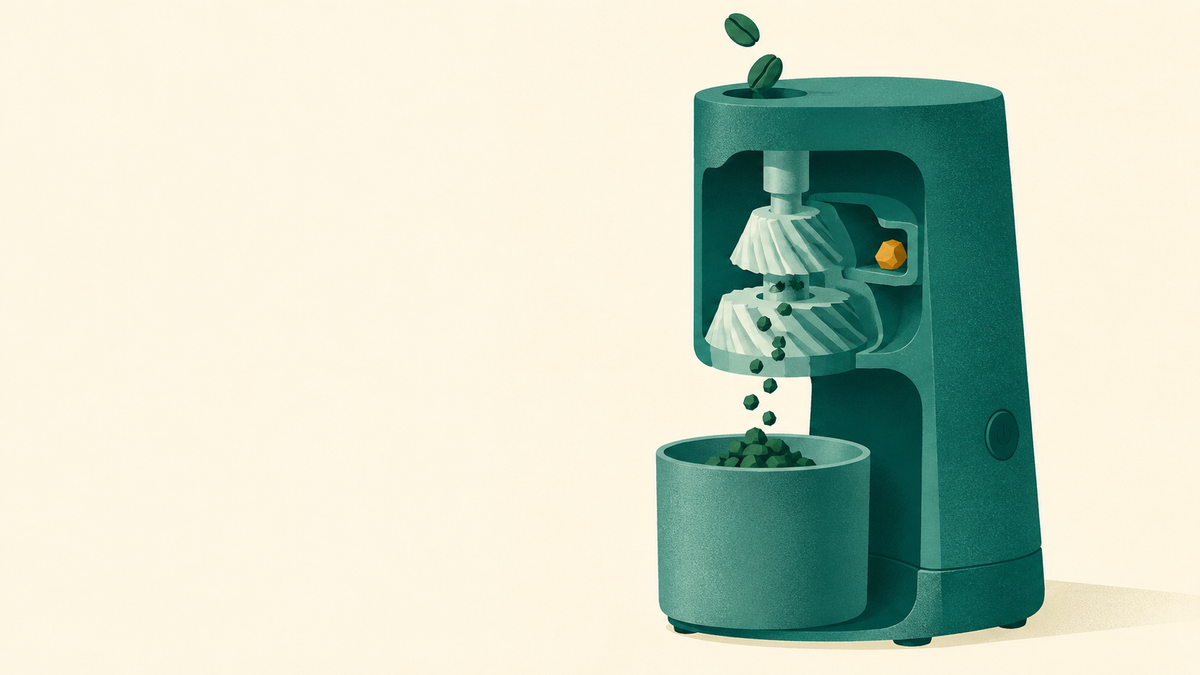
Niche Coffee makes home coffee grinders, and founder Martin Nicholson built the Niche Zero around grinding one measured dose at a time. His product brief focused on a household problem: commercial-style grinders could be large, noisy and leave ground coffee inside between uses.
The name “Zero” makes that problem memorable, but useful measurement requires more than checking whether the output weighs the same as the input. A founder developing a low-waste product should distinguish material trapped permanently, material exchanged on the next cycle and the consistency of the delivered dose. Each answers a different customer question.
Designing for the pause between coffees
Niche's company history dates Nicholson's initial problem identification to 2014 and describes four years of development with more than thirty prototypes. Those are company-reported milestones, not evidence that a certain development timetable guarantees a commercial result.
Single dosing means weighing the beans for one preparation and grinding that amount, instead of keeping a larger supply in a hopper. The intended household can change coffee without managing a large stored quantity inside the grinder. That workflow imposes an extra weighing step while aiming to improve control.
The same feature has different value for different users. A household making one or two coffees may accept the step. A busy counter continuously preparing drinks has a different throughput problem. A founder should specify the context before making a universal claim that a feature is more convenient.
The product's current specification page, checked October 6, 2026, describes 63 mm conical burrs and dose consistency of less than plus or minus 0.2 grams, citing independent test data. Burrs are the shaped grinding surfaces. Dose consistency describes variation in delivered weight; it does not establish that nothing remains inside.
Three numbers hiding inside one promise
Kaffeemacher's review explains its distinction between temporary and permanent retention. Retention is ground coffee remaining in the grinder. Temporary retained coffee exchanges with later grinding; permanent retained coffee stays in internal spaces under the test's definition.
Its October 2025 remeasurement, incorporated into an August 2026 update, reports 0.2 grams of temporary retention and 0.7 grams of permanent retention, totaling 0.9 grams. Kaffeemacher says it bought the equipment and does not sell the Niche. These are that team's results under its method, not measurements performed for this article.
A steady output weight can coexist with internal residue. Material from an earlier cycle may emerge while an equal quantity of new material stays behind. The scale shows a balanced total, but it cannot identify which particles came from which dose.
This is the consequential distinction for product development. A specification about consistency and a promise about freshness may require different evidence. A founder should ask which customer outcome each number supports before making them interchangeable in sales copy.
- Dose consistency: how repeatable is the delivered weight? This number alone cannot tell a household whether older coffee is mixed into the next dose.
- Temporary retention: how much material can exchange between cycles? An exchange measurement does not, by itself, establish whether a particular customer notices a taste difference.
- Permanent retention: how much remains in internal spaces under the test method? That continuing internal quantity is not necessarily material discarded on every use.
These three questions are an original interpretation of the measurement problem. It is not a replacement for the testing method. Material, settings, cleaning history and the point at which a measurement stops can alter the result. Use a written protocol when comparing devices.
A lower-waste claim needs a realistic denominator
Suppose, purely for illustration, a customer grinds an 18-gram dose and 0.2 grams of earlier coffee exchanges into it. That amount is approximately 1.1 percent of the dose: 0.2 divided by 18, multiplied by 100. An assumed 1.5 grams would be 8.3 percent.
These fractions illustrate scale. They do not predict flavor, prove a device comparison or describe the coffee each owner will receive. The larger value is an invented comparison input. A smaller exchanged quantity may matter to one customer and be unimportant to another.
Now consider a separate hypothetical waste practice. A customer purges two grams before each morning's brewing, 300 mornings a year. That totals 600 grams. At an assumed £30 per kilogram of beans, it costs £18 a year.
If a different workflow eliminates that entire purge, £18 is the illustrative annual ingredient saving. It does not establish a grinder's payback: purchase price, lifespan, other equipment, maintenance and the customer's reasons for buying remain outside the calculation. Most of a premium product's value may be convenience, control or enjoyment.
Do not multiply permanent retention by every use as if it were discarded on every cycle. That would price a continuing internal quantity as a recurring material loss. Identify the mechanism of waste before attaching money to it.
Turn the complaint into a testable product brief
A prospective maker can use five fields: intended user, interrupted task, measurable outcome, acceptable compromise and evidence required. Fill them in for one specific context rather than for “all coffee lovers.”
For a hypothetical home grinder, the user might be a household switching between regular coffee and decaf. The interrupted task is changing beans without lengthy cleanup. The outcome is a defined level of carryover under a fixed protocol. The acceptable compromise might be weighing each dose. The evidence includes observed workflow and suitable technical tests.
The brief should say what would make the design fail. If the user dislikes weighing more than they dislike carryover, the engineering result may not solve their actual problem. A superior laboratory number can still be a poor product fit.
PopSockets' observed-use story offers a way to challenge the founder's original brief. Watch what customers do rather than only ask whether they like the feature. For a grinder, the relevant observation includes preparing beans, selecting a setting, moving the cup and resetting the workspace.
U-Turn Audio's simplification case makes a related manufacturing point. A focused appliance need not imitate every function of professional equipment. It needs to perform the intended customer's task well enough to justify its own costs and compromises.
Write the measurement sentence first
Within an hour, choose one complaint about a physical product and write two sentences: what the customer experiences, and what the proposed test actually measures. Ask someone unfamiliar with the project whether the second sentence proves the first. If it does not, identify the missing observation.
Niche is a surviving company, and the opened sources do not disclose full product margins or the probability of another prototype succeeding. Its transferable contribution is a sharply defined household task. The naming can attract attention. The brief becomes useful when “less waste” has a measurement, a context and an honest account of what remains.
Discussion
Sign in with Google or just a name. No email link, no password to remember.