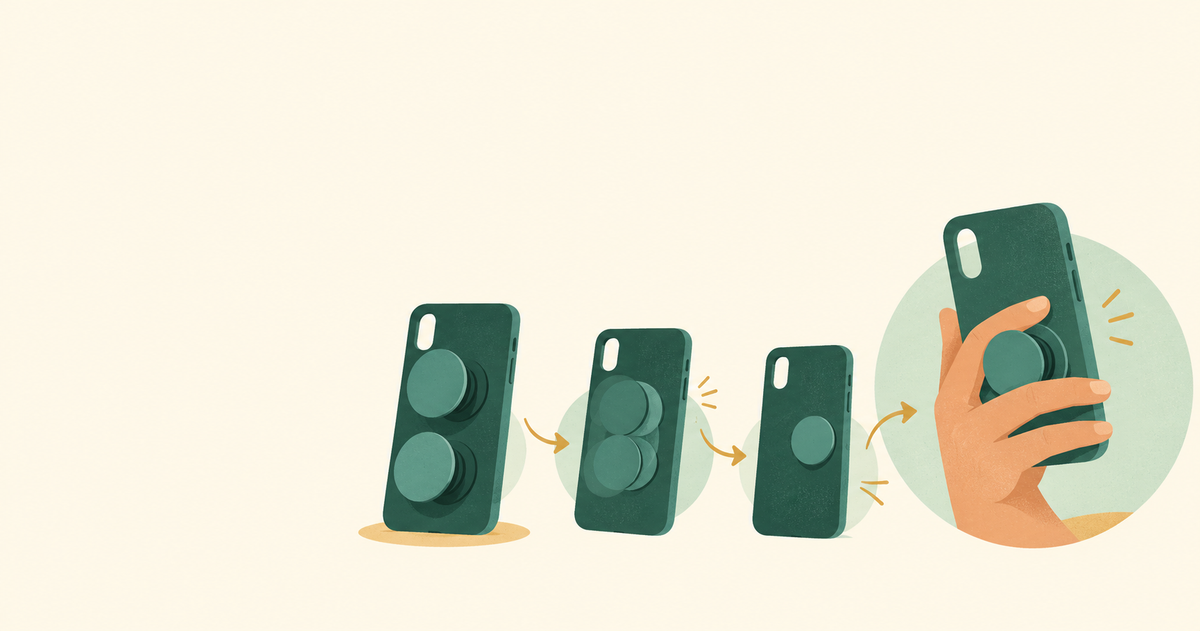
David Barnett did not set out to invent a phone grip. The philosophy professor wanted to stop earbud cables tangling, so his first product put two expandable discs on an iPhone case as cord wraps. Students who handled prototypes used the discs to grip and prop up their phones instead. Barnett eventually stripped away the case and the second disc, leaving the single adhesive PopGrip that became the business. The founder lesson is unusually practical: when customers repeatedly use a prototype "wrong," measure that behavior before defending the feature that inspired the product.
The original problem was not the valuable one
Barnett began with buttons glued to the back of his phone so he could wind wired earbuds around them. He taught himself computer-aided design, made dozens of prototypes, and brought an integrated phone case to Kickstarter in 2012.
In a long Shopify founder interview, Barnett explained that people became excited by benefits he did not originally emphasize. A collapsible disc made a phone easier to hold and could serve as a stand. The earbud-management story was becoming baggage.
The insight did not come from asking, "Would you buy a phone grip?" Customers did not have a familiar category name. It came from watching what hands did with the object.
Subtraction made the product easier to sell
An integrated case created multiple inventory problems: phone model, case color, graphic, and two mechanisms. A stand-alone adhesive grip reduced compatibility dependence and allowed customers to put it on many cases. Removing the second disc also moved the remaining grip toward the position users preferred.
This is a variant explosion calculation. Assume five phone models, four case colors, and ten graphics. The case product creates 200 stock-keeping units:
5 x 4 x 10 = 200 SKUs.
A universal base with ten interchangeable graphics creates roughly eleven core items before bundles. Actual PopSockets inventory was more complex, but the mechanism is clear. Product subtraction can improve both the customer proposition and working capital.
For comparison, WeatherTech wins by managing fit-specific variants. PopSockets found leverage by escaping most of them.
Observed use needs a threshold
One inventive use can be a curiosity. Repeated unprompted use is product evidence. Run a structured handling test with 15 to 20 people:
- Give each person the prototype without explaining every feature.
- Ask them to complete the ordinary task.
- Record the first use, repeated use, and ignored feature.
- Ask what they would miss if one part disappeared.
- Offer two versions at the same price and record the choice.
Set a rule before the test. For example: if at least 12 of 20 people use the device primarily as a grip and fewer than five use the cable wrap, build the grip-only version. The exact threshold is illustrative. Writing it first prevents a founder from treating every gesture as support for the preferred concept.
The first Kickstarter was evidence, not a verdict
The original case campaign did not create the final mass-market product. That is precisely why it is useful. A crowdfunding page can validate a particular configuration while obscuring the stronger adjacent use. Paid support says something is attractive; behavior says which part.
Barnett spent about 15 months and created roughly 60 prototypes before the initial campaign, according to Forbes. The same account reported first-year U.S. sales of 30,000 units and 35 million units across 40 countries in 2017. Those are founder-provided sales figures, not audited profit.
The scale should not be read backward as proof that the original idea was obviously good. It shows the value of allowing prototype evidence to change the noun. The business moved from "earbud case" to "phone grip."
Do not confuse a new use with a safe claim
Some observed uses create liability or technical demands. If customers stand on a stool, carry a device by a cable, or use a kitchen tool near flame, the founder should not market the behavior until it is tested and appropriate. Classify discoveries:
- Safe and supported: promote it.
- Promising but untested: prototype and verify.
- Unsafe or incompatible: design it out and warn clearly.
PopSockets continued this pattern years later. TechRadar reported in June 2026 that Barnett had revisited an ultra-thin concept after hearing objections from people worried a grip would catch on a pocket. The new version was tested through 100,000 open-close cycles and a 30-pound pull, according to the company. Customer objection supplied the design target; engineering supplied the evidence.
Let subtraction change the cash plan
Removing a feature is not only an aesthetic decision. It can eliminate a component, tool, assembly step, inspection point, instruction, and failure mode. The founder should translate the simpler behavior into a simpler bill of materials before choosing the next production quantity.
Suppose the case version needs four molded parts in three phone sizes and two colors. That creates 24 part-color-size combinations before packaging. A two-part universal grip in six colors creates 12. If a supplier requires 1,000 pieces per combination, the first version demands 24,000 components while the second demands 12,000. Actual assembly and minimums will differ, but the multiplication reveals why a seemingly small feature can double cash exposure.
Subtraction also changes the test. Ask whether the simplified object still performs the repeated job, survives the new load, and can be explained without the removed origin story. Then price both landed cost and expected failure cost. A cheaper product that fails more often is not simpler in the customer's life.
Keep a discarded-feature log. Record what was removed, the behavior evidence, the saved complexity, and the condition that would justify bringing it back. That prevents a later team from restoring old features merely because the original patent, mold, or presentation deck still exists.
Use three rounds instead of one large test. The first five users expose confusion. The next ten compare the simplified and original versions. The final five try the chosen object without coaching. Between rounds, change only one meaningful variable. That sequence is small enough for a founder to observe directly and structured enough to prevent a charismatic participant from outweighing repeated behavior.
Write down non-use too. A person who never deploys the grip, removes it before putting the phone away, or hands the phone to someone else has supplied product evidence. Silence is not an objection the sales copy can overcome automatically. It may indicate the wrong customer, placement, thickness, or task.
A one-hour product-subtraction review
- List the three features that created the idea.
- List the three behaviors customers actually repeat.
- Mark any feature that adds variants, assembly steps, failure points, or explanation.
- Sketch the smallest product that preserves the repeated behavior.
- Calculate SKU count and first-order cash for both versions.
- Put both in front of users without naming the preferred answer.
The Liquid Death pilot tested whether positioning could attract action before production. Barnett's test is closer to the object: let use reveal what the positioning should promise.
A founder's origin story can explain where an invention came from. It should not become a specification. Customers may discover the business while using the prototype for something else.
Discussion
Sign in with Google or just a name. No email link, no password to remember.