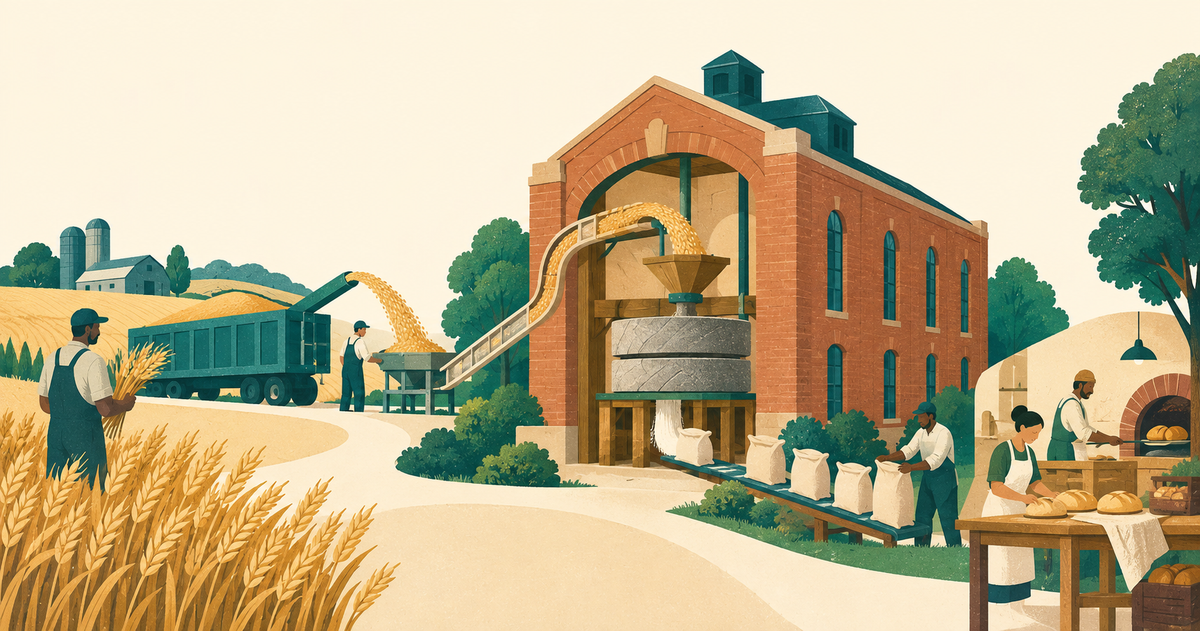
Maine Grains began with a conference, not a mill. In 2007, Amber Lambke helped convene farmers, bakers, and grain enthusiasts in Skowhegan, Maine. The meetings exposed a structural gap: farmers could grow grain and bakers wanted local flour, but the region lacked processing capacity between them. Lambke and Michael Scholz eventually bought a former county jail for US$65,000 and converted it into a gristmill. Their story offers a way to find durable small-business opportunities: map a local value chain, locate the asset every participant needs, and validate throughput before buying the building.
The customers identified an absent machine
Lambke was a speech pathologist when she helped start the Kneading Conference. According to the Whole Grains Council's field report, the event brought commercial bakers, home bakers, and farmers together. Farmers began growing wheat, corn, oats, and rye. The bakers generally wanted flour, not raw grain.
That observation changed the opportunity. Another farm would add supply. Another bakery would add demand. A mill could unlock transactions between both.
Maine Grains' company history dates the conference to 2007, the building purchase to 2009, and the mill opening to September 2012. Five years elapsed between convening the market and running production. By 2022, the company says it had milled 10 million pounds in its first decade.
The US$65,000 building was not the project cost
The former Somerset County Jail looked inexpensive. The Whole Grains Council reported a US$65,000 purchase price for the 14,000-square-foot building. Renovation and equipment brought initial investment to about US$1.5 million in that 2016 account.
A later Bangor Daily News report quoted Lambke saying the building, renovation, and mill required more than US$3 million in financing, with Slow Money Maine helping arrange more than half. The figures are not necessarily contradictory: one may describe initial investment while the other includes subsequent financing and expansion. They show why a cheap property should never anchor the capital estimate.
List the entire conversion:
- purchase and legal closing;
- food-safe surfaces, power, ventilation, fire protection, and accessibility;
- grain receiving, cleaning, testing, milling, sifting, packing, and dust control;
- working capital for grain, packaging, payroll, and receivables;
- training, certification, laboratory testing, and launch losses;
- contingency for a historic building.
Throughput had to serve two sides
The 2016 field report said the mill received roughly twelve one-ton totes every two weeks, sold 360 tons the prior year, and was on course for 700 tons. About 90 percent of grain came from Maine, while bakery and foodservice bulk bags formed the largest part of sales. Retail packs added another channel.
This is a two-sided throughput problem. Farmers need predictable purchases. Bakers need consistent flour. The mill earns its place by reducing the mismatch between agricultural lots and customer specifications.
A useful utilization model is:
Required annual volume = annual fixed cost / contribution per processed ton.
Assume a small processor has US$420,000 of annual fixed cost and earns US$600 of contribution per ton after grain, packaging, variable labor, and outbound freight. Break-even volume is 700 tons:
US$420,000 / US$600 = 700 tons.
At 50 operating weeks, that means 14 tons per week. A founder should collect letters of intent from both suppliers and buyers around that weekly number before committing to equipment. These inputs are illustrative, not Maine Grains' accounts.
Quality control was part of market creation
The Whole Grains Council observed that incoming grain was tested for moisture, fungus, and field sprouting, with some functional tests sent as far as Kansas because Maine lacked a grain lab. Lambke took a milling course at Kansas State and hired the instructor as a consultant.
This is a useful warning about "missing middle" businesses. The visible asset may expose another absent service. A mill without testing cannot guarantee bakery performance. A founder may need to build a lab partnership, certification route, repair service, cold store, or training program beside the central machine.
The logic resembles OpenFlexure's local microscope network: distributing equipment is not enough when adoption depends on nearby capability.
Rent and byproducts reduced concentration
A CEI profile said the building also housed a cafe, yarn shop, radio station, and farmers market. Maine Grains says milling byproducts go to composters, livestock farmers, and value-added producers.
Neither activity replaces the core flour business. They improve asset use and reduce waste. A founder considering a processing hub should list every stream leaving the machine: main product, lower-grade output, byproduct, heat, storage, workspace, and customer traffic. Then test which streams have real buyers.
Match commitments on both sides
A processing business can look fully booked while remaining exposed. Farmers may offer tonnes that do not meet the mill's specification. Bakeries may express interest without committing to weekly volume. The founder needs matched commitments that name quantity, quality, timing, and price logic on both sides.
Build a rolling 12-month table. For each grain, list contracted incoming tonnes, expected test loss, saleable flour yield, committed customer tonnes, and uncommitted balance. Then apply a pessimistic case for crop failure or buyer delay. The table will show whether the bottleneck is supply, milling capacity, storage, quality testing, or demand.
Cash timing matters as much as tonnes. A farmer may need payment at harvest while a wholesale buyer pays 30 days after delivery. Storage, milling, packaging, and freight sit between them. Calculate the maximum cash tied up from grain purchase to customer collection. A profitable conversion margin can still fail if the working-capital bridge is missing.
Start with a tolling or pilot batch when possible. Processing grain owned by a committed customer can reveal yield, labor, testing, and machine limits without asking the mill to finance every input. The pilot should still include rejected material and cleanup time. Otherwise it understates the real conversion cost.
A one-hour missing-link map
- Write the local product from raw input to final customer.
- Name the business at each handoff and the unit it buys or sells.
- Interview one supplier and one buyer about delays, minimums, quality, and transport.
- Circle the step currently performed far away, manually, or not at all.
- Estimate annual fixed cost and contribution per unit for that step.
- Ask enough participants to cover a minimum weekly throughput before pricing property or equipment.
Diaspora's harvest-financing model begins with paying producers and matching inventory to a crop cycle. Maine Grains asks the preceding infrastructure question: what if the product cannot reach the customer in the required form at all?
The mill was not born because an old jail was cheap. It became plausible because years of convening revealed a repeated blocked transaction. Find the missing exchange first. The building is the last part of the idea.
Discussion
Sign in with Google or just a name. No email link, no password to remember.