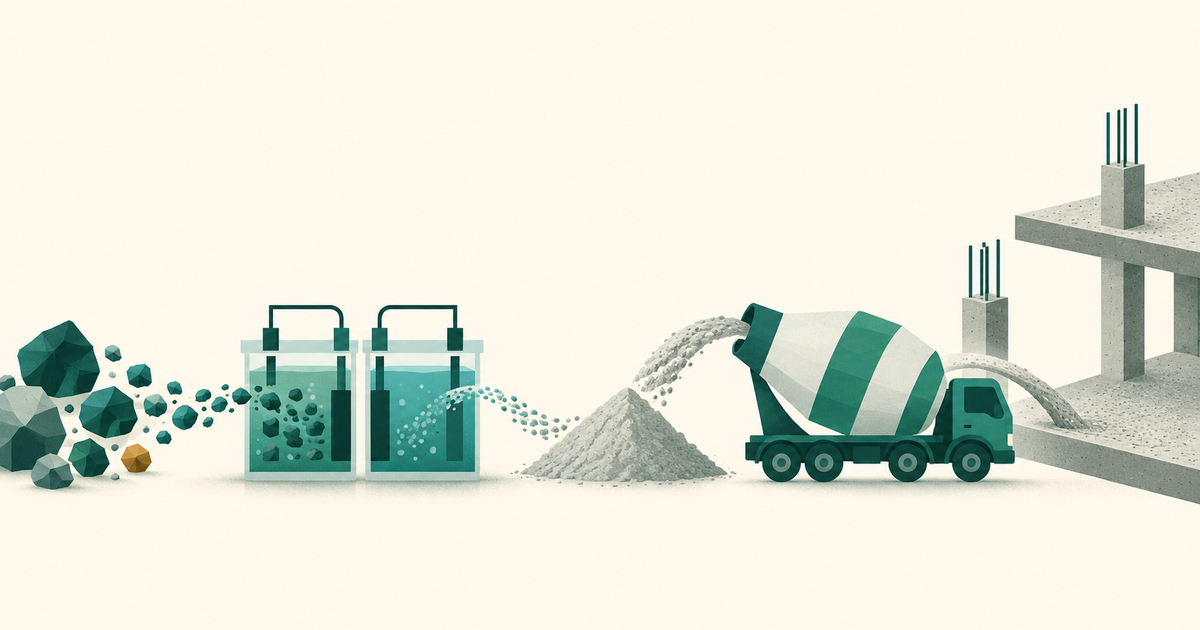
Sublime Systems is developing cement made with an electrochemical process instead of a conventional high-temperature kiln. Cofounders Leah Ellis and Yet-Ming Chiang are not commercializing only a cleaner chemical reaction. They must deliver a powder that passes recognized performance standards, works in existing ready-mix plants and job-site equipment, survives field trials, and attracts buyers before a full-scale factory exists.
That makes Sublime a practical case in industrial technology adoption. A technical breakthrough reaches customers faster when the output fits the installed workflow and when early buyers help finance scale without pretending pilot capacity is mass production.
The innovation happens upstream of a familiar job
Ordinary portland cement is made by heating limestone and other materials. Sublime's process description says its system uses electricity at ambient temperature to separate calcium and silicate ingredients from rocks or industrial materials, then blends them into cement. The company says the result complies with ASTM C1157, a performance specification for hydraulic cement.
Those are company claims, but the mechanism is clear: change how cementitious ingredients are produced while keeping the customer's concrete workflow recognizable. Sublime says its cement can enter familiar mix designs, ready-mix trucks, pumps, placing, and finishing. That lowers adoption work for contractors compared with a material that needs new equipment or unfamiliar field behavior.
This is the compatibility wedge. For any emerging technology, list the customer's installed assets, approved procedures, trained labor, procurement codes, and warranty assumptions. Redesign the innovation around the most expensive item the customer should not have to change.
Qualification is a ladder, not a certificate
Sublime's validation sequence moves from material characterization and mortar through concrete tests, ready-mix trials, small batches, external labs, and field pours. It identifies American Engineering Testing for ASTM qualification and describes tests for strength, shrinkage, chloride permeability, freeze-thaw resistance, and other properties.
A standard does not eliminate customer risk. It gives engineers a shared language for evaluating it. Each rung should answer a different objection:
- Material tests ask whether the chemistry is consistent.
- Concrete tests ask how it behaves with aggregates, water, and admixtures.
- Ready-mix trials ask whether normal batching equipment can handle it.
- Field pours ask whether transport, pumping, placing, and finishing remain practical.
- Longer observation asks whether durability claims survive time and exposure.
A founder should not combine these into "validated." State which rung passed, who ran it, on what date, and what remains unknown.
The scale gap deserves its own arithmetic
Sublime currently describes a 250-ton-per-year pilot. In 2024 it described a planned Holyoke facility at 30,000 tons per year, while current pages use less specific language about first commercial-scale facilities. The older number should therefore be treated as a plan, not a current operating capacity. The US Department of Energy confirms that the proposed first commercial electrochemical cement project is in Holyoke, Massachusetts.
The planned jump from 250 to 30,000 tons is 120 times pilot nameplate capacity. Even if the chemistry scales, material handling, electrode life, maintenance, energy contracts, feedstock consistency, staffing, and product logistics may not scale proportionally.
A scale-risk table should separate four ratios:
| Ratio | Question |
|---|---|
| Capacity multiple | How many pilot plants equal the commercial target? |
| Continuous-run multiple | How much longer must equipment operate between shutdowns? |
| Customer multiple | How many qualified projects absorb output? |
| Capital multiple | How much cash is committed before stable product revenue? |
If a pilot runs 2,000 hours annually and the commercial design requires 8,000, the endurance multiple is four even before capacity is considered. Every multiple needs an owner and evidence.
Sell the material and the environmental attribute separately
Scale creates a geographic problem. Cement is heavy and usually sold near production, while large companies may want lower-carbon material in regions where the new supplier has no plant. Sublime and Microsoft signed a 2024 memorandum to explore environmental attribute certificates, according to Sublime's announcement. The physical cement and the verified environmental benefit could be contracted separately through a book-and-claim model.
The announcement also says a $75 million strategic investment from Holcim and CRH included equity and prepaid cement offtake. These are company-disclosed terms, not a complete contract. Still, prepaid offtake illustrates a commercialization tool: a credible future customer commits cash or purchases before full production, giving the manufacturer demand evidence and project financing.
The method needs safeguards. An offtake should specify volume, quality, price logic, delivery window, qualification conditions, remedies, and whether payment is refundable. Environmental attributes need independent accounting that prevents two customers from claiming the same benefit. A memorandum of understanding is not revenue, and a reservation is not delivered product.
A commercialization map any industrial founder can use
- Name the standard the customer already trusts.
- List every workflow step from receiving to finished use and mark what changes.
- Build a qualification ladder with a buyer at each rung.
- Calculate capacity, endurance, customer, and capital multiples from pilot to plant.
- Seek one paid trial or conditional offtake tied to clear acceptance criteria.
- Publish current capacity separately from planned capacity.
The duration-specific positioning in Form Energy's iron-air battery model shows why emerging technology must win a defined job. Notpla's familiar takeaway container demonstrates compatibility at a smaller physical scale. Zipline's approved delivery system shows why technology, operations, and institutional acceptance have to arrive together.
Sublime remains in scale-up, and its economics at mature commercial production are not publicly proven. Company statements about performance and cost require continued third-party verification. That uncertainty is not a footnote; it is the business problem. The best industrial innovation does not ask customers to admire a reactor. It removes one adoption objection at a time until the new material can enter an old truck, pass an old test, and do an old job with a better production path.
Industrial founders should also distinguish technical buyer, economic buyer, and risk approver. A concrete producer may run the mix. A developer may pay the premium. An engineer or insurer may decide whether the material is allowed. A climate team may value the emissions benefit but control none of the job-site decisions. A commercial pilot fails when only one of these people agrees.
Create an adoption ledger with one row for each participant. Record the promised benefit, evidence required, budget owner, approval date, and consequence of failure. Then attach the smallest trial that can answer that participant's question. The technical buyer might need pumpability data. Procurement needs supply and price terms. The engineer needs test reports. Finance needs a credible path from pilot cost to repeatable price. Scale begins when those separate approvals converge on the same shipment.
Test that ledger before committing to enormous capacity. Ask a buyer to trace one actual order from specification to pour, then mark every change to paperwork, storage, batching, testing, insurance, or liability. The shortest credible route to adoption often has the fewest changed boxes, not the most dramatic laboratory result.
Discussion
Sign in with Google or just a name. No email link, no password to remember.