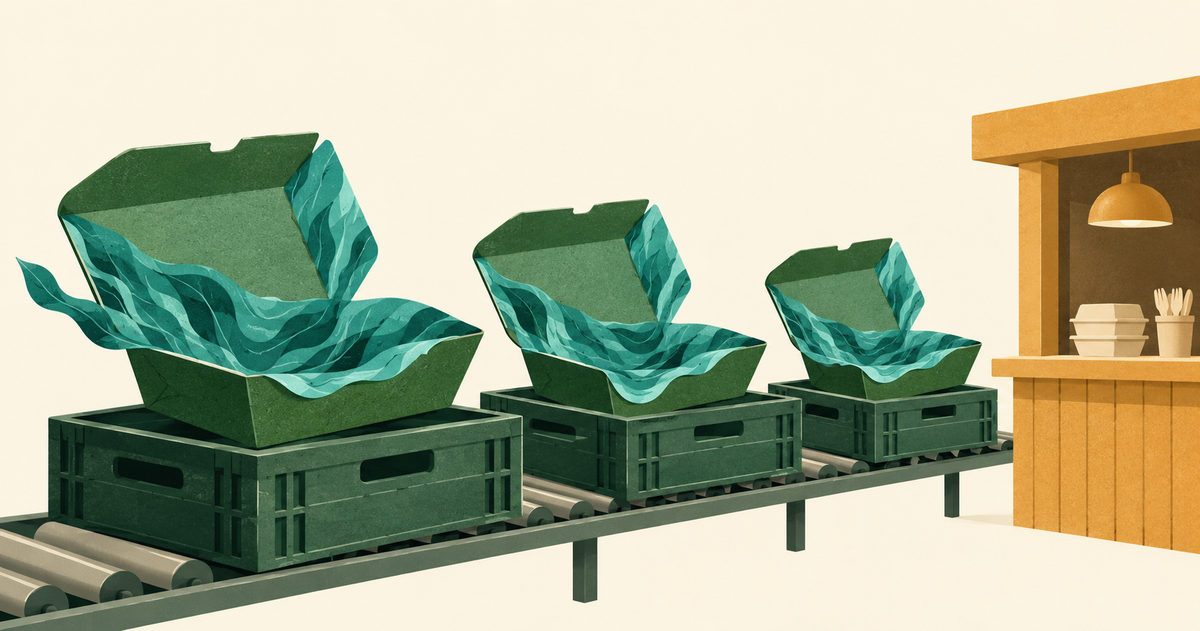
Notpla's most transferable commercialization move is not the edible water bubble that made the company famous. It is the ordinary takeaway box. The London biomaterials company put a seaweed-based coating inside a familiar foodservice format, then worked with distributors and large venues that already move millions of containers. Its own impact reporting says its products had replaced more than 41 million single-use plastic items in total by 2025/26. That is a company measure, not an audited sales figure, but it reveals the mechanism: a new material scales faster when buyers do not have to redesign the whole meal, kitchen, or waste routine around it.
The spectacular prototype was not the only market
Co-founders Rodrigo Garcia Gonzalez and Pierre Paslier developed Ooho, an edible seaweed membrane for liquids. It creates a striking demonstration at races and events. Yet flexible bubbles require filling systems and a use occasion that tolerates a different package. A coated paperboard box asks less of a caterer. Food still goes into a box, lids still close, and distributors can add another item to a catalog.
Notpla's 2025/26 impact page reports an all-time total above 41 million replaced single-use plastic items across stadiums, universities, and foodservice. It names Just Eat as a channel through which millions of seaweed-coated containers reached customers. These are Notpla's own impact claims, so they should not be treated as third-party verification of unit sales or disposal outcomes.
The product claim is more specific. Notpla's food-container page says a third-party-reviewed life-cycle assessment found up to 79 percent lower embodied carbon dioxide equivalent than polypropylene alternatives and 39 percent lower than PLA-coated paperboard. The phrase "up to" matters, as do the particular comparison and methodology. A buyer should request the assessment and model its actual format and disposal system rather than copying the best figure into procurement material.
Distribution made the material purchasable
In 2023, Earthshot documented partners including Bidfood, Bunzl, and Just Eat. Its report on Notpla's expansion said Bidfood UK had more than 45,000 customers and had launched a seaweed-coated box range. The £1 million Earthshot prize funded ten hires and machinery for another product line. Earthshot also reported a 40 percent peak in commercial inbound the month after the award. Those numbers show attention and channel access, not automatic repeat purchase.
The distinction is crucial for materials founders. A restaurant rarely wants to become a packaging importer, specification laboratory, or waste educator. A known distributor can handle credit, mixed orders, route delivery, and sales relationships. The startup still needs to prove grease resistance, moisture performance, food contact requirements, storage life, and price. Distribution removes buying friction, not technical risk.
Model the buyer's whole switch cost
Imagine a 20-site food operator using 2 million boxes a year. Its current box costs an illustrative £0.12. A new coating raises unit price to £0.15, adding £60,000 annually:
2,000,000 x (£0.15 - £0.12) = £60,000.
Suppose the alternative eliminates a £14,000 annual waste-stream charge, saves £9,000 of staff time previously spent separating liners, and supports a venue contract worth £25,000 in annual contribution that requires plastic-free serviceware. Net added cost becomes £12,000:
£60,000 - £14,000 - £9,000 - £25,000 = £12,000.
That is £0.006 per served meal if all 2 million units are used. These inputs are illustrative, not Notpla customer data. The point is that procurement needs a system calculation. A material with a higher piece price can still win when it reduces waste handling, compliance friction, or lost business. It can also lose if leakage, short shelf life, or supply interruptions add hidden costs.
Choose the lowest-behavior wedge
| Application | Buyer behavior change | Operational proof |
|---|---|---|
| Coated takeaway box | Low | Barrier performance, nesting, storage, disposal |
| Edible liquid bubble | High | Filling, hygiene, handling, customer instruction |
| Flexible film | Medium to high | Machine compatibility, seal, shelf life, print |
| Rigid molded item | Medium | Tooling, strength, throughput, end-of-life route |
A scientific platform may support all four. The commercial starting point should be the application with urgent buyer demand, tolerable certification, an existing ordering path, and few required behavior changes. This is the opposite of choosing the product that makes the best demonstration video.
What transfers, and what does not
Foodservice has very high unit volume and intense price pressure. It also has concentrated channels: distributors, stadium operators, caterers, and delivery platforms can expose one material to many sites. A laboratory selling a low-volume aerospace composite cannot copy that route. Nor can a packaging founder assume environmental benefit from a natural feedstock alone. Manufacturing energy, additives, transport, food waste, and end-of-life conditions all affect the comparison.
Notpla has raised substantial capital, including a £20 million round announced in 2024, so this is not a garage-scale formula for bootstrapping a materials plant. The transferable lesson is about adoption sequencing, not financing equivalence. The production assets, testing, and working capital behind millions of pieces remain substantial.
A one-hour adoption map
- Name the current product your material replaces, including exact dimensions and barrier job.
- Write every machine, person, distributor, and waste stream it touches.
- Mark each required behavior change. Eliminate changes that do not create essential value.
- Ask three buyers for their current piece price, failure rate, storage limit, and disposal cost.
- Identify the distributor already serving those buyers and the evidence its category manager needs.
Do this before optimizing a broad platform story. It produces a testable sales brief: one format, one workflow, one economic comparison. The approach extends the first-customer map by adding the intermediary who already holds the account.
There is also a capacity gate. Before a national distributor lists a product, model the largest plausible weekly reorder, raw-material lead time, conversion yield, and cash gap between supplier payment and customer receipt. A listing that empties inventory can damage a young supplier faster than a small pilot. Map the concentration explicitly with the platform dependency audit.
Notpla's box matters because it makes advanced material look operationally boring. Buyers can focus on performance and cost instead of learning a new ritual. That is a hard-won form of innovation. Founders commercializing science should ask not only what their material can become, but which familiar object lets a customer adopt it with the fewest new instructions.
A pilot should test disposal as carefully as serving. Mark a limited number of sites, count containers issued, inspect contamination in the actual waste stream, and ask the waste contractor what happens after collection. A package can perform well at the counter while failing the buyer's environmental objective downstream. Publish the boundary of any result, including site, duration, format, and comparison.
Keep claims narrower than the evidence. "Plastic-free coating in this tested box" is more useful than a sweeping promise that every application disappears harmlessly everywhere. Procurement teams need material composition, certifications, storage conditions, and disposal instructions they can place in their own operating manuals.
A new material travels faster when it arrives inside a format buyers already know how to use.
Discussion
Sign in with Google or just a name. No email link, no password to remember.