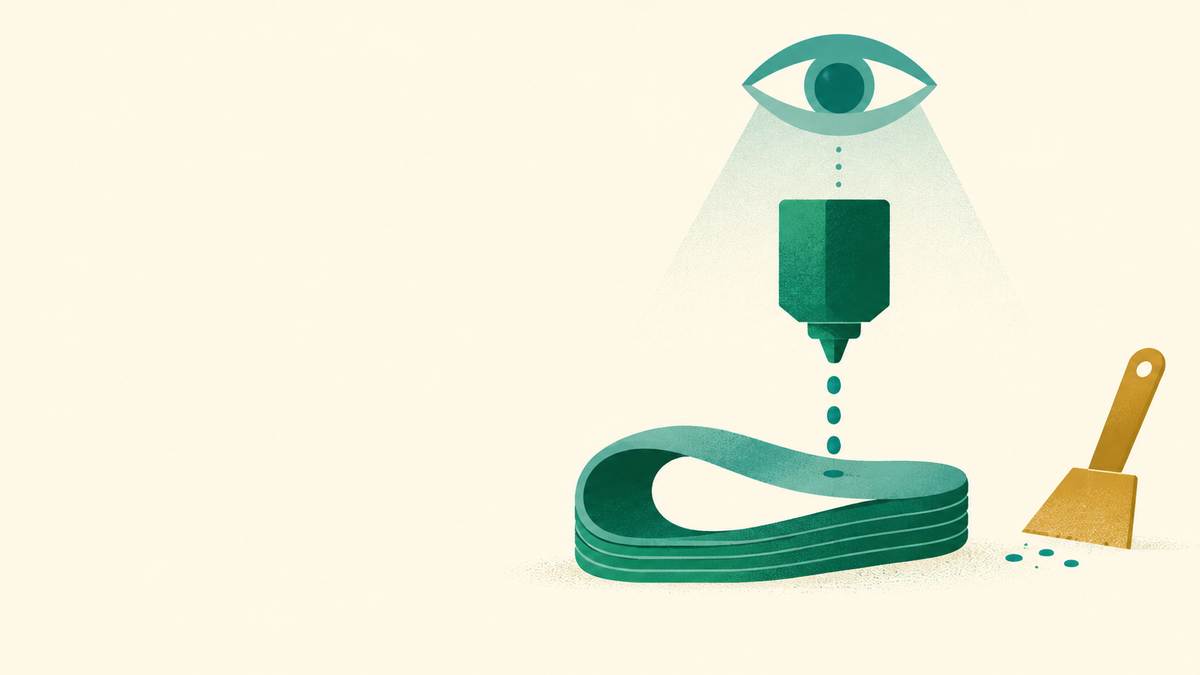
Inkbit develops 3D-printing technology that deposits droplets of material while an optical system checks the shape being built. Work with MIT and ETH Zurich showed why that feedback mattered: it could remove the mechanical smoothing step that restricted which resins the printer could use.
Removing that contact opened a material choice. The consequential question for a hardware founder is which soft-and-rigid assembly that choice can change. Identify the joining work the new structure might remove, then calculate how much finishing you can afford before the complete part becomes more expensive.
The scraper had been choosing the chemistry
MIT's November 15, 2023 account explains the constraint in conventional multimaterial inkjet printing. Droplets of resin are deposited, smoothed and cured, or hardened. Mechanical smoothing can smear resins that cure more slowly.
The researchers used vision-controlled jetting, combining optical measurement with adjustments to deposition. Removing the contact-based smoothing step allowed them to work with slower-curing chemistries and make structures combining soft and rigid materials.
ETH Zurich's Soft Robotics Lab project description describes scanning printed layers and compensating for unevenness. Demonstrations included a hand, a walking robot and a pump-like artificial heart. The page also says printed systems were connected to motors; a complex printed structure is not a claim that every supporting component appeared from the printer.
Inkbit's current technology page presents the same combination of inkjet deposition, optical scanning and feedback control as its manufacturing platform. These sources establish the process and reported demonstrations, not a guaranteed cost or outcome for an arbitrary customer design.
The change is specific. Better observation did more than supply another inspection picture. It helped replace a physical operation that had constrained material choice. That can matter to the product a founder is able to design.
Look for the joint that currently defines the part
A physical product often combines materials because one job needs stiffness and another needs flexibility. Conventional assembly may require separate pieces, fastening, bonding or seals. The interface then becomes part of the product's cost and potential failure.
A multimaterial process can make a different arrangement possible. It does not automatically make the original interface unnecessary or every material combination suitable. The product's loads, environment and required life still need their own engineering evidence.
Start with one assembly and draw the path from each piece to the finished job. Mark where material properties change and what the connection does. A connector that permits repair or movement may be valuable, even if a printer could replace it with a permanent structure.
This original interface map helps identify a useful candidate:
| Existing handoff | Possible printed change | Evidence still needed |
|---|---|---|
| Rigid support to flexible contact surface | Combine regions within a printed structure | Required behavior at the material boundary |
| Separate channel pieces to sealed passage | Form internal passages as part of the geometry | Clear passages and acceptable finished operation |
| Several parts to an assembled shape | Reduce joining work | Repair access and complete supporting components |
| Printed support to finished part | Remove temporary support material | Finishing time and accepted final condition |
The entries are possible evaluation questions, not claims that Inkbit provides a suitable substitute for every listed application. Choose a candidate because a named handoff is expensive or limiting, not because the demonstration resembles an impressive robot.
Deleted assembly has a maximum finishing allowance
Consider illustrative US-dollar arithmetic for a fictional component, unrelated to Inkbit quotations. The existing assembly uses US$30 of bought parts, US$20 of joining labor and US$8 of inspection. Its variable cost is US$58 per accepted assembly, assuming those inputs already allow for routine rejects.
A supplier offers a printed structure for US$42, with US$12 of finishing and the same US$8 inspection. Assume these figures also allow for routine rejects. The result is US$62. Eliminating a US$20 joining operation has not made the complete deliverable cheaper.
Under those assumptions, the printed route's maximum finishing allowance at cost parity is US$8: US$58 minus US$42 minus US$8. If finishing can be demonstrated at US$6, the total becomes US$56. If it takes US$15, the total becomes US$65.
Now revise the original joining estimate from US$20 to US$15. Existing cost falls to US$53, and the finishing allowance falls to US$3. A small mistake about the work being removed can change the procurement decision.
This is a quote-reading calculation, not a payback forecast or a claim about printed parts' quality. Keep both routes tied to the same finished requirement. If one quote excludes a necessary support component or test, the totals are not yet comparable.
U-Turn Audio's selective tooling story offers a related principle: manufacturing investment should address a specific component constraint. A new material route needs the same specificity.
A print can simplify one handoff and complicate another
Integrated geometry may reduce joining while changing how the part is cleaned, inspected, repaired or replaced. Ask which of those consequences matters to the customer before approving the design.
For a low-cost disposable fixture, replacing an integrated part may be acceptable. For an item intended to last, losing access to a replaceable region can create a service problem. These are product choices, not conclusions supplied by the printing method.
Ask the supplier to identify what it delivers: a structure directly from the printer, a finished part or a complete working assembly. The ETH demonstration's motor connection is a useful reminder that the boundary deserves an explicit description.
Also specify which material property is essential. Soft is too vague for a purchasing requirement. The responsible engineer should define the relevant behavior under actual operating conditions and decide what evidence is sufficient.
Blue Robotics' flooded motor shows another case where changing a physical interface changed the product architecture. The transferable habit is to locate the constraint precisely before assigning value to its removal.
Send the supplier the assembly, not the inspiration
Start the next supplier conversation with an hour spent mapping one existing assembly's interfaces. Attach its intended function, the work you expect to eliminate, the supporting components that remain and the accepted condition of the deliverable.
Then build the finishing allowance from an actual existing cost record and a sufficiently complete supplier quote. Leave material suitability and new-process labor unknown until the appropriate evaluation answers them.
The opened sources do not establish a universal production yield, service life or savings rate. The 2023 demonstrations are historical research results, and today's commercial claims still require task-specific evidence. A surviving technology company is not proof that every potential customer has an economical application.
What makes the advance useful is the causal chain: optical feedback helped remove a scraper, removing the scraper widened material choice, and wider material choice can change a particular assembly. The business starts where that chain reaches a part somebody actually needs.
Discussion
Sign in with Google or just a name. No email link, no password to remember.