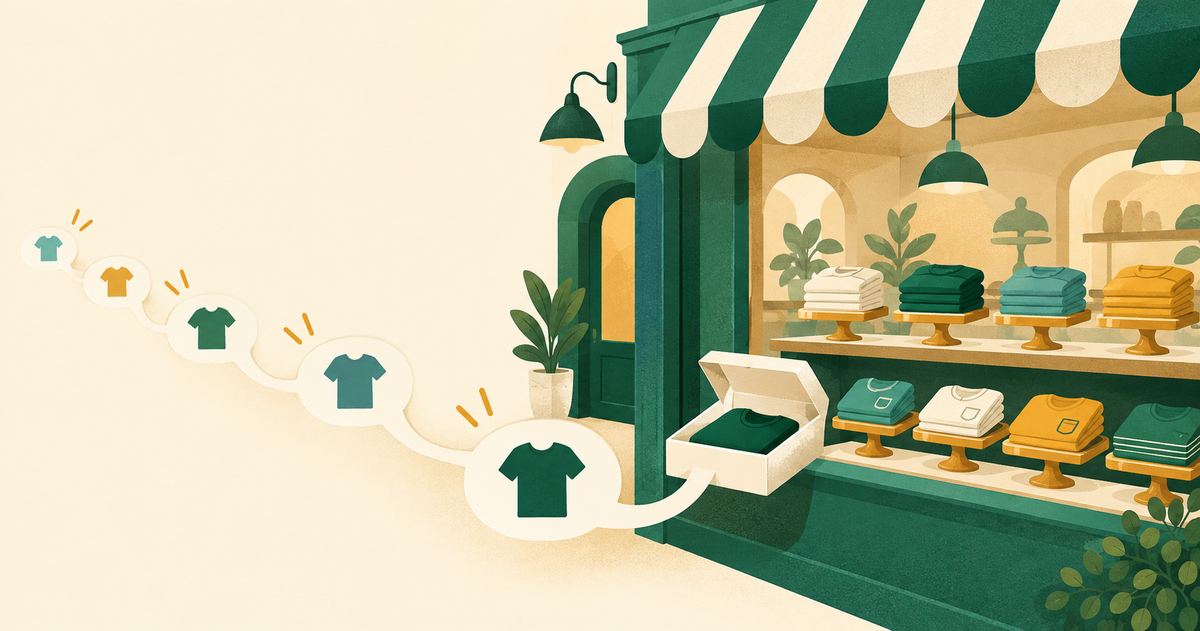
Johnny Cupcakes sells T-shirts, not cake. Founder Johnny Earle made that mismatch the product's distribution system: bakery cases held folded shirts, staff packed orders in pastry boxes, and vanilla scent made visitors look twice. More than 400 people reportedly came to the opening of its Newbury Street store, which generated over three months of rent in one day. The tactic is not "make a quirky shop." It is to spend a bounded acquisition budget on a physical detail customers can explain in one sentence, photograph without instruction, and connect to the product.
The shop gave an ordinary category a story
Earle started putting the nickname Johnny Cupcakes on shirts while working at Newbury Comics and playing in a band. He sold early pieces from his car. The category was crowded, and the product did not have a patented technical advantage.
His company history says he and his father turned the first shop into an old-fashioned bakery. Shirts sat in industrial refrigerators and on baking racks. Purchases went into pastry boxes. Earle says he directed advertising money into product, packaging, events, and retail details so customers would carry the story through word of mouth.
The theme worked because it was legible. A visitor could tell a friend, "I found a T-shirt shop that looks and smells like a bakery." The sentence contains category, surprise, and image.
The expensive store had a measurable opening
Inc. reported that Earle moved in 2005 from a location costing about US$700 a month to Newbury Street rent above US$7,000. He spent heavily on the experience rather than cheap fixtures. More than 400 people came for opening day, and Earle said sales exceeded three months of rent. The business reportedly reached US$1 million in annual revenue about two years later.
These are founder-reported figures and revenue, not profit. The rent comparison still provides a useful gate. Three months of rent above US$7,000 implies opening-day sales above US$21,000. That did not repay construction, inventory, payroll, or all occupancy costs, but it showed concentrated demand.
A founder should calculate the experience as acquisition capital:
Allowable experience spend = expected new customers x first-order contribution + expected repeat contribution.
Assume a US$12,000 installation attracts 800 incremental visitors, 25 percent buy, first-order contribution is US$28, and 30 percent of buyers return once at the same contribution. Expected contribution is US$7,280:
800 x 25% x US$28 + 800 x 25% x 30% x US$28 = US$7,280.
On direct sales alone, the installation fails. It needs lower cost, more traffic, better conversion, repeat purchases, or measurable earned reach. "People will talk" is not the missing US$4,720.
Design for retelling, not decoration
A distinctive space needs four jobs:
- Orient: make clear what is actually sold.
- Demonstrate: let fixtures improve browsing or product understanding.
- Trigger: create one detail worth photographing or retelling.
- Close: make purchase and fulfillment easy despite the theater.
Johnny Cupcakes' pastry box did all four after purchase. It protected the shirt, extended the joke, made the package recognizable, and gave the buyer a prop for the story.
At an MIT Sloan talk covered by MIT News, Earle described oven-mitt tags, surprise items in online orders, bakery displays, and oven doors that emitted steam. The article said more than 400 customers attended the store opening with little conventional advertising. Every detail repeated the same premise rather than adding unrelated novelty.
Use an experience scorecard
| Test | Question | Minimum evidence |
|---|---|---|
| Clarity | Do visitors know what is for sale? | 8 of 10 explain it correctly |
| Retelling | Can they describe the surprise later? | One repeated sentence |
| Conversion | Does it help purchase? | Tracked lift against ordinary fixture |
| Durability | Can staff reset and maintain it? | Written daily routine |
| Economics | Does contribution repay it? | Payback inside its useful life |
The thresholds are illustrative. The discipline matters. A photogenic feature that confuses customers or slows checkout is media, not retail infrastructure.
Test the idea without signing a premium lease
Earle's company says it has operated more than 400 pop-ups in settings ranging from galleries and universities to actual bakeries. A founder can use a weekend pop-up to test a retail premise before permanent construction.
Within an hour, write one-sentence answers:
- What ordinary category do we sell?
- What surprising environment makes its promise easier to remember?
- Which one prop improves both operation and story?
- What behavior will prove the experience worked?
- What is the maximum spend if no press arrives?
Then build only the most visible reversible element. Track passersby, entries, purchasers, average contribution, photographs with permission where applicable, referral codes, and repeat orders. Do not count social reach twice when it comes from the same customer.
Give every prop an operating owner
Retail theater decays quickly when nobody owns the reset. Steam stops working, surprise inserts run out, display stock becomes dusty, and staff improvise explanations. The result is worse than a plain store because the broken promise becomes the memorable detail.
Add each experience element to the opening and closing checklist. Record who tests it, how long the reset takes, what consumables it needs, and what happens when it fails during a busy period. A prop that needs 20 minutes of specialist attention every morning has a labor cost even if it was inexpensive to build.
Use a contribution payback, not an impressions estimate. Suppose a reversible pop-up feature costs US$2,400, including fabrication and staff reset time. If it produces 120 additional purchases with US$18 contribution each, it returns US$2,160 and has not yet paid back. Referral orders can count only when a code or customer question connects them to the experience. Press coverage is upside, not the base case.
This arithmetic protects the creative idea. When the most distinctive element also improves navigation, packaging, product demonstration, or checkout, it can earn its place without a viral post. The best retail media still works on an ordinary Tuesday.
Ask staff one more question after the test: which detail did customers mention without prompting? Unprompted repetition is stronger than a survey response written to please the owner. Keep the element that customers can name, staff can maintain, and contribution can support. Remove the feature that produces photographs but blocks the aisle, slows checkout, or requires a long explanation.
The restaurant seeding in Ghia's category-building story borrowed another venue to teach a drinking ritual. Johnny Cupcakes turned its own venue into the explanation. Nightingale's retail staircase supplies another live comparison: a physical channel should earn the next, larger commitment. The current Cotopaxi launch-event draft is a near-match and is therefore not used as a public internal link.
The bakery theme was effective because it was not a campaign pasted onto the store. It shaped fixtures, packaging, events, and language. If a customer can carry one coherent detail out the door, the shop has done part of the advertising. If the detail cannot repay itself without being called "brand," it is just expensive scenery.
Discussion
Sign in with Google or just a name. No email link, no password to remember.