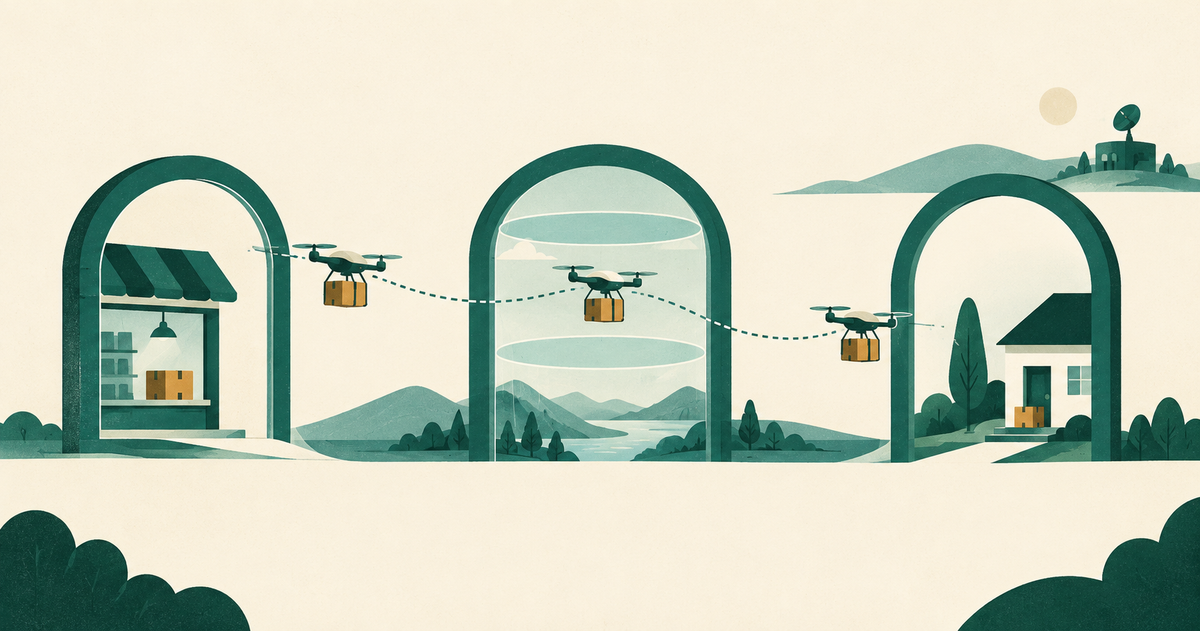
Zipline's product is not just a drone. It is an approved delivery operation attached to a retailer, staffed by remote operators, integrated with store picking, and bounded by payload, range, weather, landing space, and aviation rules. In March 2026, the FAA approved an increase at Zipline's Pea Ridge operation from 100 to 400 operations per day and allowed 24-hour service. That change illustrates where emerging hardware becomes a business: regulatory capacity and site throughput must expand with aircraft capability. Founders commercializing regulated machines should map the complete service unit, then sell one measurable job that is valuable inside the present operating envelope.
Approval is part of production capacity
A factory can build more aircraft without creating permission to fly them commercially. In the United States, package-delivery operators use an air-carrier framework and need authority for operations beyond visual line of sight. The approval specifies where and how the service can run.
The FAA's public environmental-review record shows how capacity at Pea Ridge changed in stages. An original decision covered 20 daily operations. A later change allowed 100, holidays, and longer hours. The March 24, 2026 decision supported up to 400 operations per day and 24-hour operation. A May 2025 review also addressed use of Zipline's P2 aircraft.
This is not a general license for unlimited flights everywhere. It is a site-specific expansion inside an operating specification. For a founder, the commercial forecast must use approved throughput, not theoretical aircraft throughput.
The unit sold is a completed delivery
Zipline says it designs, manufactures, and operates its autonomous delivery system. Its company figures report more than 2.5 million deliveries and 135 million autonomous commercial miles since 2016. Those are self-reported operating totals, not an independent audit, but the business model is clear: customers buy delivery performance, not an aircraft in a box.
That means unit economics should be calculated per successful delivery. Include store labor to pick and load, vehicle depreciation, maintenance, batteries and electricity, site equipment, remote supervision, communications, insurance, compliance, failed missions, and customer support.
Illustrative daily arithmetic for one site: 160 completed deliveries at $7 of gross service revenue produce $1,120. Direct daily site and flight costs of $720 leave $400 contribution before corporate engineering and overhead. At 80 deliveries with the same fixed site cost, contribution can disappear. Utilization is therefore a product requirement, not just a sales goal.
Site contribution per day = completed deliveries x net revenue per delivery minus variable flight cost minus daily site cost.
Retail integration determines utilization
Walmart reported more than 150,000 drone deliveries across its program since 2021 and described frequent orders such as fruit, eggs, ice cream, pet food, baby formula, and cold medicine. It also noted Zipline's first P2 Walmart sites in Mesquite and Waxahachie, Texas. The broader announcement primarily concerned expansion with Wing, so its totals should not be attributed to Zipline alone.
The order examples reveal the job. Drone delivery is strongest when a small, time-sensitive basket is worth moving separately. It is weaker for a weekly cart that exceeds payload or can wait for a route carrying many orders. The retailer must expose eligible inventory, pick quickly, package within weight and shape limits, and transfer it to the aircraft without losing the time advantage.
| Constraint | Commercial question | Metric |
|---|---|---|
| Payload | How many requested baskets qualify? | Eligible-order share |
| Service radius | How many customers are reachable? | Address coverage |
| Store handoff | Can picking keep up? | Order-ready minutes |
| Weather and airspace | How often is service available? | Dispatch availability |
| Demand density | Can fixed site cost be spread? | Completed flights per site-day |
Choose the first job by urgency and fit
Zipline began commercial operations with medical delivery in Rwanda before US home retail. Critical medical items have high urgency, low payload, and costly delays. That is a better early fit than competing with a van on every grocery basket.
Emerging-technology founders should score candidate jobs from one to five on urgency, payload fit, route repeatability, customer concentration, approval complexity, and value of time saved. Start where value is high and variability is low. A machine does not need the largest market first. It needs a narrow market that pays for the current limitations.
This decision rule resembles the threshold approach in Opulo's small-batch manufacturing case. The right customer is determined by the stage where the hardware's strengths outweigh the surrounding process cost.
A one-hour commercialization map
- Draw the service from customer order to confirmed completion.
- Mark every step owned by the customer, regulator, partner, and your company.
- Write the current hard limit beside payload, range, hours, approvals, and site throughput.
- Calculate contribution at 25, 50, and 80 percent of approved daily capacity.
- Choose one job whose urgency supports the price at the 50 percent case.
Do not put future regulatory changes or an unbuilt aircraft into the base case. Model them separately as upside. The supplier dependency method in MNT Reform's map can extend the diagram to aircraft and dock components. The first-customer framework in Where First Customers Actually Come From can identify concentrated institutional buyers before a broad consumer launch.
Zipline's scale claims attract attention, but the founder lesson sits in the operating specification. A better aircraft matters only when approval, store labor, demand density, and site economics let it complete more valuable deliveries. Commercialization happens when the whole system works often enough, safely enough, and cheaply enough that a customer renews the service.
Record cancellations as carefully as completed flights. Separate weather, airspace, aircraft, store preparation, customer-site obstruction, and demand. The largest category identifies the next capacity investment. Without that classification, an engineering team may improve range while store handoff remains the real bottleneck.
Sell reliability as a distribution, not an average
An average 15-minute delivery can hide a service that is unavailable during the conditions customers care about most. Report the share completed within the promise, the share rejected before dispatch, and the tail of slow outcomes. Segment by hour, weather, store, payload, and customer-site type. A retailer needs to know how often the option can actually be offered.
Create a fallback for every accepted order. If the aircraft cannot launch after the store has picked the basket, decide whether a ground courier takes it, the order is cancelled, or the customer chooses. Price that fallback into the service. Otherwise rare aviation interruptions become expensive manual exceptions and undermine confidence in the whole channel.
For an early institutional customer, write a service-level agreement around outcomes the current approval supports. Avoid promising a future range, payload, or operating hour. A narrow promise met consistently is stronger commercial evidence than a broad demonstration. Expansion should follow measured demand density and regulatory capacity, because empty approved flights and unapproved customer demand both fail to pay for the site.
The aircraft can make the flight; the surrounding system makes the flight dependable enough to become a business.
Discussion
Sign in with Google or just a name. No email link, no password to remember.