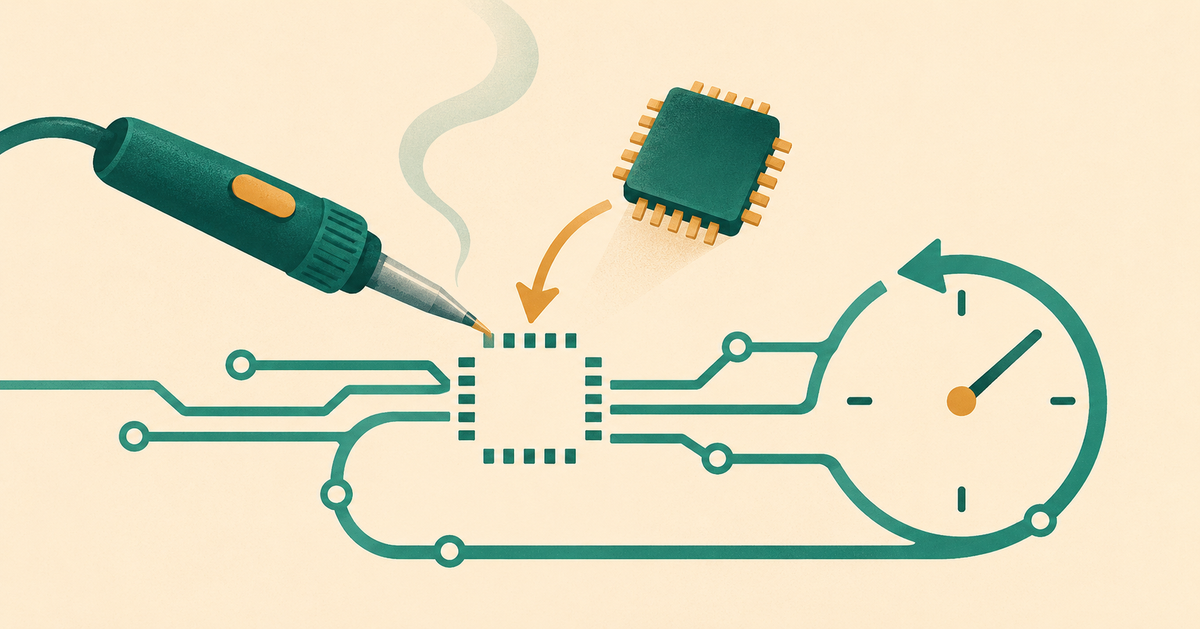
Solder Ninja Pen is a compact 45 W USB-powered soldering iron designed by Nicolas Schurando and assembled in France by Sitron Labs. Schurando's project log records a painful reversal: the design looked ready for production, then its microcontroller and power components became unobtainable. A substitute part did not simply restore the old schedule. It restarted design, firmware and validation work.
The replacement part inherits every dependency
In August 2023, Schurando wrote that the STM32F0 at the heart of the product had become almost impossible for a small buyer to source. He found newer STM32 parts, then ran into unavailable DC-DC converters. Eventually the RP2040, announced by Raspberry Pi in 2021, became the basis of a redesign.
The finished manual shows what emerged from that work: 5 V to 20 V USB-C input, 7.5 W to 45 W draw, a claimed five-second heat-up at 45 W, replaceable Weller RT Micro-compatible tips, fall detection and a machined aluminum body. Those are current manufacturer specifications, not measurements made for this article.
The log also exposes a second tension. Choices that make a polished manufactured product can make one-off reproduction expensive. Schurando estimated that machining a single enclosure could cost roughly ten times a printed alternative, and the PCB needed an unusual depth-milling operation. Publishing files does not make every production choice accessible at prototype quantities.
These records mix company statements, founder recollections and independent reporting. Company numbers are attributed rather than presented as audited results. The mechanism is useful because it identifies a decision to test, not because one visible company guarantees another's outcome.
Put engineering hours beside the cheaper chip
Consider an invented run of 500 tools. A replacement controller saves US$1.20 per unit, or US$600. Assume schematic and layout changes take 24 hours, firmware work 40 hours, and validation 24 hours. At an illustrative US$70 per engineering hour, the redesign costs US$6,160 before new prototypes. The unit saving needs 5,134 units to recover that labor alone. If the replacement instead prevents a six-month stockout, avoided delay may justify it, but that is a different calculation.
This arithmetic is illustrative. Its invented inputs are not the subject company's costs, margins or forecast. Replace every input with a dated quote, invoice or observed time before using the result for a commitment.
A decision rule worth carrying forward
For every proposed substitute, list five owners: electrical, mechanical, firmware, sourcing and acceptance. A part is not approved until each affected owner has either repeated the relevant check or documented why it is unchanged.
The rule forces attention onto the denominator behind the attractive headline. Orders are not accepted deliveries. A technical specification is not a validated workflow. Enterprise value is not founder proceeds. Traffic is not contribution. Naming the conversion between those states is the beginning of useful operating evidence.
Build an evidence ladder before scaling
Start with the weakest evidence and refuse to give it a stronger name. A comment, waiting-list entry or sample request shows attention. A deposit or paid order shows willingness to buy under stated terms. An accepted delivery shows that the operation fulfilled the promise. A reorder, referral or renewed contract shows that value lasted beyond novelty. For Solder Ninja Pen and how component shortages turn a finished prototype back into an engineering project, those stages should be recorded separately because each one authorizes a different size of commitment.
Next, attach time to every observation. A strong launch week can hide a slow replenishment cycle, seasonal use or a queue created by publicity. Record the date of purchase, date cash becomes available, date production begins, date the customer accepts the result and date any return or support cost appears. A contribution estimate assembled from events in different months can look healthy while the bank balance is under strain.
Then give variance the same attention as the average. One fast machine, cooperative bakery, cheap parcel or enthusiastic interview does not describe a repeatable system. Keep the best, median and worst observed case. Investigate the worst before buying capacity for the average. If the downside is a safety failure, unusable batch or loss of an essential customer, an average result is the wrong decision tool.
Finally, write who owns every handoff. The supplier may finish a component while the founder still owns inspection. A carrier may deliver the box while the business still owns setup. A retailer may place an order while the manufacturer still owns sell-through risk through markdowns or returns. A buyer may acquire the company while the founder remains exposed through deferred consideration. Ownership of the next action is part of the cost.
This ladder prevents a common analytical shortcut: using one vivid public milestone to fill several private cells. It is acceptable for cells to remain blank. In fact, a blank can be the most decision-useful result because it identifies the next small test. The goal is not to make the story look complete. It is to stop the next commitment from depending on an unsupported conversion.
Keep the first version deliberately small. One batch, one customer segment, one configuration or one channel makes a failure interpretable. Changing product, price, audience and fulfillment at the same time may produce a better headline, but it destroys the comparison. Record the baseline before intervention, change one important variable, and choose the review date in advance. If the result misses the threshold, shrink or stop the commitment without rewriting the threshold afterward. A disciplined no is useful evidence and preserves cash for a better test.
Run the one-hour version
Open the bill of materials for one revenue-critical product. Circle every sole-sourced active component and record available stock, approved alternates and the last date a real unit passed its acceptance test. Start with the item whose remaining stock covers the fewest production weeks.
- Write the next irreversible commitment.
- Choose one observed denominator connected to cash or accepted output.
- Separate company claims, independent evidence and your assumptions.
- Set the result that would shrink or stop the commitment.
- Keep the record and compare the forecast with the eventual outcome.
Two adjacent Builtplain cases offer useful contrast: PocketBeagle configuration record and Keyboardio quality gate. They use different products but apply the same discipline of counting the work around the visible milestone.
What the public record cannot answer
Public sources do not reveal complete private margins, cohort retention, contracts, ownership waterfalls or defect ledgers. No inference here fills those gaps. Survivorship bias also applies: visible companies leave better records than similar attempts that failed. Use the case to design a smaller test, not to claim a guaranteed result.
Sources checked on November 17, 2026
- Creator project logs documenting the STM32 shortage, redesign around RP2040 and open-hardware tradeoffs
- Official September 2025 user manual with power, heat-up, safety and assembly facts
- Current official product specifications, RP2040 confirmation, documentation and firmware links
A component shortage does not care how finished a prototype feels. The honest schedule begins again at the first dependency the new part changes.
Discussion
Sign in with Google or just a name. No email link, no password to remember.