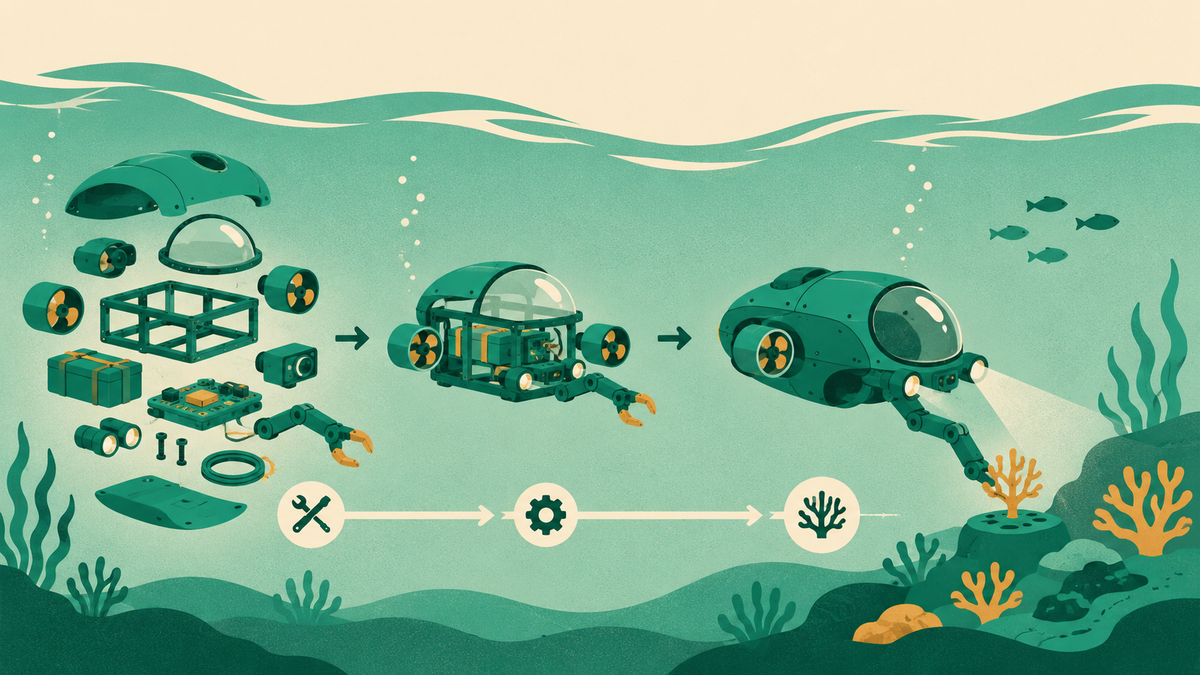
OpenROV began with open plans and kits for small underwater robots, then developed Trident, a ready-to-use underwater drone. Both could put a camera below the surface, but they served different customers. A kit buyer accepts assembly and improvisation. A finished-product buyer transfers that work to the manufacturer and expects support when salt water, motors, cables and software meet.
Hardware founders should decide which customer they are qualifying. Community enthusiasm for an open prototype is valuable evidence, but it is not the same as demand for a sealed, supported appliance.
The kit made learning visible
OpenROV's early machines let explorers assemble remotely operated vehicles from available components and shared designs. A TED Fellows program guide described four years of designing and piloting before Trident. The project later used Kickstarter for both kits and the finished vehicle, as summarized in the source-linked company history.
The original Trident campaign records the finished-product promise, while the OpenROV software repository preserves primary evidence of the earlier open platform. Neither source proves present support or availability.
Community discussions about maintaining motors and rebuilding older units are topic signals, not defect-rate evidence. They reveal the ownership jobs around underwater hardware: rinsing after salt exposure, diagnosing a stalled propeller, protecting a tether and finding replacement components.
The open kit exposes those jobs by design. The builder sees the electronics and mechanical compromises. A finished enclosure hides them, which improves accessibility while increasing the maker's obligation to document maintenance and provide a repair path.
Do not average two different buyers
| Dimension | Kit buyer | Finished-product buyer |
|---|---|---|
| Primary value | Learning and modification | Reliable underwater observation |
| Assembly | Part of the experience | Expected to be complete |
| Failure response | Diagnose with community and docs | Contact manufacturer or service |
| Variation | Often acceptable | Usually unwanted |
| Documentation | Build detail | Use, care and troubleshooting |
A founder can sell both, but should keep separate funnels, support records and success measures. A kit forum full of inventive builders may intimidate a customer who simply wants to inspect a boat hull. A polished product page may disappoint a builder who expected accessible internals.
Illustrative arithmetic: support moves into the price
Imagine a kit selling for $700 with $350 in parts and fulfillment and two hours of expected support at $30 per hour. Contribution before fixed costs is $290. Now imagine a finished unit at $1,500 with $720 hardware, $100 final assembly and test, $80 fulfillment, a 4 percent warranty reserve and three hours of expected support. Its pre-overhead contribution is $1,500 minus $720, $100, $80, $60 and $90, or $450.
The finished unit produces more dollars but a lower illustrative contribution percentage: 30 percent versus about 41 percent. These are not OpenROV figures. They show why removing customer labor does not automatically create a richer business. The manufacturer absorbs assembly variance, waterproofing checks and more expensive failures.
Add a batch-return scenario. If 5 percent of 500 finished units require a $140 round-trip and repair, the event costs $3,500 before staff time. A kit company may never have built that logistics muscle.
Water makes the handoff explicit
An underwater product needs a defined boundary between normal care and covered failure. Salt exposure, maximum depth, tether strain, charging and storage should be explained before the first dive. The quick-start sequence should include recovery and rinse, not stop when the camera turns on.
OpenROV eventually became part of Sofar Ocean, and Trident is no longer a current mass-market product. That outcome limits any claim that its transition produced a durable consumer line. It makes the support-tail question more useful. Owners can retain working hardware after the original product focus changes.
A founder should prepare an end-of-life folder while the product is alive: final firmware, compatible parts, diagnostic steps, safety boundaries, data export and the date through which paid or warranty service is promised. Open source can help, but a repository is not automatically a spare-parts network.
Use the kit as research without exploiting builders
Builders often reveal failure modes and desired features. Compensate that contribution with credit, early access, replacement parts or clearly stated community terms. Do not quietly convert volunteer troubleshooting into an unlimited commercial support desk.
Tag each lesson by source: internal test, builder report, repeated field report or verified returned unit. A forum post can start an investigation. It cannot establish prevalence. This is the same evidence discipline used in Blue Robotics' flooded-motor design story.
The one-hour product-boundary test
- Write the outcome the customer believes they bought.
- List every task still assigned to that customer.
- Circle tasks that can destroy the product or create a safety risk.
- Move one task into design, pre-shipment testing or clearer instruction.
- Price the support and warranty work that remains.
OpenROV's path does not mean every kit should become an appliance. Some products are better when building is the point. The decision turns on the customer's job. If the buyer wants to learn robotics, visible assembly is value. If the buyer needs images beneath a hull before the tide changes, assembly is delay.
The moment a founder sells completion, hidden work does not vanish. It crosses the counter and becomes the company's work.
Separate field maintenance from factory repair
Every failure should have a designated level. Field maintenance covers safe cleaning, inspection and replaceable consumables. Module service covers a documented swap. Factory repair covers pressure boundaries, sealed electronics or faults that require specialized tests.
Give each level a time and tool assumption. If a boat operator must mail the whole vehicle for a propeller module that can be safely replaced with two screws, downtime and shipping become design costs. If a pressure seal requires calibrated inspection, encouraging a casual field repair can create a larger failure.
Illustratively, a $90 replaceable module shipped overnight may be cheaper than a $45 component inside a $220 round-trip factory repair. The right choice depends on safety, failure diagnosis and inventory, not parts price alone.
Publish the maintenance boundary before a customer buys. That candor does not weaken the product. It tells the operator whether the tool fits the mission and gives the founder a support system that can survive beyond the launch.
Test documentation with a person who did not build the machine. Give them the packed unit and the written sequence, then observe without coaching until they complete a safe dry run, launch, recovery and post-use care. Record the first point of hesitation. The founder's familiarity is a poor proxy for customer readiness, especially when one skipped rinse or seal check may shorten product life. A finished product is complete only when its owner can finish the whole use cycle.
Repeat that observation after six weeks. First-use success does not prove that storage, charging and maintenance instructions survived. A returning owner reveals whether the routine became part of ownership or disappeared with the excitement of unboxing.
Keyboardio's quality-gate story shows how material and assembly variation must be resolved before finished hardware ships.
Discussion
Sign in with Google or just a name. No email link, no password to remember.