The constraint behind the story
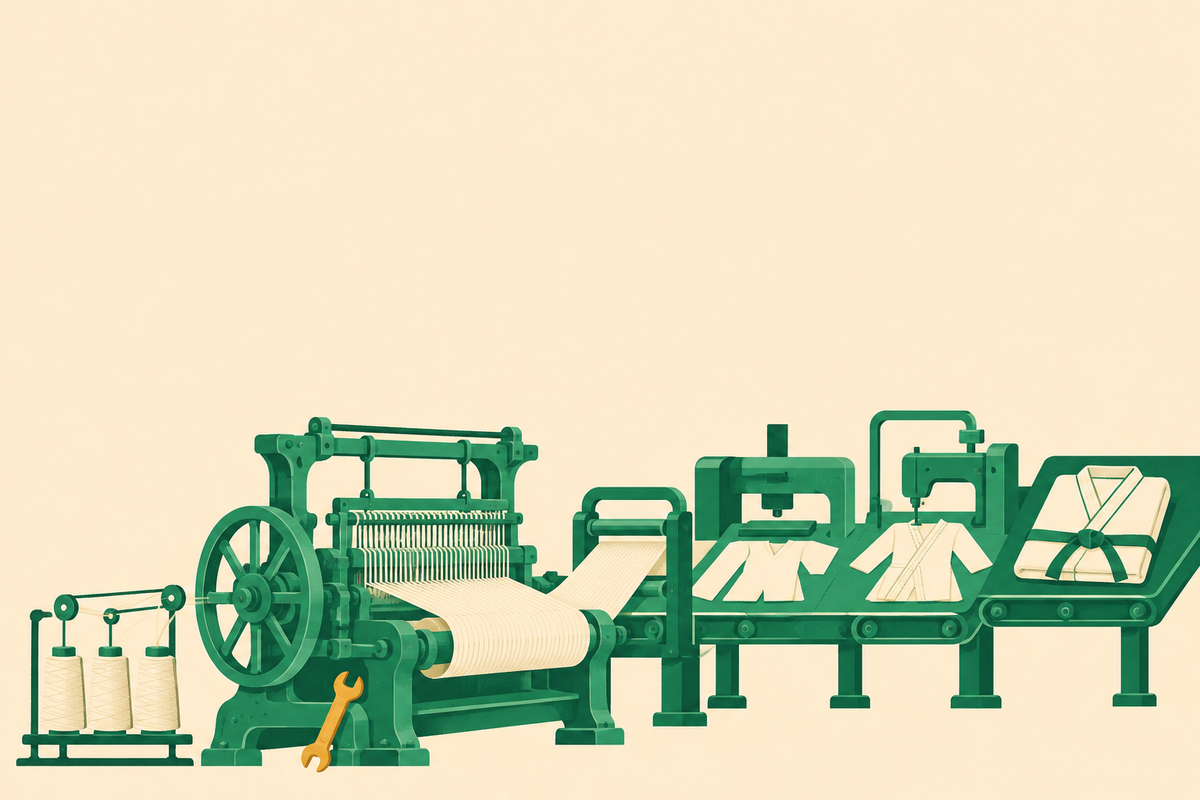
Origin makes apparel, boots and Brazilian jiu-jitsu uniforms in the United States. Founder Pete Roberts says a Pakistani supplier copied his uniform design and sold it to other brands. His response was unusually expensive: rebuild the production capability near Farmington, Maine, starting with reclaimed textile machinery and a timber-frame factory.
Origin dates its manufacturing mission to 2011. Its factory page says an 80-person jiu-jitsu plant produces 650 uniforms and more than 2,000 rash guards per week, while a 34-person boot plant makes 100 pairs per day. The Alliance for American Manufacturing reports that the company grew from Roberts and one employee to almost 400 employees and added a 170,000-square-foot apparel facility in North Carolina. These output and employment figures are company statements relayed by an industry group, not audited financials.
Put a number on the mechanism
Vertical integration can turn a supplier dependency into an owned capability, but it also converts variable purchase orders into fixed payroll, buildings, maintenance and training. Origin did more than buy machines. It had to recover process knowledge from old equipment and experienced makers, then pass it to new employees. The moat, if one forms, is the production system and workforce, not the patriotic label alone.
Illustrative break-even: an outsourced uniform costs $70 landed. An internal line has $350,000 in annual fixed cost and $45 variable cost per unit. The saving is $25 per unit, so break-even volume is 14,000 units a year. At 10,000 units, integration costs more. At 20,000, the model shows $150,000 of annual advantage before capital expenditure and mistakes. Replace every input with a quote before deciding.
A decision rule, not a slogan
Integrate the dependency that is both strategically dangerous and economically repeatable. Score each component on annual spend, defect cost, lead-time variance, intellectual-property exposure and learning value. Start with one process where volume can keep equipment busy. Owning an idle factory is not resilience.
The transferable question is not whether to copy the visible tactic. It is whether the same constraint exists in your business. A mechanism that removes inventory risk, protects control or lowers freight can be valuable even when the brand story is completely different. Start with the constraint, name the unit and preserve a record that can prove what changed.
A useful dashboard separates leading evidence from outcomes. Leading evidence includes cycle time, inquiries, defects, queued orders and cash committed. Outcomes include contribution margin, repeat purchases, inventory age and cash returned. A public milestone can look impressive while the outcome deteriorates. Record both on the same weekly page.
A second worksheet should follow the cash rather than the publicity. Mark when money leaves, when the product or obligation is ready, when the customer pays and when a return could reverse that payment. Add the people-hours that do not appear on a supplier invoice. This timeline often reveals that a profitable-looking unit still needs financing because cash is committed long before it comes back.
What the case cannot prove
There is also a survivorship problem. This company is visible because the choice became part of a durable story. Similar businesses may have tried the same move and failed because their demand, timing or balance sheet differed. Treat the case as a source of variables, not a guaranteed recipe. A pilot should be small enough that a negative result buys information instead of threatening payroll.
Set a stop rule before excitement arrives. Decide the maximum cash, calendar time and operational errors the test may consume. State what result earns another batch and what result ends the experiment. This prevents a founder from turning sunk cost into strategy. It also gives suppliers and employees a clearer promise than open-ended optimism.
The numbers in this case belong to their stated periods and sources. They are not a current valuation, audited margin or forecast. The calculation here is illustrative and deliberately exposes its assumptions. Replace every assumption with your own quote, wage, defect rate and selling price before committing capital.
The evidence base for this case includes the primary account supporting report additional source. They agree on the central mechanism, while promotional sources are treated as attributed company claims. No anonymous comment is used to verify a material number.
Next, identify the capacity that cannot be purchased quickly. It might be an experienced operator, a certified component, a trusted community partner, a retail slot or a trustee willing to challenge management. Give that constraint an owner and an early warning measure. Revenue is a lagging signal when the scarce input takes months to replace.
Customer evidence also needs a hierarchy. A compliment is weaker than an email address, a deposit is weaker than a completed full-price order, and a first order is weaker than a repeat after the customer has lived with the product. Record evidence at the strongest level actually reached. Do not promote interest into demand merely because production planning needs a confident number.
Review the pilot on a fixed date with someone who did not design it. Give that person the original assumptions, actual invoices, defects, delays and customer evidence. Ask which result would change the decision. This small challenge guards against moving the goalposts after money has been spent. It also creates a record that a future employee, lender or supplier can understand without relying on the founder's memory.
Keep the resulting worksheet with the purchase order or board record. A decision log is cheap institutional memory, especially when the original constraint disappears and later teams wonder why the operating rule exists.
A one-hour first move
Within an hour, build a supplier-risk table for the five components that most often delay or differentiate your product. Add annual units and current landed cost. Circle only the component with high risk and enough repeat volume to support a pilot cell. Origin's story is not an instruction to rebuild an industry at once. It is evidence that capability returns through a sequence of machines, people and orders.
The first move is intentionally modest: make the constraint visible on one sheet, obtain one real quote and run one bounded test. That can be completed without a rebrand, a large equipment order or a financing announcement. Good operating choices usually become clearer when the unit of work is small enough to count.
Finally, write the counterfactual. Describe what the business would do if it did not choose this mechanism. Outsourcing, a smaller catalogue, a conventional promotion, a strategic sale or ordinary virgin material may be less distinctive and still be economically stronger. A decision becomes defensible only when its costs are compared with a plausible alternative, not with doing nothing.
Readers comparing physical-product paths may also use Builtplain's pieces on shared chip manufacturing, crowdfunding demand that became factory risk and repeat crowdfunding without outside investors. Each shows a different point where demand, production and ownership meet.
Discussion
Sign in with Google or just a name. No email link, no password to remember.