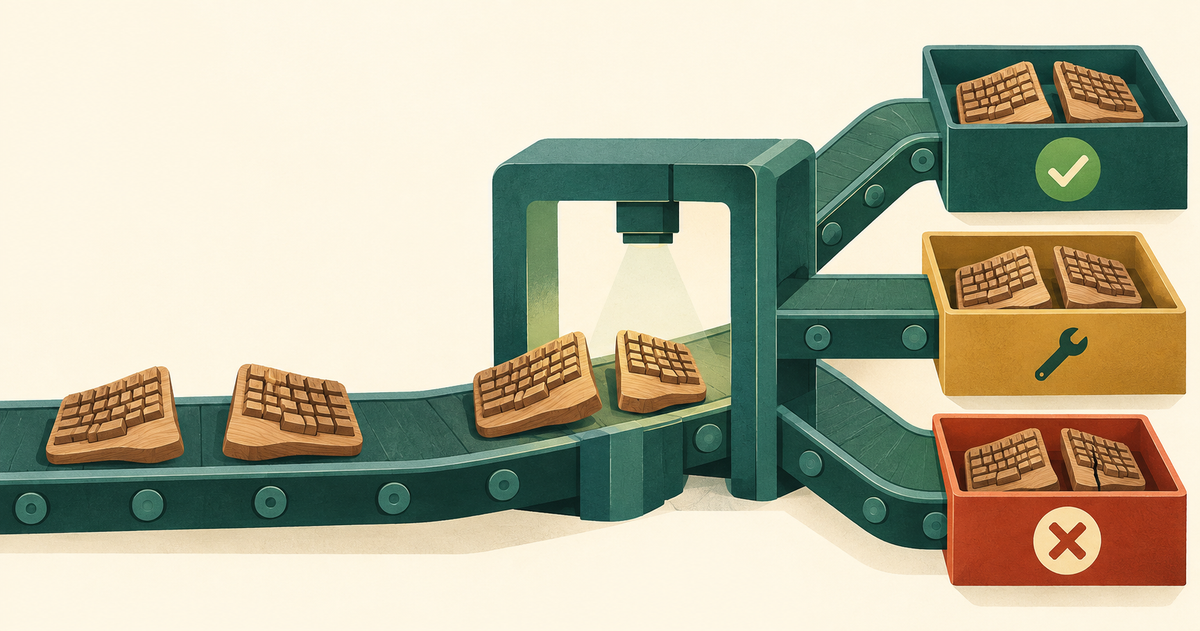
Keyboardio's Model 01 was an ergonomic keyboard with a distinctive maple enclosure. That enclosure made the product memorable, but it also became the schedule's least predictable part. During the first mass-production run, suppliers delivered wood with discoloration, cracks, misplaced inserts, over-milling, and fit problems. Cofounders Jesse Vincent and Kaia Dekker responded by splitting production, adding suppliers, documenting acceptable defects, and paying for deeper inspection. The transferable lesson is not to avoid natural materials. It is to make their variability a measurable production input before the ship date depends on it.
A finished design still contained an unfrozen material
The Model 01 paired custom electronics and an unusual split layout with two sculpted wooden shells. Injection-molded plastic can vary, but wood adds color, grain, moisture, warping, knots, and finish behavior. A drawing can specify dimensions. It cannot make every board visually identical.
In a detailed production update, Keyboardio said the factory had assembled the first 1,000 units and placed them into a 72-hour burn-in test. It had split Kickstarter manufacturing into two batches of 1,000 because the wood supplier was behind. Inspectors found spots, cracks, incorrectly installed brass inserts, and hundreds of over-milled pieces that left a gap between the baseplate and enclosure.
The team chose a 100 percent check for at least the first several hundred units rather than relying immediately on sample inspection. That cost more, but early units were teaching the company what its defect categories actually looked like.
The defect rate moved too much for averages to be safe
A later Keyboardio update described one delivery in which the first checked pieces appeared to have a 10 percent defect rate, while samples from another portion suggested 30 percent. Earlier deliveries had produced reported defect rates between 40 and 80 percent.
That spread is more important than any single percentage. A purchase order for 1,000 shells does not mean 1,000 shippable keyboards. At a 10 percent rejection rate, 1,000 shells yield 900. At 30 percent, they yield 700. If 950 customer orders are waiting, both deliveries are late even though the supplier technically delivered the ordered quantity.
Use yield, not purchase quantity, in the schedule:
Required input = required good units / expected yield.
For 1,000 good enclosures at 85 percent expected yield, the illustrative input requirement is 1,177 units. Add a confidence range. If yield could fall to 70 percent, the requirement becomes 1,429. The gap between those numbers is working capital and lead-time risk.
Aesthetic defects need a boundary sample
Keyboardio wrote that it showed the factory examples of unacceptable tooling marks, visible filler, and discoloration. That converts taste into evidence. Without physical or photographic boundary samples, a supplier and founder can both say "good wood" while imagining different products.
Create three reference sets:
- Accept: natural variation the customer should expect.
- Rework: a correctable finish, fit, or assembly problem.
- Reject: cracks, unsafe inserts, structural warping, or appearance outside the sold promise.
For every category, add a viewing distance, lighting condition, measurement tool, and responsible decision-maker. An enclosure that rocks on a glass plate is testable. "Looks premium" is not.
Sampling changes as the process earns trust
By January 2018, the company reported that two new wood suppliers had each delivered 1,000 enclosures. One supplier's first 500 needed added clearance around the USB port. A third-party agent sampled 80 completed keyboards, and the company ordered rework when the old supplier's enclosure defects crossed its threshold. It also sent Vincent to Shenzhen as the next run approached the Chinese New Year shutdown.
This suggests a practical inspection ladder:
- Inspect all units from a new supplier or changed process.
- Record defect type by lot, not only total rejects.
- Reduce to random sampling only after several stable lots.
- Return to full inspection when tooling, material, staff, or factory changes.
- Put a founder or trained inspector on site when a calendar shutdown removes the chance to rework later.
A small company does not need to invent a statistical quality system alone. A qualified inspector can set an acceptable quality limit and sample size. The founder still has to define which defects are critical, major, and minor.
Calculate the cheaper failure
Assume full inspection costs US$2.50 per unit for a 1,000-unit run, or US$2,500. Suppose skipping it allows 60 defective products to ship. If replacement hardware, two-way freight, handling, and support average US$85 per case, direct failure cost is US$5,100.
60 x US$85 = US$5,100.
Under those illustrative inputs, full inspection saves US$2,600 before counting reviews, chargebacks, and lost time. But if stable production reduces escapes to five units, inspection costs more than the direct failures. That is why inspection depth should follow process evidence, not habit.
Put rework inside the purchase order
Inspection discovers a problem; a purchase agreement decides who absorbs it. Before production, define the acceptance sample, measurement method, defect classes, rework location, freight responsibility, and date by which corrected goods must be ready. A vague promise of "high quality" leaves the most expensive decisions until the schedule is already broken.
For a natural material, attach photographs of acceptable variation and physical limit samples where possible. Record dimensions at agreed humidity and temperature. If appearance is judged under a specific light, state it. The goal is not to eliminate judgment. It is to make the factory's judgment resemble the customer's before thousands of parts exist.
Track the cost of quality in four buckets: prevention, inspection, factory rework, and customer failure. Prevention includes better fixtures and drying controls. Inspection includes third-party checks. Rework includes sanding, refinishing, sorting, and delay. Customer failure includes replacement, freight, support, and refunds. A team that measures only the inspection invoice may cut the cheapest visible line and increase the other three.
Close every lot with a short supplier review. Which defect dominated? Did its frequency fall after correction? Did the definition itself change? A stable supplier should earn lighter sampling. A new process, new material batch, or new subcontractor should reset that confidence.
The compliance gate in the GameTank case protects a product from an invisible technical failure. Keyboardio's gate handles the opposite problem: visible variation that electronics tests cannot catch. Both must sit before fulfillment.
A one-hour natural-material risk review
- Circle every part whose appearance or dimensions change with grain, moisture, temperature, firing, dye, or hand finishing.
- Write the promised customer standard in observable terms.
- Ask for yield by lot from the supplier, not a general quality claim.
- Price full inspection for the first run and one rework cycle.
- Calculate required input at expected yield and at a pessimistic yield.
- Identify the last date a rejected lot can be replaced without missing the public promise.
U-Turn Audio simplified before tooling. Keyboardio shows what comes after: a differentiated material can remain the bottleneck even when the electronic product works.
The maple enclosure was not decoration added after engineering. It was a component with its own yield curve, supplier network, inspection language, and schedule. A founder who sells natural variation should still industrialize the boundary between character and defect.
Discussion
Sign in with Google or just a name. No email link, no password to remember.