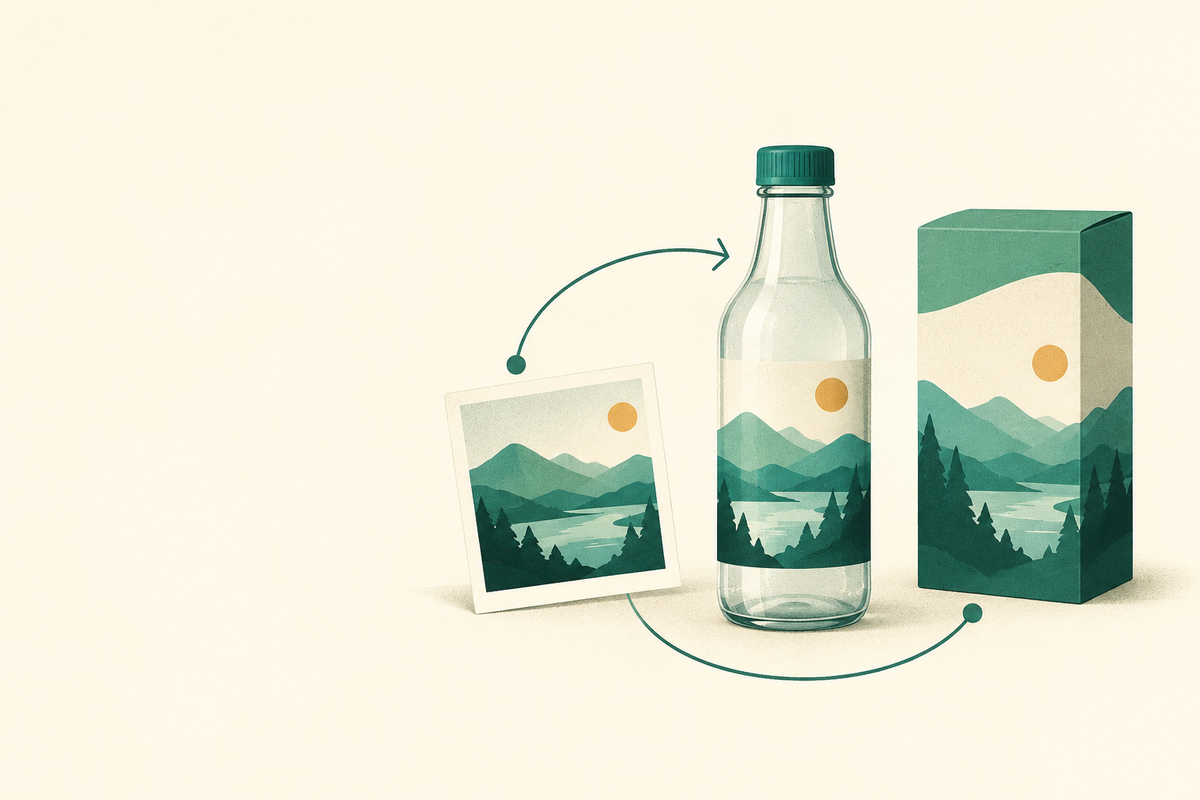
Jones Soda sells soft drinks with consumer photographs on its bottles. Turning a customer's image into physical packaging gives that person a concrete reason to notice, remember and show the product.
For another small product brand, the useful mechanism is participation with a visible outcome. It also creates work: selecting images, obtaining the required information, preparing packaging and helping contributors find the result. A submission form is only the beginning of a repeatable customer-photo program.
The bottle became a place to participate
A 2014 company announcement carried by BevNET said Jones had used consumer photos on labels since 1996. It described an eighteenth-anniversary event showing photographs in a Seattle gallery. That is a documented historical activity, not a measured return on the label strategy.
The mechanism has an advantage over an invisible contribution. A customer can point to an object in the world and say that their photograph appears on it. The object is already moving through a product distribution channel, so participation and packaging can share the same surface.
That does not mean every photograph sells another bottle. Someone might enjoy submitting a picture without buying again. A selected contributor might show the bottle to friends who never become customers. The commercial effect needs measuring separately from the appeal of the idea.
Jones' current photo submission form, checked October 6, 2026, asks for contributor details, the image and information about the photographer. It includes content and, where applicable, model-release steps. Submission is not a guarantee of selection.
The company's privacy policy dated January 19, 2024 also describes information associated with photograph submissions and gallery interaction. These pages demonstrate that participation involves handling people and permissions, not just downloading appealing pictures.
The contributor needs a finished experience
A small brand considering the tactic should begin with a question: what happens after a customer submits something? If the answer is “we might use it someday,” the invitation creates a promise with no defined finish.
Define a complete route from contribution to recognition. The customer submits. The brand checks eligibility and the required permissions. Someone selects and prepares the material. A production run uses it. The contributor receives a useful notification and a way to locate or receive the finished object.
Each handoff has a failure mode. The file may be unsuitable for printing. The selected image may reach a packaging supplier after the cutoff. The contributor may receive an email saying they were chosen but never find the bottle. A long-lived page may disappear while the customer still remembers the moment.
Public collector discussions make the last problem visible. A collector's Reddit question asked about viewing older label photographs. That is a signal of a reader need, not proof of how Jones currently manages its archive. The practical question for a new program is how a participant will find their contribution later.
Do not promise permanent public hosting casually. A durable internal record and a clear contributor notification may be more achievable than an elaborate gallery whose maintenance has no owner.
Price the work before calling the content free
Imagine a fictional beverage company receiving 100 submissions for a limited packaging run. If reviewing each takes three minutes, screening alone takes five hours. At an assumed $25 an hour, that is $125 of work.
Suppose selecting, checking and preparing ten usable images takes another 45 minutes each. That adds 7.5 hours, or $187.50. Add an assumed $100 in packaging setup charges and $80 to ship finished samples to contributors. The program costs $492.50 before other overhead or additional production costs.
These are illustrative US-dollar inputs, not Jones' costs. They deliberately value the contributor's supplied image at zero to show that even donated content can require paid operating work.
If an additional order earns $10 of contribution after product and ordinary fulfillment costs, 50 incremental orders would cover $500 and therefore clear the modeled $492.50 cost. Forty-nine would provide only $490. Gross revenue cannot substitute for contribution in that calculation.
There may be other benefits: a stronger connection with existing customers, useful imagery or an event worth attending. Record those as separate objectives. Do not count the same participant's purchase once as acquisition and again as a new retention gain.
Johnny Cupcakes' store experience offers a related distribution idea: a physical surface can give people something to talk about. Customer-photo labels add another requirement, because the person contributing the material needs a reliable outcome.
A small program with a clear finish
Start with one product run and a small number of selected contributions. Limit the invitation to a format you can produce without redesigning every package. A bounded experiment is easier to cost and easier for participants to understand.
Write the operating brief before collecting images:
- State what contributors are submitting and how selection works.
- Specify the file requirements and production cutoff.
- Identify whose information and permissions need checking with suitable professional help.
- Assign one person to handle questions and incomplete submissions.
- Define how selected contributors will see the finished product.
- Retain a record of the image, approval and relevant production run.
- Set a date to assess participation, labor and commercial results.
This is a workflow checklist, not advice on drafting releases or interpreting privacy law. Use appropriate professional support for those parts. The founder's immediate job is to identify the work and avoid making a vague promise that nobody is equipped to fulfill.
Plan for rejection as well as selection. An unselected contributor should still understand what happened. There is no need to send a long personal critique, but a clear timeline is better than an indefinite silence that looks like a broken process.
Count the outcome you intended
For a pilot, track submissions completed, images usable, preparation hours, selected contributors notified and finished samples delivered. Those numbers tell you whether the operation works. They do not establish incremental customer acquisition.
For the commercial question, ask new buyers how they discovered the product and whether the label contribution changed their decision. Compare the run with a reasonably similar ordinary run, noting changes in season, distribution and promotions. A label program launched alongside a new retailer cannot claim all of that retailer's sales.
Rancho Gordo's customer support illustrates another route to customer participation: help people use the product well before expecting referrals. A photograph on a package cannot compensate for a drink or delivery experience the customer dislikes.
Within an hour, write a sample contributor notification and estimate the time to process ten submissions. If you cannot tell a selected person when and where they will encounter the result, refine the production plan before inviting hundreds more.
The evidence supports Jones' long-running use of consumer photos, not a universal acquisition formula. What transfers is the closed loop: a customer gives something, the business does the work to turn it into a real object, and the customer can find that object. Participation becomes memorable when it reaches a finish.
Discussion
Sign in with Google or just a name. No email link, no password to remember.