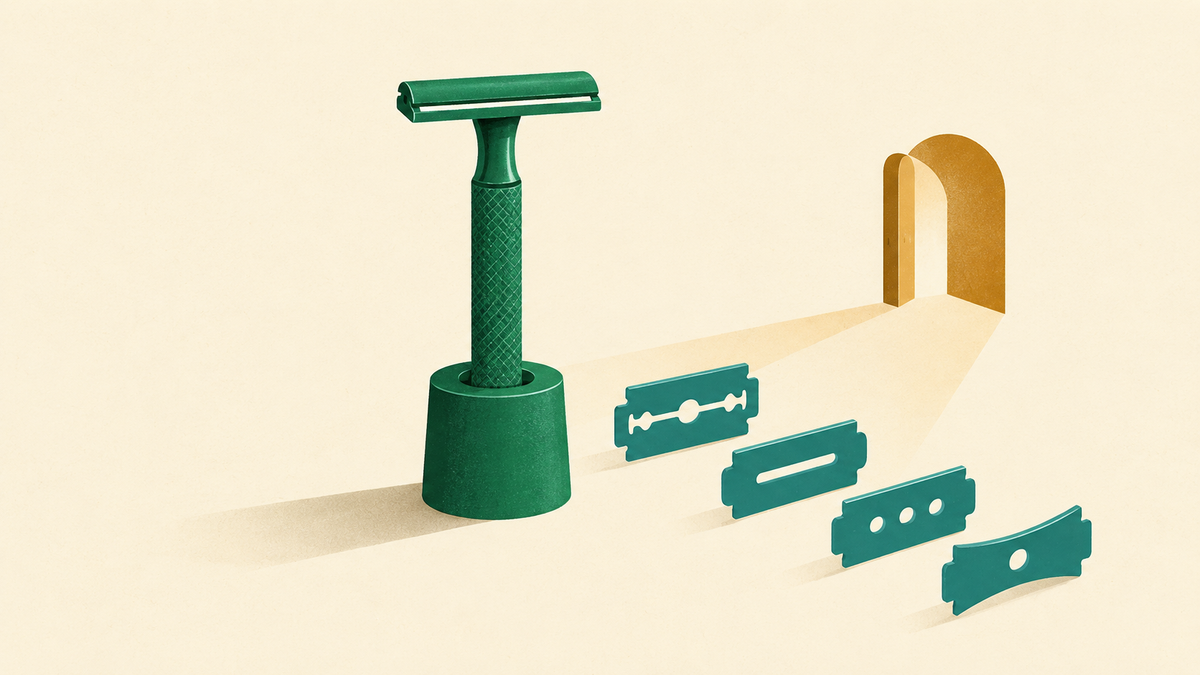
Henson Shaving makes machined metal safety razors that accept ordinary double-edge blades. Founder Daniel Jantzi built the Canadian brand around a durable holder whose buyers can purchase replacement blades elsewhere, making future refill sales optional.
For a founder considering the same choice, the important calculation starts with the first sale. If customers can buy consumables elsewhere, the hardware must fund its manufacturing, acquisition and support costs without an assumed stream of captive refills. Compatibility can remove a buying objection. It also removes revenue the business might otherwise have kept.
A familiar blade, a different job for the factory
Henson's company account describes an aerospace manufacturing background and a design effort focused on holding the blade more securely. The AL13 is machined from aluminum, with blade extension and exposure controlled through the shape of the holder. The company says standard double-edge blades fit, including blades bought from other sellers.
The distinction is useful. Henson did not need to persuade customers to adopt a proprietary blade format to sell a new holder. It could concentrate its engineering argument on the part it makes. That does not establish superior shaving results for every user, and this article does not assess its health or skin-performance claims.
The February 2022 Lather Talk episode description identifies Jantzi as the company's founder and CEO at that time. The listing also mentions interest in a more aggressive AL13 plate. It is evidence of a named founder and product discussion, not a transcript proving his private reasoning or current job title.
The commercial tension is visible in the company's own explanation: a customer can buy a long-lived razor and never buy a blade from Henson. A founder has to be willing to price that relationship honestly. Cheap compatible inputs benefit the buyer, but the seller still has a machining invoice.
Compatibility makes the initial margin carry more weight
Imagine a hypothetical razor maker selling a holder for US$70 before sales tax. This is a planning example, not Henson's current price or internal accounts. Assume machining, finishing and packaging cost US$25; payment and fulfillment cost US$7; expected returns and support cost US$4; and acquiring the order costs US$20.
The first order leaves US$14: US$70 minus US$25, US$7, US$4 and US$20. That is contribution before salaries, rent, equipment investment, tax and other overhead. It is not profit. If acquisition costs rise to US$32, contribution falls to US$2.
Now suppose the business expects US$12 of additional contribution from blade purchases over the next two years. If that assumption supports its spending today, it is taking a risk the compatible design explicitly permits customers to avoid. Remove the US$12 from the base case. Add it back only when actual purchases justify it.
At 5,000 first orders, US$14 of contribution yields US$70,000 before overhead. At US$2, the same order count yields US$10,000. The machine has made the same number of holders. The commercial system has produced a very different resource for keeping the business alive.
This is the practical consequence of the design choice. The product can be appealing while its acquisition channel is uneconomic. Framework's component-cost pricing case offers a related discipline: connect the selling price to the costs that actually changed. A good engineering explanation cannot make those costs disappear.
Make the contribution sheet a channel decision. A channel with a higher acquisition bill needs a higher first-order contribution, lower service cost or evidence of additional purchases. The existence of inexpensive standard blades does not supply that evidence. Set the spending limit from observed orders before expanding the channel.
Put the refill assumption through four questions
| Question | Evidence to collect | Planning consequence |
|---|---|---|
| Must the buyer purchase your refill? | Verified compatibility and available alternatives | Keep optional refill sales outside the base case |
| Will the buyer need another holder? | Observed replacement and additional-unit orders | Separate repeat users from gifts and second locations |
| Does the first order fund support? | Tickets, return costs and actual contribution | Reserve support money before buying more traffic |
| Can others explain the difference? | A clear product demonstration and buyer feedback | Test whether the engineering story survives beyond the founder |
Use the table as a business-design check, not a score predicting success. A standard consumable may be essential to the product's appeal. A proprietary one may create convenience or genuine technical benefits. Either route needs evidence about customer use and the expense of serving it.
Do not count gifts as proof that the original customer replaces the product frequently. A gift order has its own occasion, customer and acquisition path. Treating every returning email address as recurring personal consumption can produce an inflated lifetime-value estimate.
The holder also needs an understandable first use
Henson's FAQ states that the handle must be fully tightened to achieve the intended blade support and exposure. It also explains that the blades are not proprietary and describes Canadian design, manufacturing, assembly and packaging. These are the manufacturer's published descriptions, checked October 6, 2026.
The tightening instruction reveals a transferable constraint. A precisely made product still depends on an ordinary person assembling or using it correctly. The factory tolerance and the customer's behavior belong in the same product plan. A buyer misunderstanding one step can create a return that looks like a manufacturing defect.
For your product, identify the setup step that changes its intended performance. Put that step on the first-use card, show what completion looks like, and provide a clear support route. Have customers explain the instruction back in their own words before treating the card as finished.
PopSockets' prototype story shows why observed use can change a founder's understanding of the product. Here the question is narrower: does the compatible input work as intended when a new buyer fits it? The interface should be tested with the actual range of inputs the business claims to support.
A one-hour test of the business promise
Take your last twenty hardware orders and build a first-order contribution sheet. Use actual acquisition spending, landed manufacturing costs, fulfillment and expected service cost. Leave future consumable sales at zero. Mark any missing input instead of substituting an optimistic average.
Then list three reasons customers might buy consumables from you despite having alternatives: availability, convenient packaging, or a verified performance match. Ask whether those reasons survive a competitor offering the same standard. The answer helps distinguish an optional accessory business from a dependable cash stream.
Henson is a surviving example, not evidence that every precision workshop can build a consumer brand. Its public pages do not disclose the full margins or acquisition ledger. The replicable choice is to make compatibility explicit and budget around it. If the customer can leave the refill relationship after one purchase, the first purchase must still be worth making for both sides.
Discussion
Sign in with Google or just a name. No email link, no password to remember.