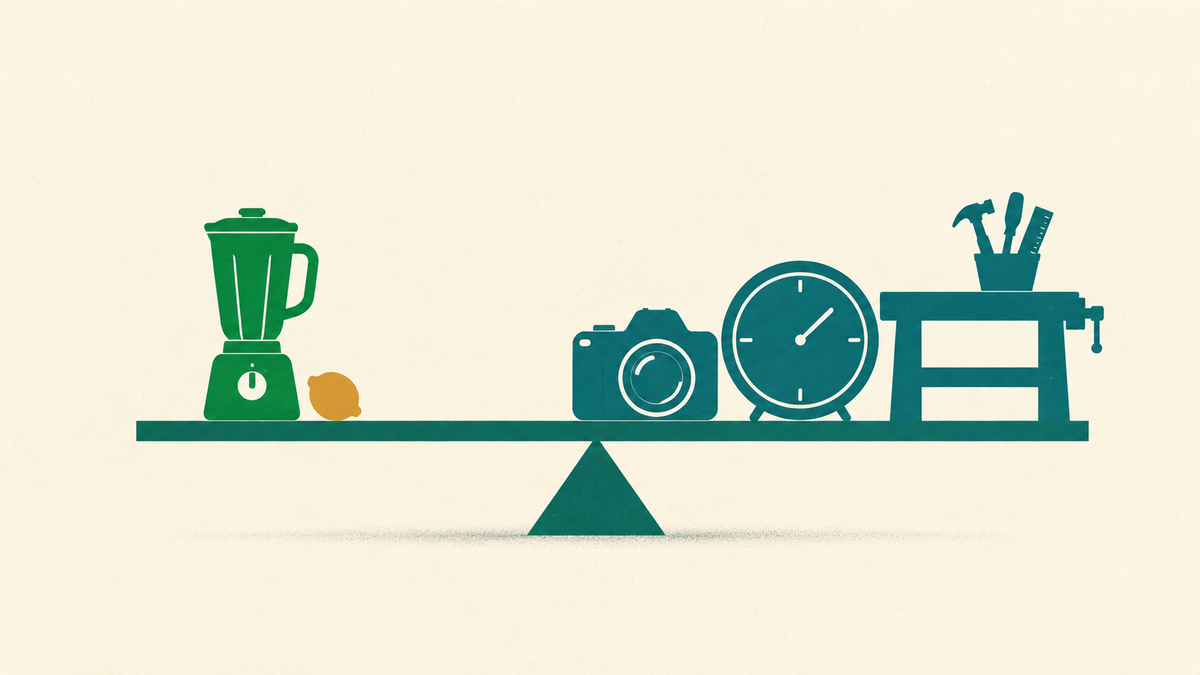
Blendtec makes kitchen blenders, and its founder Tom Dickson became the face of the “Will It Blend?” video series after marketing director George Wright noticed his unusual engineering tests. The famous US$50 starting budget describes a small purchase of props, not the full cost of producing attention or acquiring an appliance buyer.
A product founder can learn from the campaign without planning around a misleadingly cheap acquisition channel. Separate the cash spent on the first shoot, the resources already inside the business, the ongoing production cost and the contribution from actual product orders. Otherwise a memorable origin story becomes an unusable budget.
The cheap purchase had an expensive context
In a 2012 company interview, Dickson described Wright buying items for five videos with US$50, followed by the company's video crew making the clips. The crew is the important detail for a founder trying to copy the economics. The public account does not say that producing the campaign required only fifty dollars of total resources.
Inc.'s June 2008 interview corroborates the small initial spending and describes the existing commercial business, its trade-show demonstrations and word-of-mouth sales. Wright found an interesting behavior inside an operating manufacturer. He was not building a factory, hiring everyone and buying cameras with the same US$50.
That context does not diminish the idea. It helps explain why an apparently tiny experiment was possible. Dickson already had a product, a testing habit and an organization capable of producing and selling blenders. Wright recognized a way to turn an internal activity into something a wider audience wanted to watch.
BYU Magazine's Spring 2009 account places the series' start in October 2006 and recounts Wright discovering the debris from Dickson's destructive tests. The chronology matters: the resource base preceded the viral result. A new manufacturer should copy the bounded experiment, while pricing whatever resource base it still has to create.
Build two budgets before recording
The first budget answers a cash question: what additional money must leave the business to run the experiment this week? The second answers an economic question: what resources does the experiment consume, including time that could have been used elsewhere?
Consider an illustrative shoot for a hypothetical appliance maker. Props cost US$50. A staff member spends six hours preparing and editing at an assumed loaded cost of US$35 an hour. The presenter spends two hours at US$50 an hour. Studio and equipment use is allocated US$80. The product used in the shoot costs US$60 to replace.
The resource cost is US$500: US$50 plus US$210, US$100, US$80 and US$60. If the team, equipment and product are already available, the immediately incremental cash bill may be much smaller. Both numbers can be useful. Neither should quietly substitute for the other.
Existing salaries are not automatically avoidable costs. If the staff member has otherwise idle capacity, the opportunity cost differs from displacing a profitable production task. Record the assumptions rather than treating an allocated hourly rate as an exact cash payment.
- Incremental cash: can we afford this week's experiment? Include bought props and products, but distinguish them from already-paid salaries.
- Recurring production: can we maintain the format? Budget planning, revisions and support rather than treating the first successful shoot as a complete operating plan.
- Order contribution: does the attention support the product business? Include returns and fulfillment, and document the uncertain attribution between a viewed clip and an incremental purchase.
Keep the experiment small enough that a failure is informative and affordable. A cheap first video can justify a second attempt. It cannot establish that a weekly production schedule is affordable for the next year.
Media receipts and blender orders belong on different lines
The Inc. interview describes Dickson receiving money through video revenue sharing, speaking and branded promotional appearances. Those are distinct from selling a blender. The campaign could become a media asset while also serving the appliance business.
A maker should therefore keep two ledgers. Record media receipts and their associated production or appearance costs in one. Record attributable product orders, product contribution and campaign costs in another. Use a documented allocation if a shared shoot supports both.
Do not subtract media income from campaign spending and announce that customers arrived free. Media work consumed time and assets. Product purchases still need a defined attribution method. A net figure may be appropriate for a combined project, but readers of that figure need to know what was combined.
For example, suppose the hypothetical US$500 shoot brings US$120 in media receipts, costs another US$40 to administer that work and produces eight incremental appliance orders. Each order contributes an assumed US$45 after its variable product, payment and delivery costs.
Media contribution is US$80. Product contribution is US$360. Together they leave the project US$60 short of the US$500 resource cost. Looking only at US$50 of props would make the experiment appear comfortably profitable. Looking at the full project reveals the remaining gap.
This is invented arithmetic, not Blendtec's accounts. It deliberately leaves out tax, fixed overhead and future orders. Those future orders may matter, but they require evidence rather than a promise that visibility eventually pays.
What to borrow from a surviving viral campaign
Borrow the habit of finding an inexpensive experiment inside work the company already does well. Ask which product property can be shown accurately using ordinary, approved use. Record the expense, production time and purchase path before measuring the result.
The original series sometimes used dangerous materials. Those scenes are historical context, not instructions. A current product demonstration should follow the product's intended use and avoid implying that theatrical destruction proves every performance claim.
Liquid Death's premanufacturing demand test asks whether attention can reveal willingness to buy before production. Blendtec adds the opposite starting condition: a working manufacturer can use existing resources to reduce the cost of testing attention. Those resources still have economic value.
Ridge's sponsorship portfolio provides a separate acquisition question about repeated distribution spending. A successful original clip does not tell a founder the return from the next placement, creator or episode. Budget the continuation on its own evidence.
The first hour should produce a cost card
Choose one proposed video and write its cash cost, staff hours, displaced work, replacement products and expected order contribution. Define what counts as an incremental order, how long you will observe it and which returns reduce its value. Assign media receipts separately.
Then write the maximum loss you are willing to accept to learn from the test. Blendtec's outcome is a survivor story, and public interviews do not establish a probability that another maker will go viral. What a founder can reproduce is a small, clearly costed experiment. Fifty dollars can be a good start. It is a poor name for everything the business spent.
Discussion
Sign in with Google or just a name. No email link, no password to remember.