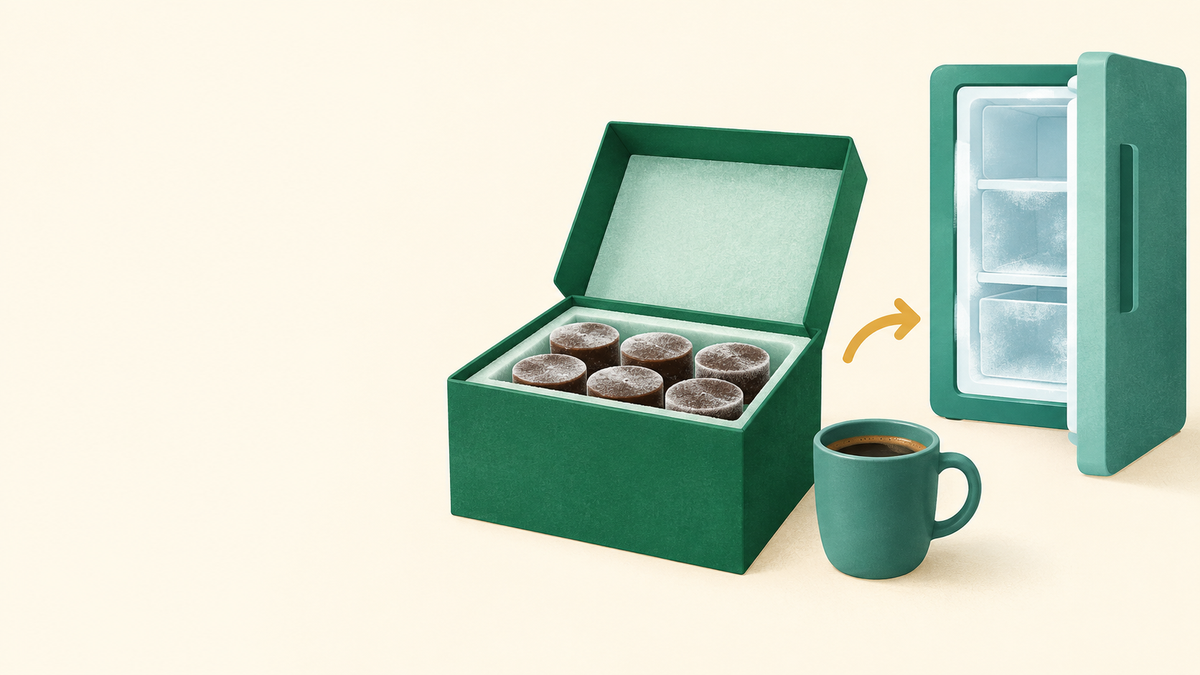
Cometeer sells brewed coffee frozen into single-serving portions that customers melt to make a drink. The product removes a brewing task from the kitchen, while adding another job for the business: delivering frozen inventory to someone who can put it away.
For an entrepreneur developing a convenient food, that exchange deserves a cash model before a larger launch. Bigger shipments spread delivery costs across more servings, but they also require a customer to buy, store and consume more. The useful unit is a completed shipment that fits a household's routine, not simply a portion leaving the production line.
The kitchen gets simpler because work moved upstream
Cometeer's iced-coffee page, checked October 14, 2026, describes frozen coffee capsules delivered using dry ice. Its Stasis offer page also tells buyers to transfer the portions to a freezer and describes making drinks without a dedicated brewing machine.
These are seller descriptions of the product and fulfillment route. They do not establish every customer's delivery experience, the company's costs or a universal storage life. Promotional prices can also differ by offer, so no one landing page should be treated as a complete current price list.
In a September 2025 Daily Beast product review, writer Mia Maguire reported receiving coffee in a box with dry ice and preparing drinks from the frozen portions. The publication discloses affiliate commerce. This supplies a described receipt and use experience, not an independent cold-chain validation.
Convenience is therefore real as a design choice without being free as an operating choice. Brewing, portioning and freezing occur before the parcel reaches the customer. Delivery and freezer storage become part of the product's path to use.
The commercial lesson does not require judging the coffee's taste. A founder can examine where work moves, who performs it and who pays for it without pretending to have tried the product.
Batch the shipment without overfilling the household
A per-parcel fulfillment cost creates pressure toward larger orders. A customer's rate of consumption creates pressure in the other direction. The first useful calculation puts those pressures on the same page.
Consider a fictional frozen-portion business. All figures are illustrative US dollars and do not estimate Cometeer's accounts. Assume each serving sells for $2 and costs $0.70 to produce and pack individually. A completed shipment adds $18 of combined insulated packing and transport costs.
At sixteen servings, sales are $32 and the listed costs total $11.20 plus $18. Contribution is $2.80 before overhead, customer acquisition, refunds and costs not included. The delivery cost alone is $1.125 per serving.
At thirty-two servings, sales are $64 and the listed costs total $22.40 plus $18. Contribution becomes $23.60. Delivery cost per serving falls to $0.5625. Doubling servings did not double the listed fulfillment charge, which explains the commercial attraction of a larger box.
Do not stop there. A hypothetical customer using one serving every two days needs sixty-four days to consume thirty-two servings. At one serving a day, the same shipment lasts thirty-two days. A four-week reorder schedule would fit neither customer exactly without accounting for existing stock and actual use.
Those consumption rates are invented. They show why a sensible dispatch quantity depends on the household rather than the supplier's preferred margin. If stock accumulates, a profitable-looking shipment can become a paused order, support problem or abandoned routine.
Build the dispatch window around receipt
A delivery promise needs more than a carrier transit estimate. It starts with order cutoff and production readiness, passes through dispatch and transport, then ends with the customer's ability to receive and store the product.
For actual frozen-food fulfillment, use competent specialists and the applicable product and transport requirements. This article does not prescribe dry-ice quantities, packaging specifications or temperature limits. Those need validation for the real route and product.
The operating plan can still ask clear commercial questions. Which dispatch days have a reliable receipt path? What happens when an address is wrong? How is a customer told to prepare for delivery? Who decides whether a delayed shipment can be accepted or needs another outcome?
Record exceptions as completed cases, not merely late parcels. A replacement shipment has another fulfillment charge and consumes more product. A refund can reverse the original contribution. The cost needs to follow the case to resolution.
Nightingale's frozen-food retail expansion concerns adding channel tiers. Cometeer's format raises a different direct-delivery question: how much inventory should one household receive at once, and on what timetable?
The first box can conceal the replacement bill
Return to the fictional thirty-two-serving shipment with $23.60 contribution. Suppose one failed delivery requires sending another full box, with $22.40 of product cost and another $18 of fulfillment. The extra cost is $40.40 if there is no further customer payment.
Across one hundred original shipments, assume three such replacements. The $121.20 total replacement cost averages $1.212 per original shipment. Listed contribution falls from $23.60 to about $22.39 before additional support or other costs.
Now use the same three-percent scenario with the sixteen-serving box. Each replacement costs $29.20, or $87.60 across the sample. Average cost is $0.876 per original shipment, reducing $2.80 contribution to about $1.92.
The scenario does not establish that larger boxes are always better. Their higher product commitment and slower household consumption still matter. It shows why a thin initial contribution leaves less room for exceptions, even when the replacement parcel is smaller.
Do not call three replacements a measured failure rate for Cometeer or for frozen delivery generally. It is an assumption to vary. A real pilot should record observed outcomes and retain the small sample's uncertainty.
Give the customer an inventory question
Before encouraging a reorder, ask how much usable stock remains and how quickly it is being consumed. A reminder based only on the original order date can push the customer's freezer further from the supplier's forecast.
For a pilot, a simple reply can be enough. Ask whether the next shipment should arrive sooner, later or in another size. Record the reason. Distinguish a change in taste preference from a timing mismatch or lack of storage.
A returns policy designed around the product begins with the customer's actual experience. Frozen deliveries likewise need an exception route that matches the object being shipped rather than a generic parcel script.
Within an hour, sketch one proposed shipment size, two plausible consumption rates and a dispatch-to-storage timeline. Add one delayed-delivery case with its complete replacement or refund cost. The result is a brief for a properly designed pilot, not permission to skip fulfillment validation.
A published delivery review cannot supply a failure rate, and Cometeer's public offers do not reveal profitability or retention. Its continued product offering is also only the surviving case; failed frozen-food launches are absent from the comparison. Use the pilot to collect the actual costs and consumption patterns the public story cannot provide.
The useful idea is the exchange of work. Removing the brewer makes the cup easier. A viable business has to make the journey to the freezer work too.
Discussion
Sign in with Google or just a name. No email link, no password to remember.