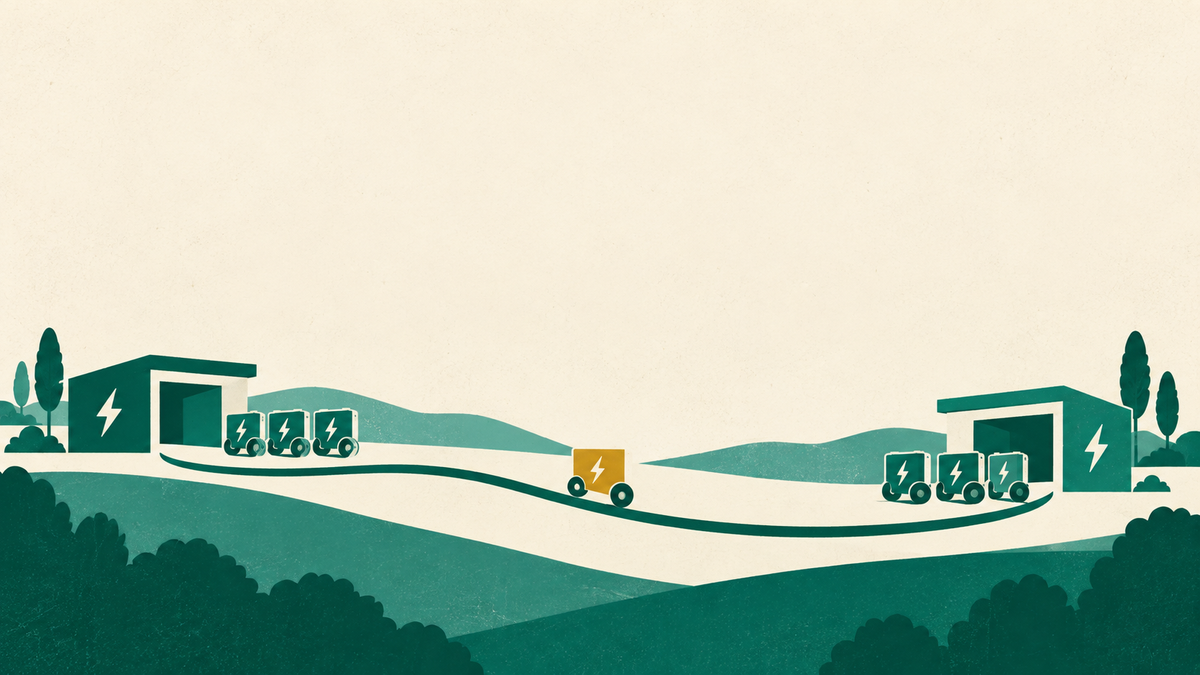
Revoy builds a battery-powered drive unit that fits between a diesel truck and its trailer, adding electric propulsion without replacing the tractor. The startup's commercial challenge is less visible than the machine: it must put charged units in the right places, often enough to make the swap network worth operating.
For an infrastructure founder, the useful question is whether one repeated route can support the system's fixed costs. A large market for trucks does not answer it. Model completed customer journeys, charging queues and spare equipment before using a successful demonstration as a reason to add another station.
The removable machine changes the adoption decision
In its January 31, 2024 launch announcement, Revoy described a swappable electric vehicle that couples to existing trucks and trailers, with charging infrastructure handled by the company. It promoted a short swapping stop and substantial fuel savings. Those are historical company claims, rather than independently measured operating results.
The important design choice is the removable unit. A fleet can retain its tractor while using another company's propulsion asset. The startup, in turn, must finance and operate a pool of machines. Moving the purchase burden away from the customer does not remove it from the business.
IEEE Spectrum's September 2026 account describes the dolly, a wheeled unit containing the battery, motor and drive axle. It reports a planned initial Oregon corridor and a model in which Revoy owns the units and charges by the mile. The described expansion remains a plan. The article attributes pilot performance to chief executive Peter Reinhardt.
Hackaday's September 20 discussion highlights the same adoption benefit: existing vehicles can participate. It provides a community discovery signal, not another independent field test of fuel consumption.
Separate miles sold from batteries owned
The fleet's buying unit may be a mile of service. Revoy's operating unit is a machine cycling through driving, swapping, charging, inspection and maintenance. A useful business model needs both units on the same page.
Start with a route that has predictable endpoints. Record loaded journeys in each direction, the time of departure and the maximum delay the operator will tolerate. Then identify the interval during which a returned unit cannot serve another customer.
A machine may return to a station before it becomes available. Charging occupies time. An inspection may occupy a worker and a bay. Repairs can remove a unit from service entirely. Counting every unit on site as immediately usable makes a busy corridor look much easier than it is.
Likewise, a nominal route distance does not establish available range under every load, grade, temperature and operating condition. Those inputs belong in a customer-specific qualification exercise. This article does not certify truck compatibility or prescribe a transport safety procedure.
A small corridor calculation
Consider illustrative US-dollar arithmetic for a hypothetical system, not Revoy's pricing or accounts. Suppose two stations support a 200-mile route. Eight completed journeys per day create 1,600 billable miles. Assume each mile leaves US$0.22 after electricity, variable maintenance and other direct delivery costs.
Daily contribution = 8 x 200 x US$0.22 = US$352.
If station labor, site costs and allocated equipment costs total US$300 per operating day, US$52 remains before central overhead and taxes. At four journeys, contribution falls to US$176, producing a US$124 shortfall against those same costs.
The break-even traffic requirement is US$300 divided by US$44 contribution per journey, or 6.82 journeys. The corridor needs at least seven completed journeys under these assumptions. Interested fleets are not the denominator. Journeys actually delivered and paid for are.
Now assume the customer price is competitive only when contribution falls to US$0.15 per mile. Each journey then contributes US$30, and daily break-even moves to ten journeys. That change can overturn the station decision without any change in battery technology.
Include allocated equipment cost honestly. An operator that excludes depreciation and financing can announce an attractive operating margin while its machines consume more capital than the route replaces. Obtain actual cost and service-life estimates before treating this example as a budget.
The queue can break the economics first
A second illustrative test concerns readiness. Assume a returned unit needs three hours of charging and processing before it can leave again. With perfectly even hourly departures, three rotating units can meet a three-hour turnaround if each becomes ready exactly when needed. A fourth would provide one ready buffer. That extra unit is an explicit service assumption, not a mathematical necessity. Longer processing or overlapping demands can consume the buffer.
This is a simplified steady-flow model. It excludes travel-time interactions, uneven arrivals and units moving between stations. Build a timed schedule for the real route rather than multiply this station estimate into a purchase order.
Now compress the same departures into a morning burst. A daily average still says one departure per hour, yet several customers may need charged units simultaneously. One spare cannot cover several overlapping demands. The business needs an hourly availability ledger, not just a daily utilization percentage.
Ask what happens when the planned charged unit is unavailable. A diesel fallback might preserve the delivery while reducing the promised electrification. Another route or delayed departure might preserve energy use while harming customer service. The contract and reporting should make that trade-off visible.
Record direction separately. Eight outbound journeys do not guarantee eight returns at the right time. A customer might bring freight back tomorrow or return through a different route. An equipment owner must arrange the repositioning or carry the resulting imbalance. Include its cost and unavailable hours in the corridor model before treating total traffic as balanced demand.
Choose the next endpoint by commitments
The transferable expansion rule is to demand evidence of repeat use at both ends before adding infrastructure. Seek route-specific commitments with a frequency and calendar. A general sustainability objective is weaker than an operating plan that assigns Tuesday's outbound and return loads.
Keep the first corridor's learning separate from its publicity. Measure billed miles, unsuccessful swaps, idle charged units, charging congestion and maintenance withdrawals. A fleet may admire the technology while using too few journeys to sustain the location.
OX Delivers' cargo-capacity model shows another way to sell the use of a physical asset. Drone delivery's complete operating system explains why the surrounding service determines adoption. Here the distinct constraint is a pool of charged machines at fixed endpoints.
For a first route review, export a week of proposed customer departures and mark every interval in which each machine is unavailable. Calculate contribution at committed traffic, then at half that traffic. If a station needs more journeys than the customer calendar contains, network expansion is premature.
Revoy's public descriptions do not establish audited route profitability, and a pilot does not guarantee a durable network. The useful ambition is therefore smaller and more demanding: make one corridor reliably worth running. A network begins when a customer can count on the next charged unit, not when a map gains another pin.
Discussion
Sign in with Google or just a name. No email link, no password to remember.