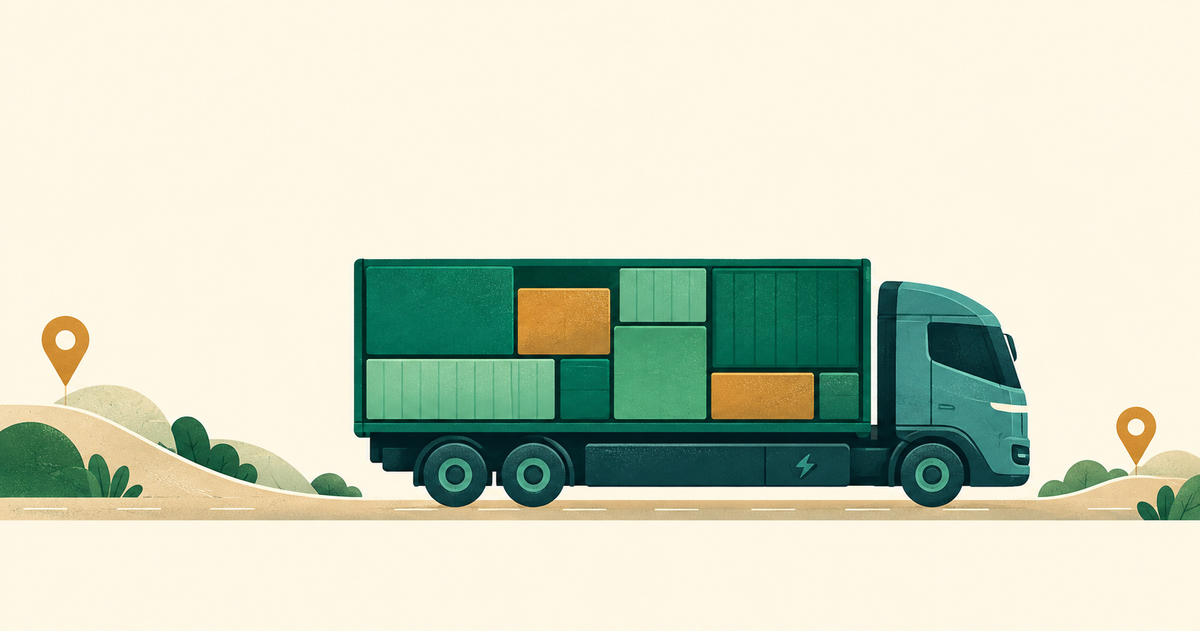
OX Delivers did not ask a small Rwandan trader to finance an electric truck. It sold space on the truck for a particular journey. That changes the adoption problem from ownership to operating expense: a customer can move crops, materials, or equipment without a vehicle loan, driver, charger, or maintenance team. OX still carries those capital and utilization risks itself. The model works only if enough paid loads share each route and the purpose-built truck lowers lifetime operating cost. For founders bringing expensive climate hardware to cash-constrained customers, the core lesson is precise: sell the productive outcome in small units, then manage utilization as rigorously as a manufacturer manages yield.
The customer buys transport, not technology
OX operates an on-demand logistics service in Rwanda around a purpose-built electric truck. A 2022 company interview hosted by AFSIC says operations began in March 2021 and, after 14 months, two depots had moved goods for more than 600 customers. OX reported 22 percent monthly revenue growth and said it was turning away 80 percent of inbound interest because it lacked trucks and delivery capacity. These are historical, self-reported figures, not audited current performance.
The customer mechanism is corroborated by development-finance research. A UNDP green-business report describes a 3.5-tonne truck and a pay-as-you-go service that lets customers rent only the space they need. A GET.invest electric-mobility guide says Rwandan customers, including smallholder farmers and small traders, can book transport using a basic service designed for 2G phones.
Those details matter more than the drivetrain in the sales conversation. A farmer values whether produce reaches a market in sellable condition and whether the trip cost leaves a margin. The electric vehicle is the service asset, not the item on the customer's balance sheet.
The provider absorbs the lumpy costs
A vehicle-service model combines at least four businesses: hardware ownership, depot operations, route sales, and credit or payment collection. OX must buy or finance trucks before every future trip is known. It must keep vehicles charged and available, match loads with routes, train drivers, and maintain parts. Low customer capital expenditure is created by high provider discipline.
This explains why capacity can be the real product. An empty return journey earns nothing while consuming time, energy, tires, and vehicle life. A fully booked outbound trip can still lose money if collections are fragmented, loading takes too long, or the depot sends a vehicle far from the next job.
Illustrative route economics
Consider a hypothetical 80-kilometer round trip. Assume energy costs $12, driver and loading labor costs $24, maintenance and tires are reserved at $14, depot overhead allocated to the route is $20, and vehicle capital is charged at $30. Total route cost is $100.
The truck has 3,000 kilograms of usable payload for this example. At 70 percent utilization, it carries 2,100 kilograms. If customers pay an average $0.06 per kilogram for this distance, route revenue is $126 and contribution is $26:
2,100 kg x $0.06 = $126 revenue.
$126 - $100 = $26 route contribution.
Break-even utilization is 55.6 percent because the truck needs $100 / $0.06, or 1,667 paid kilograms. A 40 percent load produces only $72 and loses $28 before unforeseen costs. These figures are illustrative and do not represent OX pricing or costs. They show the operating question: can the depot consistently aggregate enough compatible demand at the right time and direction?
A route deserves a launch gate
| Evidence | Minimum question | Failure signal |
|---|---|---|
| Anchor demand | Which buyer or cooperative provides a repeat base load? | Every trip starts from zero |
| Return demand | What can move back toward the depot? | Paid utilization is one-way |
| Loading density | Can several customers meet at practical collection points? | Stops consume more time than travel |
| Payment | When and how is each job collected? | Revenue exists only as receivables |
| Uptime | Which spares and technician can restore service? | One fault cancels the route |
The gate prevents a founder from equating inquiries with routable demand. OX's reported inability to serve much inbound interest demonstrated scarcity, but individual calls may occur on different days, directions, and payload requirements. Aggregation determines whether interest becomes a viable route.
Why a purpose-built truck can matter
OX says it develops hardware and software together to achieve reliability and low operating expense. That choice should be evaluated against an adapted standard vehicle, not admired in isolation. A custom truck is justified when rough-road durability, payload, repairability, energy use, or containerized shipping changes route economics enough to repay design and tooling. It is a liability when proprietary parts extend downtime or volume is too low to support spares.
A service operator gets unusually rich design feedback. It owns the vehicle, sees every fault, and knows which route and payload produced it. That closed loop resembles the traceability logic in MNT Reform's supplier map, though OX remains a commercial logistics operation. The provider can redesign around measured downtime rather than occasional customer reports.
What transfers to other hardware
Capacity sales can unlock cold storage, agricultural processing, construction equipment, energy systems, and industrial tools. It is most attractive when customers need the output intermittently, cannot finance the asset, and can share it without harming service quality. It is least attractive when demand is unpredictable, travel between customers is costly, misuse is hard to control, or regulation requires one owner-operator relationship.
The model also changes financing. Investors or lenders finance a fleet with utilization and maintenance data rather than a one-time inventory sale. That can create recurring cash flow, but it does not make the economics subscription software. Physical assets depreciate, break, and sit idle.
Map one route within an hour
- Choose one origin, destination, day, and payload class.
- List five potential anchor customers and their minimum, normal, and peak loads.
- Calculate round-trip cost including capital, downtime reserve, loading labor, and an empty return.
- Divide that cost by realistic paid capacity to find the break-even rate.
- Call customers to test schedule and payment, not general interest.
Then run the downside case at half the expected load. If the route fails immediately, find an anchor contract or postpone the asset. This is a physical version of the dependency audit: one route, depot, customer, or vehicle should not be able to stop the entire company.
OX's model is compelling because it matches payment to a job customers already understand. Its difficulty is equally clear: the company must turn dispersed demand into dense, reliable routes while keeping specialized trucks working. Selling the outcome removes the buyer's capital barrier. It does not remove capital risk; it moves that risk to the operator best positioned to manage it.
Measure customer value after the trip as well. Record sale price achieved, spoilage avoided, hours saved, and whether the customer books again. A route can hit provider break-even while failing to improve the shipper's economics. Repeat use is stronger evidence than a subsidized first journey or a long inquiry list.
The customer does not need to own the machine; the operator needs enough useful journeys to keep it moving.
Discussion
Sign in with Google or just a name. No email link, no password to remember.