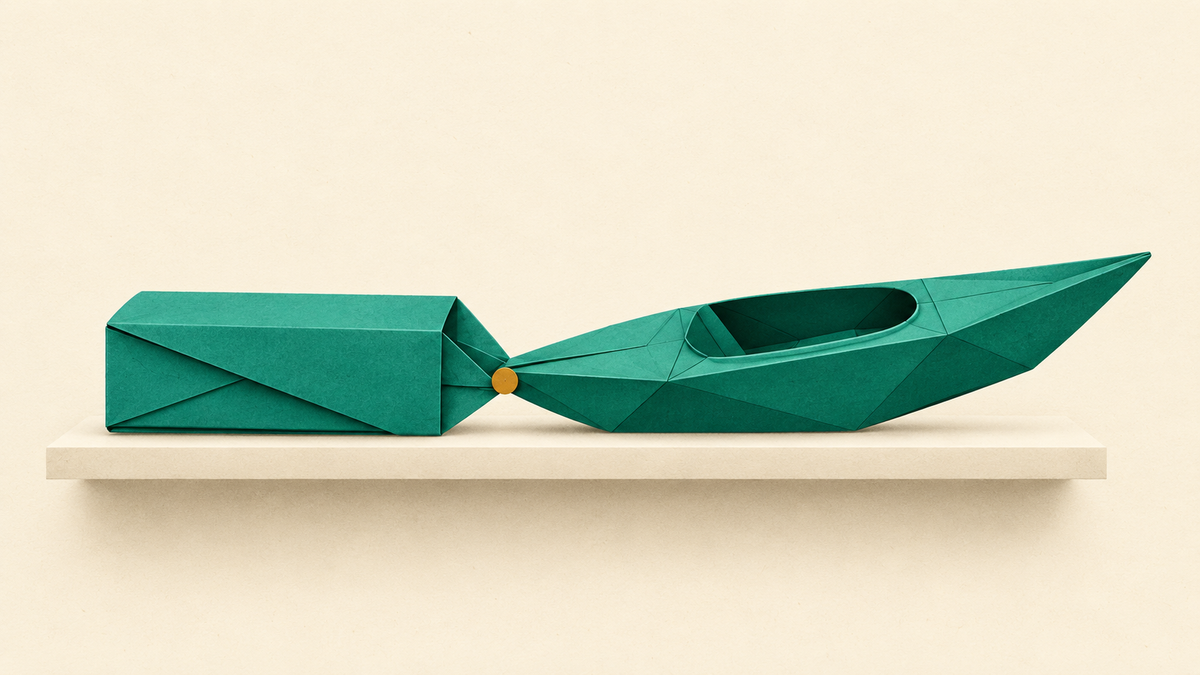
Oru Kayak sells boats that fold into portable packages, and founder Anton Willis began the idea after apartment living put his own kayak into storage. The harder design problem emerged later: making a boat compact enough to own did not necessarily make it simple enough for a new paddler to assemble.
That second constraint led to a different folding pattern for the Inlet. For a physical-product founder, the lesson is to investigate the entire ownership routine. Storage, carrying, setup and putting the product away can block adoption even when its central function works well.
The apartment changed the question
A kayak's obvious job is to carry a person on water. Willis was confronting the job before that one: keeping a kayak somewhere between trips. In ASME's 2019 engineering account, he describes moving to a studio apartment and putting his boat into storage. An article about origami specialist Robert Lang suggested another route.
Willis experimented with folded paper, cardboard and corrugated plastic. The work did not turn directly into a reliable boat. ASME recounts an early plastic prototype sinking quickly because the sheet was too small to support him. The storage insight still needed an adequate physical structure.
Entrepreneur's 2017 profile describes the evening-and-weekend prototype sequence and the eventual 25th prototype helping create the company. This is a historical account of development, not a claim that twenty-five attempts is a reproducible formula for founding a hardware business.
The useful movement in the story is from a personal obstacle to a new design category, then from an inventive object to something other people could live with. A founder can identify the first obstacle alone. Understanding the second requires watching people who have different space, confidence and habits.
A smaller boat required a new fold
ASME reports that earlier Oru designs used broadly similar crease patterns. Creating the smaller Inlet required rethinking that pattern. Its bow and stern edges stayed together, reducing assembly work, while the package folded more nearly into thirds.
That is a substantive product change. The team was not merely making the same boat shorter and calling it accessible. It changed how the customer encountered the object on shore. The account connects the redesign to buyers who found previous models too costly, unwieldy or difficult to put together.
Keep the limits intact. The article's historical weights and assembly descriptions do not establish every current model's performance. A smaller recreational product should not inherit another boat's suitability for particular waters. This story explains a design decision, not paddling instruction or a recommendation for an expedition.
Oru's 2021 announcement of joining Solo Brands mentions work to reduce lead times and improve community support. That adds another ownership constraint: a customer cannot use a clever folding design until the company delivers and supports it. The announcement does not reveal the founders' personal proceeds, and none are inferred here.
Draw the product's journey outside its main use
For your own product, write seven steps across a page: discover, buy, receive, store, prepare, use and put away. Under each, describe the physical task in everyday words. Include where the object lives and who performs the task. A product can be easy for its inventor and difficult in a third-floor apartment.
Choose a representative new customer and observe one full cycle. Record minutes, assistance, extra equipment and abandoned attempts. Ask what they would have to change at home to keep the product. Avoid prompting them with the feature you hope they praise.
- Storage: where does the product live between uses? Observe whether folded volume or a different orientation could remove a real obstacle.
- Transport: can the intended user carry it through their actual route? Weight and carrying interfaces matter differently on stairs, in a car and through a narrow doorway.
- Preparation: which step requires assistance? Fewer joins, clearer alignment or a retained connection may help, if observations support the change.
- Reset: can it be cleaned and put away without extra space? Accessible surfaces and a repeatable closing sequence can matter after the enjoyable part is over.
The responses are hypotheses. Changing one can worsen another: fewer removable parts may increase packed size; a lighter material may introduce a different durability problem. Rank the obstacles by observed frequency and consequence before choosing a redesign.
PopSockets' observed-use case is a useful companion. It follows customers discovering a function the founder did not initially emphasize. Oru's question begins earlier: what prevents a willing buyer from getting to the intended function at all?
Calculate preparation burden without pretending it is cash
Consider a hypothetical outdoor product used twenty-four times a year. Suppose preparation and packing take twenty minutes per trip. The annual burden is 480 minutes, or eight hours. A redesign that reduces the combined work to eight minutes brings that burden to 192 minutes, or 3.2 hours.
The saving is 4.8 hours a year. This is illustrative arithmetic, not a measurement of Oru's kayaks. Do not multiply it by an arbitrary hourly wage and present the result as money a buyer earns. Recreational time, paid labor and storage convenience are different benefits.
Instead, ask whether the change alters behavior. In a bounded pilot, compare the proportion of customers who complete setup unassisted, the number who use the product again and the reasons people stop. Record both successful and unsuccessful attempts. A photograph of the folded package cannot answer those questions.
For the maker, a design change has actual costs. Estimate engineering, tooling, instructions, packaging changes, compatibility work and support for earlier versions. Suppose those one-time costs total an invented US$60,000 and the new design adds US$6 of recurring cost per unit. Selling 2,000 units would add US$72,000 of cost before any increased sales or fewer returns.
That establishes the commercial question, not the answer. How much contribution does easier ownership create? Use observed demand and service changes. Do not treat a shorter setup time as an automatic price premium.
Protect the working product while testing the next one
Keep a small redesign trial separate from the promises attached to an existing product. Show prospective users what changed and what remains uncertain. Ask them to perform the ownership steps in realistic conditions rather than accept the inventor's demonstration as proof.
U-Turn Audio's selective-tooling story illustrates how a maker can sequence manufacturing investment around a specific constraint. The same discipline applies here: identify the ownership step worth changing before committing the whole range to a new geometry.
Oru's survival creates selection bias. Many useful prototypes never become durable companies, and the public accounts do not expose every failed commercial experiment. What transfers is the attention to the non-use portion of ownership, supported by observation rather than enthusiasm.
In an hour, map your product's storage-to-use cycle and identify the step you have never watched a novice complete. Arrange one observation and write the failure condition before proposing a new feature. Willis's folded boat made room for a kayak in an apartment. The continuing design work made room for kayaking in a person's day.
Discussion
Sign in with Google or just a name. No email link, no password to remember.