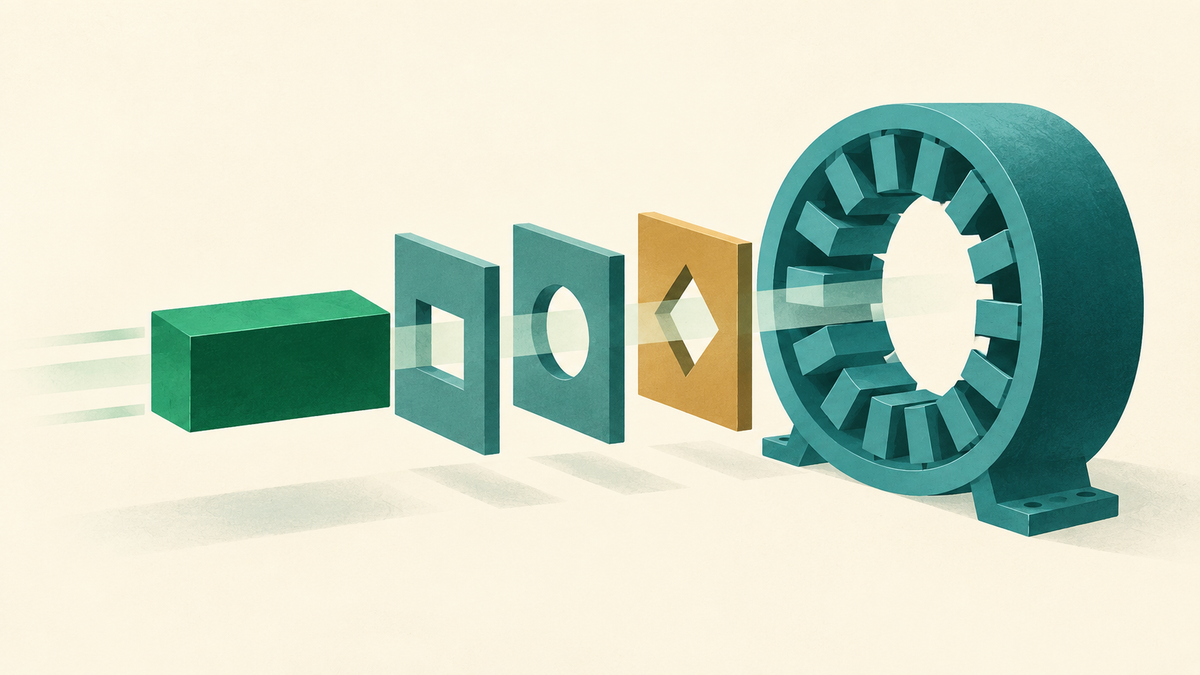
Niron Magnetics makes permanent magnets from iron nitride, a material composed of iron and nitrogen that avoids rare-earth inputs. Its partnership with General Motors shows why a new magnet business has to prove a motor application as well as manufacture the magnetic material.
The commercial lesson is in the agreement's wording: co-development for possible future vehicles. A partnership can create a route into the customer's engineering program without establishing an approved production part, a purchase order or a profitable unit. A materials founder needs a clear ladder between those milestones.
The customer bought into development
In its November 8, 2023 announcement, GM said it had agreed to co-develop motor technology with Niron and had invested through GM Ventures. The stated use was future electric vehicles. The announcement does not say that Niron magnets were already installed in production GM vehicles.
That distinction is consequential. A customer choosing a new material must know how it performs inside the product it intends to sell. The material supplier and the motor team may have to develop that answer together. The investment supports a relationship; it does not make every subsequent engineering question vanish.
A permanent magnet retains its magnetism without continuous external electrical excitation. In a motor, its useful contribution depends on the whole design. The buyer's question is therefore more specific than whether a sample is magnetic: can a defined motor deliver its required performance with a reproducible, obtainable part?
This article does not prescribe a magnet design or assert that iron nitride universally replaces another chemistry. Niron and GM are participants with commercial interests. Their descriptions establish a development relationship and stated objectives, while production qualification needs its own evidence.
Factory capacity is another milestone
Niron's September 2025 groundbreaking announcement describes a planned 1,500-ton-per-year factory in Sartell, Minnesota. It says a Minneapolis pilot plant opened in 2024 and partners were sampling products. The planned larger plant was described as becoming operational in early 2027.
Keep those dates attached to the statements. A plan for 2027 is not completed capacity in October 2026. Sampling is not the same as a qualified part, and a factory's stated annual capacity is not a measurement of accepted material shipped to a customer.
In November 19, 2025 testimony, CEO Jonathan Rowntree said the company was producing magnets for commercial clients at ton scale. That is an attributed executive statement in a public document. It does not identify a GM vehicle program or disclose a customer-level profitability result.
The sequence is meaningful without inflating it: development agreement, pilot production and a larger factory plan. Each step reduces a different uncertainty. None substitutes for the buyer accepting a specific part on a specific timetable.
Draw a ladder with evidence on every rung
For a new material, separate four commercial states. A founder should be able to name the document or observation supporting each state before describing the customer as “won.”
| State | Evidence to request | Unanswered question |
|---|---|---|
| Interest | Named application and engineering owner | Will the buyer spend time evaluating it? |
| Co-development | Agreed scope, responsibilities and tests | Will the combined system meet its requirements? |
| Qualification | Documented acceptance for the intended part and process | Can supply repeat at the required rate? |
| Recurring supply | Accepted deliveries, orders and operating records | Does the business earn adequate contribution? |
The ladder is a planning aid, not a description of Niron's confidential contracts. Actual customers may organize development differently. The useful principle is to distinguish collaboration from acceptance and acceptance from economically repeatable supply.
Assign an owner to each transition. The scientist, manufacturing lead, customer engineer and purchasing team can have different definitions of completion. Put those definitions on one sheet so a finished laboratory task does not become a sales forecast accidentally.
Sublime's cement adoption case makes a related point about entering an established industrial system. A materials founder needs to learn the customer's acceptance language, not only demonstrate an appealing chemistry.
Attach a spending limit to the next decision
For a founder, a strategic partnership creates a budgeting question: which work is justified by the evidence currently available? An investor's confidence, a customer's engineering interest and an accepted purchase order have different meanings for cash planning. Keep each on its own line.
Consider a fictional materials company planning a three-stage customer program in US dollars. Application scoping costs $20,000, sample development costs $80,000 and a production pilot costs $200,000. The full program would consume $300,000 before ordinary overhead, equipment outside the pilot and any revenue. These figures are invented, not Niron costs or contract terms.
If all three stages begin immediately, the company exposes the entire $300,000 to the unresolved application question. If it first authorizes scoping alone, its initial authorized exposure is $20,000. Before authorizing the next $80,000, it can require a named engineering owner, agreed sample requirements and a documented decision after testing.
The staged route does not make the full program cheaper. If all stages proceed, it still costs $300,000 under the assumptions. It provides an opportunity to stop or revise the work before making the next commitment. The corresponding disadvantage is time: waiting for decisions can delay engineering and supplier availability.
Suppose the customer agrees to pay $30,000 toward the sample stage. External funding reduces the modeled company's total net program requirement to $270,000 if all other assumptions remain unchanged. It does not prove a production order or profit. Record when the payment arrives; a promised reimbursement cannot pay today's invoice until collected.
Build the stop rule around the next unresolved customer decision. Specify what evidence releases the next budget, who can authorize it and which payments remain unavoidable if work pauses. A supplier reservation can survive a paused engineering program, so the authorized-stage figure must include committed cancellation and holding costs where applicable.
Use this ledger in a weekly review. Put investment announcements and endorsements in the relationship notes rather than the order column. The goal is to know which uncertainty the next month of spending will reduce, and whether the business can finance the following month if the answer is unfavorable.
The first application should have a bounded question
A small materials company cannot afford to treat every interested sector as an immediate market. Compare prospective applications by the clarity of their acceptance requirement, access to the relevant engineer, pilot cost and expected qualification timetable. Choose the one where the next unanswered question can be resolved affordably.
Tiny Tapeout's shared manufacturing model offers a useful contrast in how technical participation can be bounded. A materials supplier needs its own bounded pilot: an application, a quantity, a measurement and an explicit decision after the result.
The public sources do not disclose Niron's current unit cost, full acceptance yield or binding GM supply volumes. The surviving partnership is not a success probability for other inventors. Use it to improve the questions, then answer those questions with your own evidence.
For a one-hour pipeline review, take the strongest customer conversation in your pipeline and place it on the four-state ladder. Write what must be demonstrated before it moves upward and who decides. A new magnet can be the beginning of a new motor. The business begins to become repeatable when the customer can specify, accept and reorder the part.
Discussion
Sign in with Google or just a name. No email link, no password to remember.