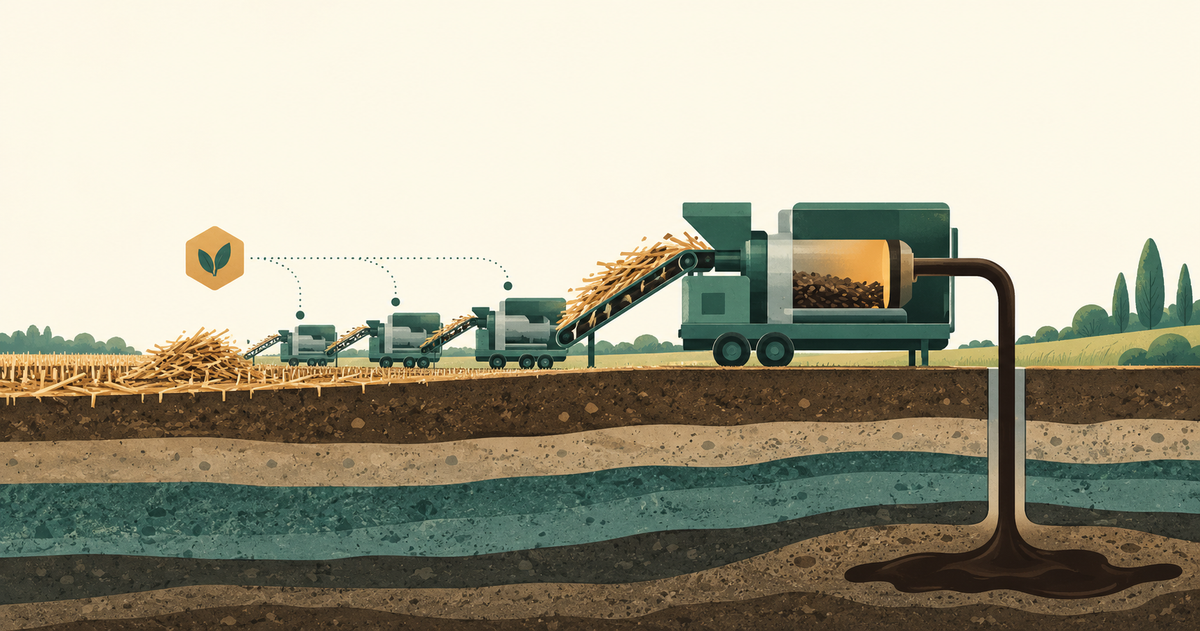
Charm Industrial does not sell a machine. It sells verified tonnes of carbon dioxide removal produced by turning waste biomass into bio-oil and storing it underground. In 2020, Stripe agreed to buy 416 tonnes at US$600 each before the process had a long operating history. Three years later, Frontier buyers signed a US$53 million agreement for 112,000 tonnes through 2030. That sequence is a commercialization playbook for emerging technology: sell a measured outcome, let an early buyer fund proof, publish delivery evidence, then use a larger offtake to justify equipment and capacity.
The first product was a delivered outcome
Charm's process uses fast pyrolysis, which heats biomass quickly with little oxygen. The output includes a carbon-rich liquid called bio-oil. Charm prepares that liquid and injects it into regulated underground formations.
In its May 2020 announcement, the company said Stripe would purchase 416 tonnes of carbon dioxide equivalent removal at US$600 per tonne. Charm planned its first injection for the following months. The buyer was not purchasing ownership of a pyrolyzer or paying for a research report. It was purchasing a defined quantity of removal.
That contract made the technical milestone commercial. The company had to source eligible biomass, process it, move the bio-oil, inject it, calculate lifecycle emissions, and document the result. Each step became part of the product boundary.
Measurement belongs inside the operation
Charm's technical FAQ says one tonne of biomass produces roughly 0.85 tonnes of net carbon dioxide removal after modeled process, transport, and injection emissions. It also states important limits: some residue must remain on fields, biomass with a better fossil-fuel-displacing use should not be claimed, and transport distance can erode the benefit.
Those are company figures and long-term averages, so a buyer should not apply 0.85 blindly to every load. The useful practice is the unit ledger. Record feedstock source, mass, moisture, transport, energy, bio-oil output, injection, and verification by batch.
An independent registry entry shows what one delivery object looks like. Isometric records 25.88 tonnes removed by Charm on March 2, 2026, under its bio-oil geological storage protocol, with 350Solutions named as verifier. One entry does not validate the whole business, but it demonstrates the difference between an announced contract and an issued removal.
The large contract was cheaper per promised tonne
TIME reported that Frontier's 2023 agreement covered 112,000 tonnes by 2030 for US$53 million. The simple contracted average was about US$473 per tonne:
US$53,000,000 / 112,000 = US$473.21 per contracted tonne.
That is about 21 percent below the US$600 first-purchase price. It is not necessarily Charm's realized net revenue per delivered tonne. Contract timing, milestones, verification, non-delivery terms, and cost sharing can change the economics. It still shows the commercial bridge an offtake can create: a buyer commits to future output at a defined scale, allowing the producer to plan equipment and hiring against demand.
TIME also reported that Charm had removed about 6,400 tonnes by late 2023, largely with purchased third-party bio-oil, while planning a fleet of ten pyrolyzers. The gap between delivered history and contracted future volume was therefore the central operating risk.
Translate the contract into machines
A founder should convert an offtake into a capacity table before celebrating its face value. Suppose one production unit can deliver 2,500 verified tonnes a year at 70 percent utilization. A contract requiring 20,000 tonnes annually needs:
20,000 / 2,500 = 8 production units.
Add one unit of maintenance and ramp buffer, and the plan becomes nine. Then calculate operators, feedstock radius, storage, injection capacity, verification delay, and working capital for each.
| Contract promise | Physical dependency | Evidence before expansion |
|---|---|---|
| Tonnes per year | Pyrolyzer throughput and uptime | Stable run data |
| Net removal | Feedstock and lifecycle emissions | Batch calculation |
| Permanence | Qualified injection site | Permit and monitoring |
| Delivery date | Verification and registry issuance | Verifier schedule |
| Price decline | Yield, labor, logistics, capital cost | Learning curve by unit |
The model resembles Form Energy's duration argument: a new technology wins by defining the unit customers value, then engineering around that unit. For Charm, the unit is not a litre of oil. It is a verified net tonne stored for a stated period.
Separate prepayment from earned revenue
An advance purchase can finance capacity, but cash received before delivery is not the same as earned revenue. The producer may owe removal or a refund. Build a delivery waterfall:
- Cash contracted.
- Cash collected.
- Capacity installed.
- Gross output produced.
- Net outcome calculated.
- Outcome independently verified.
- Credit or certificate issued to the buyer.
Report each number. Combining them allows a signed headline to outrun the factory.
Set milestones that retire different risks
An advance buyer should not release every dollar against one construction date. The first payment might fund engineering; the next might follow a stable production run; later payments can depend on injection, measurement, independent verification, and registry issuance. Each milestone should remove a named risk rather than merely mark elapsed time.
Consider an illustrative US$4 million purchase. Paying 20 percent at signing, 25 percent after the first qualified unit is operating, 25 percent after storage, and 30 percent after verification gives the producer early capital without making the buyer carry all delivery risk. The exact split depends on the technology and contract. The useful test is whether each payment leaves enough cash to complete the next physical step.
The producer should keep a matching evidence folder: equipment acceptance records, feedstock origin, run logs, mass balance, transport records, injection data, and verifier correspondence. If a tonne is later rejected, the team can trace which assumption failed. That turns verification from a final surprise into a production discipline.
This structure also reveals the right size for a first customer. A purchase that requires eight unproven machines at once may be too large to teach safely. A smaller contract that funds one complete delivery cycle can be more valuable because its evidence improves the design, price, and financing of the next seven.
A one-hour commercialization brief
- Name the measurable outcome the customer buys, not the equipment used to create it.
- Define the evidence that turns production into a deliverable unit.
- Price a first small batch high enough to include measurement and learning.
- Write the capacity added by each larger contract.
- State the failure that would stop delivery: feedstock, yield, permit, site, or verification.
- Publish delivered units separately from contracted units.
Zipline's delivery system shows why a technical product includes approval and operations. Charm extends that principle to an invisible outcome whose measurement must travel with every batch.
An early buyer did more than give Charm revenue. It forced a scientific process to become a deliverable. That is the real job of an advance market: not to declare a technology scaled, but to buy the next measurable proof.
Discussion
Sign in with Google or just a name. No email link, no password to remember.