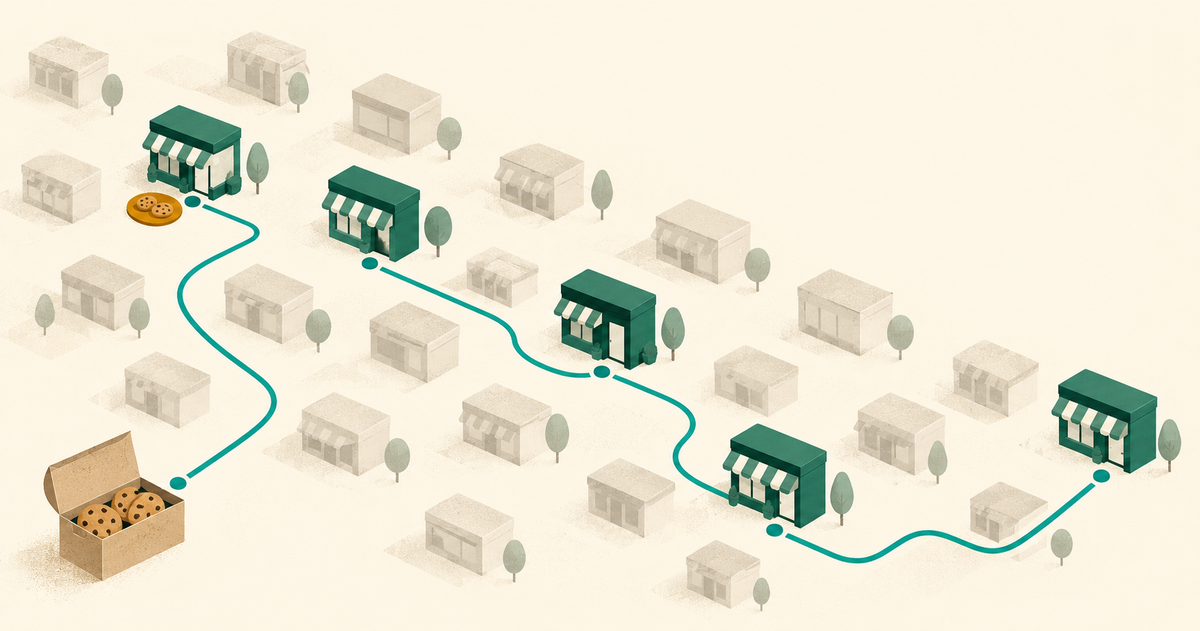
Partake Foods did not begin national retail by asking every grocer to carry its allergy-friendly cookies. Founder Denise Woodard studied the store locators of brands she admired, chose 50 stores around New York City, Brooklyn, and Jersey City, and cold-called them while 3,000 boxes sat in storage. She then sampled heavily to help early accounts sell through. This is the replicable part of the story: a first retailer list should be small enough to support store by store, selected from evidence that comparable products already sell there, and measured by reorder velocity rather than the number of logos on a pitch deck.
Three thousand boxes forced a narrow plan
Woodard incorporated Partake in 2016 after her daughter developed several food allergies. In a first-person account, she says 3,000 boxes arrived at a Jersey City storage facility on July 11, 2017. Before delivery, she had compiled the 50-store prospect list. She cold-called accounts and sold that inventory and more over the following year.
The list was not arbitrary geography. Studying other brands' locators is a simple proxy for three things: the store buys emerging products, its shoppers accept the category's price, and a relevant distributor may already serve it. That does not prove Partake will sell. It makes the first conversation better than an undifferentiated list of every grocery store.
Woodard later won placement in Whole Foods' Southwest region and supported it with travel, food-festival appearances, and sampling. By May 2020, her account said Partake was in more than 1,600 Target stores. A later Food Dive interview listed Wegmans, Target, Kroger, and Walmart. A 2025 profile reported more than 18,000 retail locations, but that current figure remains a reported company milestone rather than an audited door count.
A listing is permission to prove velocity
Founders often celebrate the purchase order as customer acquisition. For a retailer, it is closer to a trial. The shelf has a weekly economic requirement. Slow product ties up cash and space, then expires or gets marked down. The founder must help the account reach a repeatable sales rate.
Woodard says Partake traveled and sampled after entering Whole Foods. Sampling did more than create awareness. Allergy-friendly food has a taste objection: shoppers may assume that excluding ingredients means accepting a worse cookie. A bite can resolve that faster than more packaging copy.
The broader audience also surprised the founder. In Food Dive, she says she expected support from families managing allergies but found the wider wellness community helped retail entry. That is a useful correction. The safety requirement defined the product; taste and ordinary snacking needed to support a larger market.
Calculate support before accepting more doors
Suppose a case contains 12 boxes, the retailer buys each box for an illustrative $3.20, and the brand's delivered cost is $1.85. Gross contribution before selling costs is $1.35 per box, or $16.20 per case.
A four-hour in-store demo costs $90 for labor, samples, and travel. The demo must generate or protect 67 incremental box sales to cover its direct cost:
$90 / $1.35 = 66.7 boxes.
That may occur over several weeks if sampling creates repeat buyers. It may never occur in a weak store. If the brand expands from 20 to 200 locations and promises one monthly demo per store, it has created 800 hours of field work before travel. Distribution can grow faster than support capacity.
These are illustrative inputs, not Partake's margin or demo cost. The method is the contribution test: use gross profit after freight, discounts, broker fees, distributor deductions, expected spoilage, and samples. Revenue alone makes every demo look productive.
Build a 50-store evidence sheet
| Field | Why it matters |
|---|---|
| Comparable brands stocked | Shows category and price acceptance |
| Local customer fit | Connects product use to actual shoppers |
| Buyer and reset date | Determines when a pitch can become shelf space |
| Distributor route | Exposes ordering and margin constraints |
| Founder support radius | Keeps demos and checks economically reachable |
| Expected weekly units | Creates a testable reorder threshold |
Score each store from zero to two on comparable products, customer fit, and support distance. Start with the highest totals. A famous account far outside the founder's service radius may be worse than ten independent stores on one route.
The working-capital trap behind a large yes
National distribution can turn a demand win into a cash emergency. Imagine 1,600 stores take one 12-box case for launch. That is 19,200 boxes. At the illustrative $1.85 delivered cost, inventory requires $35,520 before trade marketing or reserves. If production is paid in 15 days and the retailer pays in 60, the brand must fund the gap.
A replenishment model needs four clocks: ingredient and packaging lead time, manufacturing date, retailer payment terms, and probable deductions. The company should know the cash required at the low, expected, and high initial order. A purchase order is not cash in the bank.
This is where Woodard's fundraising story can distract from the operational lesson. A later profile says she used retirement savings, sold her engagement ring, and endured 86 investor rejections. Those are reported biographical facts, not a recommended financing plan. Personal asset liquidation is not a customer-acquisition tactic.
What transfers beyond cookies
The store-locator method works for shelf-stable physical goods with visible comparable brands: beverages, personal care, tools, pet goods, and household products. It is weaker when regulation, installation, or specialized service determines the account. Sampling works when direct experience resolves a central objection, not merely because free product attracts traffic.
It also requires restraint. Partake's national outcome carries survivorship bias. Many founders sample without earning reorders. Others win a large chain before their production and cash systems are ready. The test is not whether shoppers praise the sample. It is whether weekly paid unit sales remain above the retailer's threshold after the event.
The next hour
- Open the store locators of five brands that share your shopper and price point.
- Create a list of 50 nearby accounts appearing on at least two locators.
- Visit or call five to learn buyer names, distributors, reset timing, and required margins.
- Set a minimum weekly unit target and a 30-day support plan.
- Calculate the cash needed if all five say yes at once.
Track contacts using the source discipline in Where First Customers Actually Come From, then protect the channel with the concentration questions in the platform dependency audit.
Partake's expansion is impressive, but the useful starting image is smaller: 3,000 boxes, 50 selected stores, and a founder making calls. That converts retail ambition into a route. The next hundred stores should come only after the first group proves that product, price, replenishment, and field support work together.
The first retail list should be small enough that the founder can help every store earn its second order.
Discussion
Sign in with Google or just a name. No email link, no password to remember.