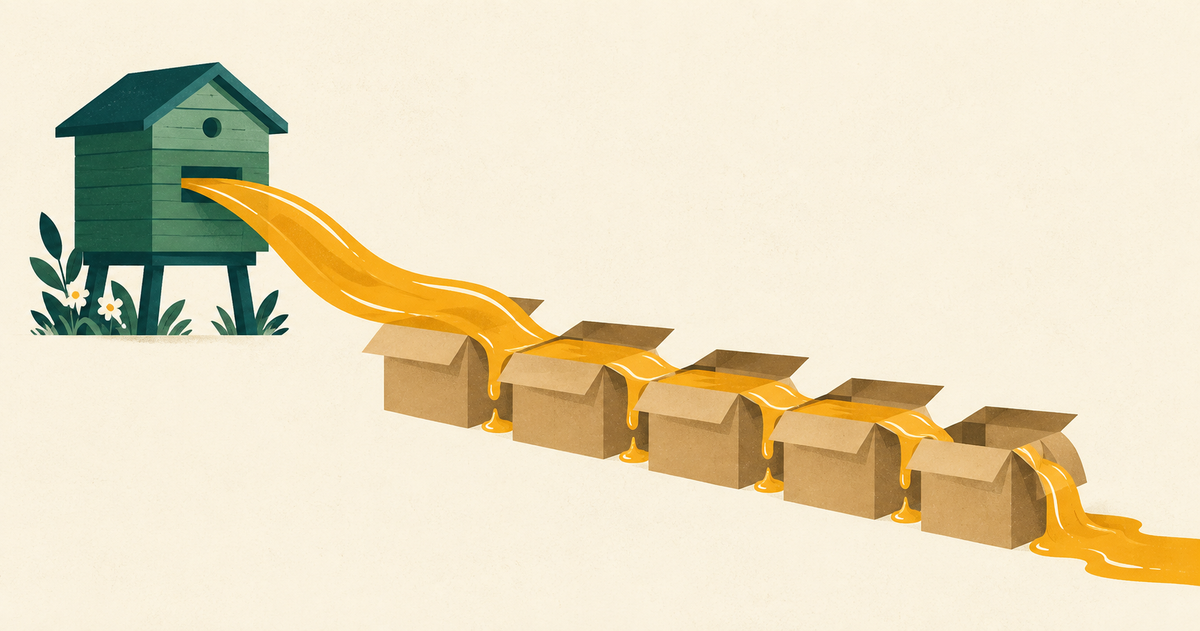
Flow Hive did not have a demand problem. It had the more dangerous opposite: a US$70,000 tooling request became US$12.2 million of preorders in eight weeks. Cedar and Stuart Anderson then had to turn a decade of prototypes into nearly 25,000 orders for customers in more than 100 countries. The practical lesson is that crowdfunding does not merely prove demand. It converts uncertainty into obligations. Before launching, a hardware founder should calculate the number of units the existing process can actually build, inspect, pack, support, and replace. A smaller campaign can be a better business if it keeps those obligations inside the team's learning capacity.
The campaign sold a mechanism that viewers understood
Cedar Anderson grew up around bees and spent roughly ten years testing ways to extract honey without removing and centrifuging conventional frames. The eventual mechanism used partially formed cells that split vertically when a key was turned, allowing honey to drain through a channel. Flow Hive's account of the development says the founders quit their jobs and sought US$70,000 in preorders for production.
The pitch compressed an unfamiliar invention into one visible action: turn a key and watch honey enter a jar. It reached the goal within minutes and US$250,000 within 15 minutes. Eight weeks produced US$12.2 million and almost 25,000 orders. That clarity was an acquisition asset, but it hid the number of operational steps between a convincing video and a delivered hive.
ABC Australia's follow-up reported that the business grew to about 35 local staff, three factories, and six or seven warehouses. Stuart Anderson admitted that the promised December delivery date had been made without understanding the workload. The campaign validated demand and multiplied the cost of every immature process at the same time.
Success should be capped by throughput, not attention
Illustrative arithmetic shows the exposure. Suppose a workshop can finish and inspect 250 kits a week. A campaign promising 5,000 kits creates 20 weeks of production before rework, supplier delays, or replacement parts. If each kit produces only 12 minutes of support, the first cohort also creates 1,000 support hours. At six productive support hours a day, that is about 167 person-days.
The same campaign at 1,000 units creates four production weeks and 200 support hours. It raises less cash, but the team can observe assembly failures, packaging damage, confusing instructions, and real customer use before those errors reach another 4,000 homes. A cap is not timidity. It prices the value of learning while changes are still cheap.
Use this capacity ceiling before setting a public reward quantity:
Safe first cohort = the lowest of production capacity, inspection capacity, packed-shipping capacity, and support capacity during the promised window.
Apply a buffer of at least 25 percent to the weakest number. A factory quotation is not the capacity of the whole system. If 4,000 units can be molded but only 900 can be tested and packed, the launch capacity is 900.
The product removed extraction work, not beekeeping
A strong demonstration can also make a mechanism look like a complete solution. Flow Hive changes honey extraction. It does not eliminate colony inspection, disease monitoring, swarm management, feeding, or seasonal work. A beekeeping trade article described the simpler extraction process while recording experts' concern that novices might mistake easier harvesting for easier animal care.
This distinction is commercially important. When marketing expands a category to beginners, support must teach the unchanged work as clearly as the new convenience. Otherwise acquisition creates unsuitable customers, poor outcomes, and blame aimed at the product. The company now publishes brood-inspection guidance, but the principle applies to any physical innovation: name the job removed and the jobs that remain.
| Launch claim | Proof needed | Work that remains |
|---|---|---|
| Faster harvest | Timed side-by-side process | Hive inspection and health management |
| Easier assembly | First-time user completion rate | Maintenance and safe operation |
| Lower labor | Loaded hours per output | Training, cleaning, and support |
| Less equipment | Full equipment list | Consumables and local requirements |
A launch-readiness test for physical products
Before opening preorders, run four gates.
- Freeze one build. Assemble ten units from the same drawings, suppliers, tools, and instructions intended for production. Record every deviation rather than fixing it silently.
- Ship the pilot. Send units through the actual carrier and packaging route. Inspect damage, customs paperwork, missing parts, and delivery time.
- Support strangers. Give the product to people who did not watch its development. Count questions and minutes to resolution.
- Model failure. Reserve cash and components for replacements. If a 5 percent defect rate would consume the campaign's remaining cash, the campaign is underpriced or oversized.
This complements the readiness discipline in Ugmonk's three-year prototype story. Flow Hive adds a different warning: even an invention that works can outrun the organization delivering it.
What to do in the next hour
Open the current campaign plan and add four rows: units assembled per week, units fully inspected per week, units packed per week, and support cases resolved per week. Use observed pilot numbers, not supplier promises. Multiply each by the number of working weeks before the delivery date, subtract a 25 percent buffer, and choose the lowest result.
Then write one sentence that begins, "This product removes..." and another that begins, "Customers still must..." Put both in the campaign. That wording protects trust because it separates a vivid mechanism from the larger job around it.
Flow Hive's launch remains an extraordinary proof of interest. It also shows why demand is not the same as readiness. The founders found tens of thousands of buyers before they had an organization sized to serve them. A hardware campaign should finance the next repeatable production step, not create a backlog so large that the company learns the same lesson thousands of times. For the supplier side of that preparation, use the critical-path method in MNT Reform's manufacturing map.
Protect the learning loop after launch
A large backlog tempts a team to freeze the design and push units out, even when the first customers reveal a correctable fault. Divide fulfillment into lots with an acceptance pause between them. For example, ship 100 units, wait for a defined observation window, classify every defect and question, then authorize the next 400 only when no stop condition is active. Suppliers dislike interruptions, so put lot acceptance and change-control rights into the purchase order before paying the deposit.
Keep campaign updates operational. Report units built, units accepted, units shipped, the present constraint, and the next decision date. Do not turn an uncertain supplier estimate into a customer promise. A date range tied to a named production milestone is more useful than confident weekly optimism.
Finally, calculate the cost of success before buying attention. If the campaign cap is 1,000 and the current audience can plausibly fill it, more paid traffic adds no useful demand. Put that budget into inspection fixtures, spare components, packaging trials, or support documentation. The best acquisition spend can be the money that makes the acquired customer whole.
Crowdfunding success is not money in the bank; it is a factory promise multiplied by every new backer.
Discussion
Sign in with Google or just a name. No email link, no password to remember.