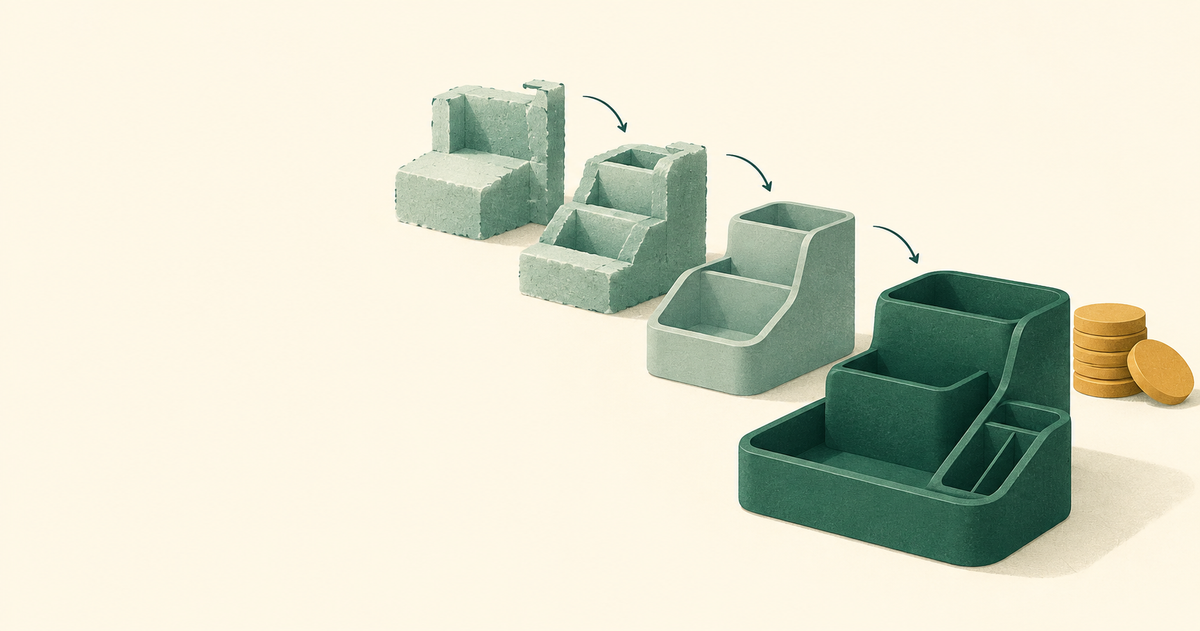
Ugmonk is a small design brand founded by Jeff Sheldon. Its modular desk organizer, Gather, raised $430,960 on Kickstarter, but the campaign did not validate a sketch. Designer Jeff Sheldon had already spent three years making foam models, engineering production drawings, building an audience around his design work, and preparing a product film. The campaign validated whether enough people would fund manufacturing at the proposed price. That distinction is the useful lesson: crowdfunding can answer a demand question after technical uncertainty has been reduced. It is a dangerous place to discover both whether buyers care and whether the object can be made.
Three years came before 47 minutes
Sheldon wanted a central place for the small objects accumulating on his desk. Existing organizers did not fit the way he worked or the restrained visual style of the other products he sold through Ugmonk. He began with sketches and foam cut by hand, then worked with industrial designers on 3D models and production drawings.
His account says the process took three years and dozens of prototypes. Manufacturing roadblocks nearly stopped the project more than once. Those years are missing from the familiar headline that Gather reached its Kickstarter goal in 47 minutes.
The complete campaign ran from May 15 to July 14, 2017. Kickstarter records 2,587 backers, $430,960 pledged, and an $18,000 goal. Dividing pledges by backers gives an average pledge of about $166.59. That is not the product's retail price and does not account for reward mixes, shipping, cancellations, taxes, fees, or failed payments. It is still a useful check on the scale of the obligation: this was a premium physical good, not a low-cost impulse pledge.
The audience was part of the production system
By 2017 Sheldon had spent years publishing his work and selling other Ugmonk products. Gather therefore launched into accumulated trust. Backers could judge his taste, product photography, and history of delivering objects. The first day's result was not evidence that any attractive desk accessory could do the same.
The launch film converted that trust into a concrete use case. Director Jeremiah Warren later described how Sheldon supplied the script, visual references, and a clear product story. Warren says the campaign passed $100,000 in 24 hours and reached $250,000 about one-third of the way through. Product Hunt and design press added momentum. The film was a sales asset built on prototypes that could be shown from multiple angles, not a substitute for prototypes.
This is where Gather differs from a cold crowdfunding launch. The campaign combined three kinds of proof:
- Problem proof: a cluttered desk and scattered tools are visible without explanation.
- Product proof: working prototypes demonstrate the modular pieces and materials.
- Delivery proof: an established maker, production drawings, and a long public design history reduce perceived execution risk.
Remove any one of the three and the same video becomes less persuasive.
The funding goal was not the project budget
An $18,000 goal can be mistaken for the cost of producing Gather. Kickstarter goals are campaign thresholds, not audited cost schedules. The final $430,960 was gross pledged value. The founder still had to pay platform and payment fees, manufacture several reward combinations, replace defects, package orders, and ship them.
Use a conservative preorder ledger before setting a goal. This illustrative example starts with 1,000 units at a $160 average collected price:
| Item | Assumption | Amount |
|---|---|---|
| Gross collected | 1,000 x $160 | $160,000 |
| Platform and payment | 8 percent | -$12,800 |
| Manufacturing | 1,050 units x $62 | -$65,100 |
| Freight and fulfillment | 1,000 x $24 | -$24,000 |
| Development and tooling | fixed | -$28,000 |
| Contingency | 10 percent of gross | -$16,000 |
| Remainder | before tax and overhead | $14,100 |
The apparent $160,000 launch leaves $14,100 before ongoing payroll, returns, tax, and founder pay. Change manufacturing cost from $62 to $72 and most of that buffer disappears. This is why a campaign that beats its goal can still create a cash crisis.
A campaign-readiness rule
Launch only when all five statements are true:
- A representative prototype performs the promised job.
- A manufacturer has reviewed current drawings and quoted the expected volume.
- The price includes fees, freight, duty, defects, replacements, and a contingency.
- The campaign can show a specific audience already responding to the work.
- The founder can explain which parts of the schedule remain uncertain.
That rule is stricter than "people told me they like it" and cheaper than discovering a tooling problem after collecting thousands of orders. It also complements the first-customer pattern: existing relationships and demonstrated expertise usually beat a cold crowd.
Within an hour, build the preorder ledger with quotes rather than hopes. Add a 10 percent unit overage, a 10 percent cash contingency, and the actual destination mix for shipping. Then write the date on every input. If the remainder is negative, the solution is not a bigger campaign goal. It is a higher price, a simpler product, a smaller promise, or a better manufacturing plan.
Gather's transferable achievement was sequencing. Sheldon used prototypes to reduce product risk, an audience to reduce attention risk, and Kickstarter to reduce inventory risk. Crowdfunding worked because it was asked to solve one expensive uncertainty, not every uncertainty at once.
Separate backer demand from a durable market
Gather's 2,587 backers were enough to justify a first production run, but a campaign audience is unusually concentrated. Backers tolerate longer waits, enjoy process updates, and may value novelty more than later retail customers. After fulfillment, a founder still needs to learn whether the product sells at a normal price without a countdown.
Track three cohorts separately: campaign backers, customers acquired from the founder's existing audience after launch, and customers arriving through ordinary retail or search. Compare refund rate, support time, accessory purchases, and contribution after shipping. If campaign customers are profitable but later customers are not, the launch validated a finite event rather than an ongoing channel.
Physical design also creates option value when the system supports additions. A modular organizer can gain trays or stands without replacing the base. That can increase order value, but every new piece adds tooling, inventory, packaging, and forecasting. Require an accessory to use an existing interface and clear a minimum preorder before it earns a production slot.
The most useful missing number in many crowdfunding retrospectives is post-fulfillment cash. Gross pledges make the headline, while damaged units, reshipments, storage, and late freight determine whether the founder can reorder. Close the campaign ledger only after the final replacement ships. Then carry the actual defect and fulfillment rates into the next batch rather than returning to the optimistic launch assumptions.
That final ledger is also the honest basis for wholesale pricing. A retailer's margin cannot be funded by ignoring costs that campaign backers already revealed.
Use the measured defect and damage rates to design the returns policy before opening ordinary retail sales.
Crowdfunding is most powerful after prototypes have answered how to build and customers are asked whether the finished idea deserves to exist.
Discussion
Sign in with Google or just a name. No email link, no password to remember.