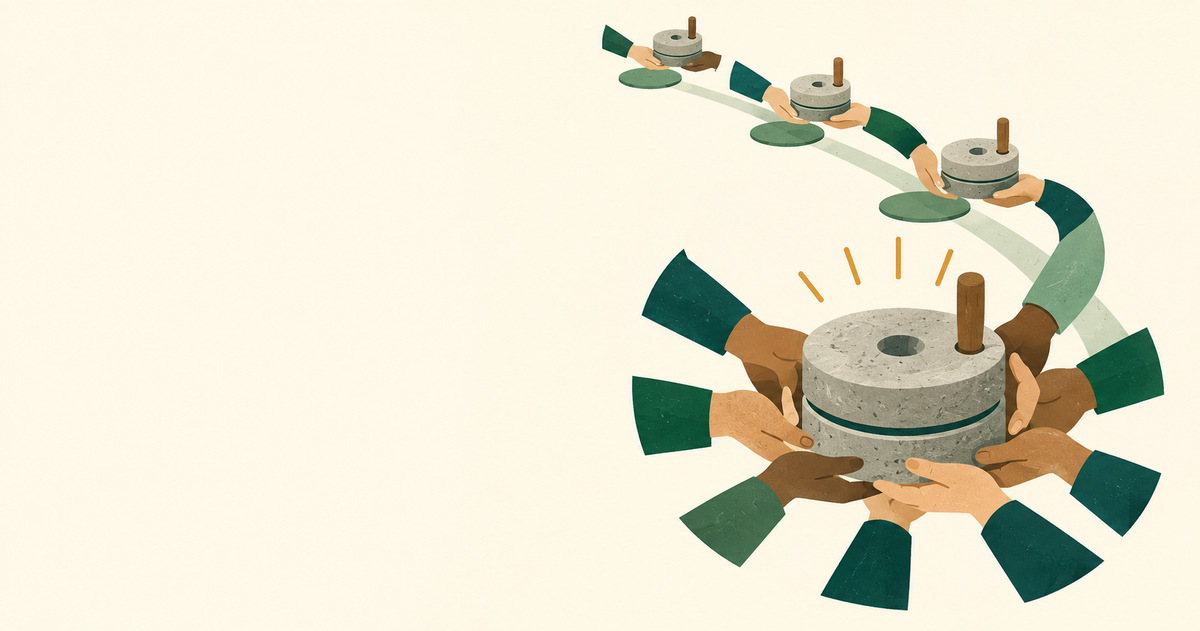
Bob's Red Mill is a flour and whole-grain company founded by Bob Moore. Moore did not hand it to employees in one ceremonial transfer. He created an employee stock ownership plan in 2010, when the company had operated for more than three decades, and the trust reached 100 percent ownership ten years later. That staged path matters. An ESOP is not a founder gift dropped into individual brokerage accounts. It is a retirement plan whose trust owns shares, whose participants receive allocations over time, and whose company must fund the transaction and future repurchases. For an owner considering succession, the first question is not generosity. It is whether the business has stable cash flow, a management team, and enough scale to carry the mechanism.
A mill became a succession problem
Bob and Charlee Moore founded Bob's Red Mill in 1978. The company grew from stone-ground grains into a broad food manufacturer. Its own history records international distribution beginning in 2000, a larger facility in 2008, and more than 200 products by the time of later milestones.
The company's founder timeline also shows why succession could not be separated from operations. A 1988 fire destroyed the original mill, and the business rebuilt before later expanding manufacturing and gluten-free capacity. A transferable company needed facilities, processes, and managers able to survive events larger than one founder's daily decisions.
Large companies made acquisition offers. Moore wanted the company to remain independent and wanted long-serving employees to share in what they had built. On his 81st birthday in 2010 he announced the ESOP. The company says it became 100 percent employee-owned on April 30, 2020.
That decade gives the transaction economic shape. A trust can acquire shares in stages while the company develops the cash flow, governance, and internal leadership needed to operate without concentrated founder ownership. The founder can receive liquidity over time rather than requiring employees to write personal checks.
What employees own
In a conventional US ESOP, a trust owns company stock for eligible employees. Individual accounts receive allocations under plan rules. Employees generally pay nothing for the shares. Value becomes a retirement benefit, subject to vesting and distribution rules, rather than cash they can trade tomorrow.
Bob's Red Mill says employees receive company stock each year. In its 2024 remembrance of Moore, the company reported more than 700 employee-owners, more than 200 products, and distribution in over 70 countries. Those scale figures are company statements. They show why this example should not be treated as a plug-in answer for a six-person contractor.
The plan also creates concentration risk. A worker's job and part of retirement wealth depend on the same private company. Diversification rules, valuation, distributions, and repurchase obligations matter. This article describes the operating questions raised by the case; it is not legal, tax, or retirement advice.
The company buys itself with future cash
A simplified leveraged ESOP can be understood with illustrative arithmetic. Suppose an independent valuation puts a company at $20 million. The ESOP trust borrows $12 million to buy 60 percent of the shares. The seller keeps 40 percent for a later stage. If the company contributes $2 million a year to service principal, ignoring interest and fees, the initial principal takes six years:
$12 million / $2 million = 6 years.
Reality adds interest, transaction costs, taxes, valuation updates, and a schedule for releasing shares to employee accounts. The company must also fund normal machinery, inventory, and payroll. If annual free cash flow is only $2.2 million, committing $2 million to the transaction leaves almost no shock absorber. A good succession structure cannot consume the operating resilience it is meant to preserve.
Later, the company faces a repurchase obligation when vested participants retire or leave and their benefits become payable. A mature ESOP therefore needs a forward model of participant ages, account values, departure assumptions, and payment rules. The purchase closes once; repurchase planning continues.
A founder-readiness test
Before paying advisers to design a transaction, score five operating conditions:
- Cash quality: are three to five years of normalized cash flows positive after real maintenance spending?
- Leadership: can managers price, hire, buy inventory, and serve key accounts without the owner?
- Customer concentration: would one lost account threaten debt service?
- Workforce scale: are there enough eligible employees to justify recurring valuation, administration, audit, and communication costs?
- Repurchase capacity: has the company modeled benefits due under plausible retirement and turnover scenarios?
If leadership is weak, ownership transfer does not repair it. The owner's most valuable pre-transaction work may be documenting decisions and transferring customer relationships, the same durable process-building that makes any founder-dependent company less fragile.
What the Bob's Red Mill case proves
It proves that a product company can move from founder ownership to employee ownership in stages and remain an operating brand after the founder's death. Moore remained on the board until he died in 2024, while ownership had already moved to the trust. The governance and economic transition were not postponed until a health event forced a hurried sale.
It does not prove that an ESOP always pays a higher price, protects every job, or gives workers direct democratic control. Trust ownership, board governance, management authority, and participant voting are distinct. Nor does the label reveal how transaction debt or account allocations affect individual workers.
Within an hour, an owner can export five years of operating cash flow, subtract realistic maintenance capital and owner replacement pay, and calculate the lowest year. Then list every decision only the owner can make. Those two documents are a focused dependency audit: they reveal whether the company is an asset capable of financing succession or still a job attached to one person.
Moore's contribution was not merely refusing an acquirer. He began succession while there was time to stage it. That preserved optionality and gave the company a decade to become fully employee-owned rather than asking one transaction to solve ownership, leadership, financing, and legacy on the same day.
A staged sale also creates checkpoints. After each tranche, the board can compare debt service with plan assumptions, test whether managers are taking real authority, and update the repurchase forecast. If the business deteriorates, the next stage can be reconsidered before the trust owns an asset it cannot support. If performance improves, later founder shares may be valued differently. That can create tension between seller price and employee benefit, which is why an independent trustee and valuation process matter.
Employees need a plain annual statement that separates account balance, vested amount, share value, and expected distribution timing. Calling everyone an owner without explaining those limits invites disappointment. The operating culture should encourage useful cost and quality decisions while making clear that management roles and trust ownership are not identical.
Employee ownership becomes real when people understand both the value they are building and the rules that turn it into retirement wealth.
Discussion
Sign in with Google or just a name. No email link, no password to remember.