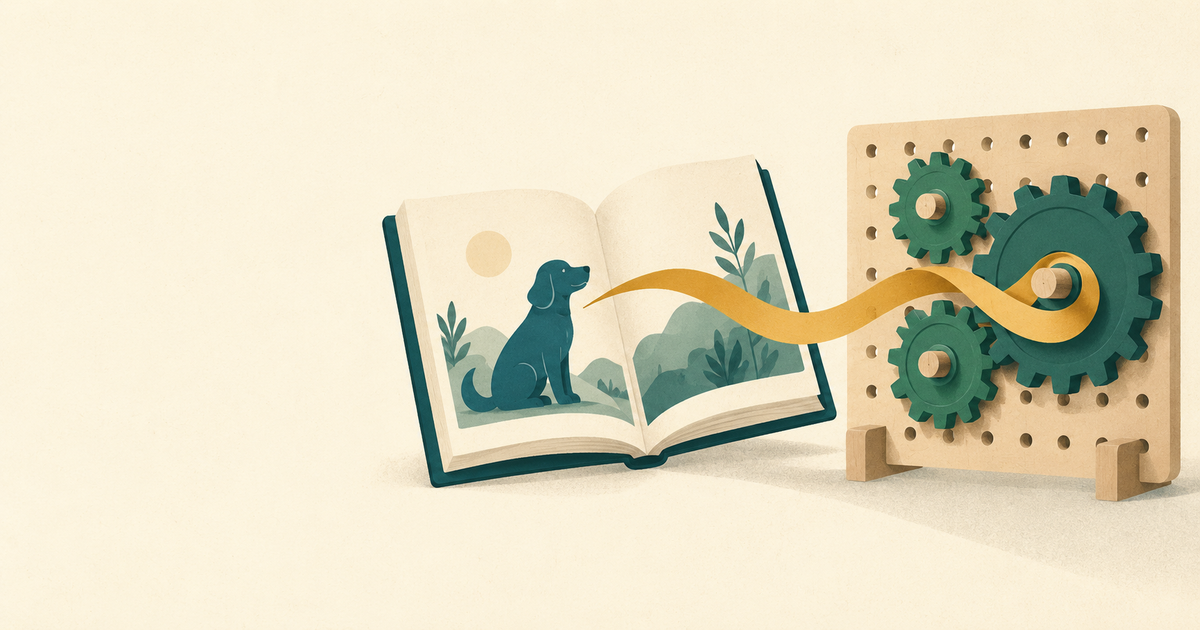
GoldieBlox began as a construction toy paired with a storybook, created by engineer Debbie Sterling. Her design problem was not only whether children could connect the pieces, but whether they wanted to build the mechanism in the first place.
A story gave the construction a purpose. That is a useful founder lesson for any physical product whose value appears only after someone begins using it: test the invitation to act separately from the instructions. Clear directions cannot rescue a task the customer has no reason to start.
A kit needed something worth making
In Physics Today's March 2013 interview, Sterling described developing the toy through work with children. The first kit contained 33 pieces, including a pegboard, wheels, axles and ribbon. Its story involved building a spinning device for a dog named Nacho. The construction supported an event in the story.
The mechanical principle was a belt drive: a loop transfers movement between wheels. Naming that principle is less important for a new user than making the movement understandable. The character's problem offered a reason to discover what the mechanism could do.
The interview is a design account, not a controlled study proving educational outcomes. It is also not evidence that all girls learn one way or all boys another. The transferable idea is narrower: a designer can experiment with the motivation surrounding a task instead of changing only its physical components.
This changes the prototype. Testing the pieces on their own answers whether assembly works. Testing the book alone answers whether the story interests someone. The commercial product depends on the handoff between reading and building.
A rejected pitch did not settle the user question
GoldieBlox's own origin story recalls a disappointing Toy Fair reception before the company turned to Kickstarter. Treat that sequence as the company's retrospective account. It does not prove that every skeptical buyer was wrong or that crowdfunding reliably validates a toy.
The conflict is useful because a retail buyer, an adult purchaser and a child user make different decisions. The retailer asks whether a product deserves shelf space. The adult asks whether it is a worthwhile purchase. The child decides whether to pick it up and persist.
GeekWire's September 2012 launch coverage describes the combined book and construction kit as the campaign began. That contemporary record supports the early product concept. An early fundraising snapshot, however, cannot establish eventual production profit, learning effectiveness or repeat purchase.
A founder should resist merging all three audiences into one approval score. An adult may praise the ambition while a child abandons the activity. A child may love a prototype that an adult finds too expensive, fragile or difficult to store. Both observations matter.
Observe the moment the product loses its user
For a supervised, age-appropriate prototype session, separate three kinds of friction. These are proposed observations for a founder, not findings from GoldieBlox's tests.
- Motivation: does the user choose to begin, and can they explain what they hope to accomplish?
- Comprehension: do they understand the next action without someone translating the instructions?
- Mechanics: can they perform that action with the actual pieces, effort and tolerances?
A pause can have any of these causes. The user may not care what happens next. They may care but misunderstand the directions. Or they may know exactly what to do while a connector is too awkward to manipulate. Rewriting the story will not fix the connector.
Record the first pause, what happened immediately before it and what assistance restarted the activity. Avoid leading questions such as whether the user found the story exciting. Watching voluntary action is often more informative than collecting polite agreement.
The approach connects to following observed use in the PopSockets story. A founder learns from the action a person takes, then identifies which part of the product supported it. Here the relevant action is moving from an interesting premise to a physical build.
A small test can separate the two promises
Create two versions of the same safe prototype. Version A uses concise task instructions. Version B uses the same pieces and assembly steps, with a short narrative reason to complete them. Keep session length and assistance consistent enough to make comparison useful.
Rotate the order across participants. Otherwise the second version may look easier simply because the user already learned the mechanism. With a small sample, describe observations and disagreements rather than declaring a universal winner.
Ask adult purchasers a different set of questions after they watch. What would they expect the box to include? Where would it be used and stored? What replacement parts might be needed? Which existing purchase would it displace? Their answers reveal the buying context without asking children to solve the pricing question.
This is formative product research. It is not a trial of long-term educational benefit. Claims about learning need an appropriate research design and evidence beyond a handful of enjoyable sessions.
Budget for observation, not a polished box
Here is an illustrative US-dollar prototype budget. Assume $120 for reusable components, $60 for simple printed materials, $80 for participant expenses and $40 for other consumables. Cash cost is $300. Add eight hours of preparation and observation valued at $30 an hour, giving a $540 total resource cost.
If six supervised sessions identify two recurring failures, the useful output is a prioritised revision list, not a conversion rate. Dividing $540 by six gives $90 per session. That figure helps compare the test with a packaging redesign or another round of promotional photography.
The inputs are hypothetical and exclude specialist safety assessment, production tooling and any institutional research requirements. A children's product cannot treat a workable prototype as evidence that it is ready for sale. The session design and materials must fit the users and setting.
For a founder on a limited budget, a rough story can be enough to test the handoff. Expensive illustration is premature if users cannot tell when to put the book down and touch the parts. Save finish work for a structure that earns it.
Write the invitation before ordering the tooling
Start with a one-hour exercise: write one sentence describing what your product lets a new user accomplish. Then write the first three actions required. Mark the point where interest must become effort. Draft two different reasons to take that step and plan a small observation session.
For a construction toy, the reason might be helping a character. For a repair kit, it might be saving a useful object. For kitchen hardware, it might be producing a particular meal. The premise must fit the real product rather than promising an outcome it cannot deliver.
Peak Design's crowdfunding history is a useful reminder that launch attention and a repeatable product business are separate stages. GoldieBlox's early design adds a stage before either: making the first use worth starting.
A good instruction tells the user what to do next. A good product also gives them a reason to want the next step.
Discussion
Sign in with Google or just a name. No email link, no password to remember.