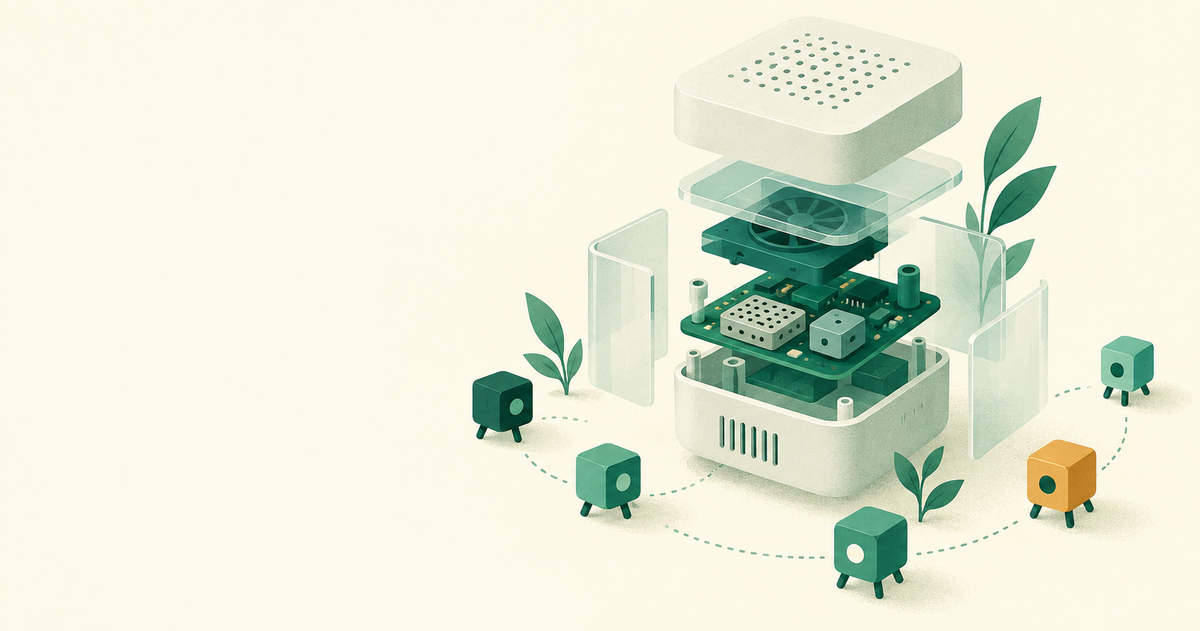
AirGradient publishes the source code, circuit schematics, circuit-board layout, and enclosure files for its air-quality monitors. That does not leave it with nothing to sell. It moves the thing customers pay for away from secrecy and toward calibrated hardware, dependable sourcing, documentation, support, and trust. The practical lesson is not that every hardware company should reveal everything. It is that design files are only a moat when competitors cannot execute them. If customers value confidence after the download, openness can become a distribution channel rather than a giveaway.
The product is more than the files
An independent assembly review confirms what “open” means here. The AirGradient ONE uses an ESP32-C3 controller plus modules from Plantower, Senseair, and Sensirion. A buyer can inspect the board, print an enclosure, change the firmware, or direct readings somewhere other than AirGradient's dashboard. The monitor also works locally without Wi-Fi.
Those freedoms expose an important distinction. A bill of materials is not a calibrated instrument. Someone still has to choose genuine sensors, test them, compensate for enclosure airflow, maintain firmware, write assembly instructions, package the parts, replace failures, and answer procurement questions. Institutional buyers also care about continuity. A school network cannot solve a failed deployment by pointing to a repository.
In its account of its business model, AirGradient says its team has more than 20 people but no sales team. That is a company statement, not an audited staffing record. Its account of a Homey integration is more revealing: four community developers volunteered, and the integration went from request to publication in 11 days. The files made outside contribution possible. The company still owned review, compatibility, and the reputation attached to the finished result.
Openness shortened the trust conversation
Chief executive Achim Haug argues that open hardware helped partnerships with UNICEF, UNDP, and universities because partners could inspect the technology and transfer skills. In Laos, AirGradient says a UNICEF-linked project deployed monitors in public schools. UNICEF separately describes 148 real-time sensors across schools, open-source technology, and public data used with other sources. The exact device count differs from AirGradient's later account, which says 160, so this article does not collapse the two figures into one.
The mechanism is useful even when a buyer never opens a CAD file. Inspectability lowers perceived lock-in. A public agency can ask whether another supplier could maintain the system, whether readings can leave the vendor's cloud, and whether local technicians can learn the design. That can remove objections before a formal sales process begins.
This resembles the operational control discussed in MNT Reform's supplier map, but the control sits with the buyer as well as the manufacturer. It also differs from a subscription-free promise. AirGradient must keep earning hardware sales because customers can leave.
A simple moat test
| Layer | Easy to copy? | What the customer actually risks |
|---|---|---|
| Published files | Yes | A clone can reproduce old geometry and firmware. |
| Component sourcing | Sometimes | Substitutions can change accuracy and availability. |
| Calibration and testing | Harder | Bad readings make the whole purchase useless. |
| Documentation and support | Slow to build | Deployment stalls when no one owns problems. |
| Institutional trust | Slowest | A buyer needs evidence that the supplier will remain accountable. |
A founder should open a layer only when the layers below it can support the resulting attention. Publishing a board layout without stable sourcing or safe assembly guidance transfers risk to users. Publishing a mature design while keeping calibration opaque may also undermine the trust benefit.
Illustrative integration arithmetic
Suppose a six-person hardware team needs a new smart-home integration. One engineer spending four weeks on it costs 160 hours. At an illustrative loaded cost of $75 an hour, that is $12,000 before maintenance. If public documentation attracts four capable volunteers and the internal team spends 30 hours briefing, reviewing, testing, and releasing their work, the direct internal cost is $2,250.
The apparent saving is $9,750. That is not free labor. The volunteers may disappear, review can take longer than building, and a broken integration still damages the manufacturer. The calculation says when openness has leverage: interfaces are documented, contribution boundaries are narrow, tests exist, and someone inside owns the result. Without those conditions, the community becomes another queue to manage.
Use a three-question gate:
- Can an outsider succeed without private knowledge? If not, documentation debt comes first.
- Can the company verify the contribution cheaply? Hardware safety and calibration changes need stronger review than a dashboard theme.
- Does broader compatibility increase device demand? If integration only creates support burden, openness is not distribution.
What cannot be copied from this case
Air-quality monitoring has unusually strong reasons for transparency. Researchers want raw data. Public institutions dislike black boxes. Technical buyers can understand schematics. A fashion object or tightly protected medical device may get less distribution value from open files and carry more certification or design-copy risk.
AirGradient also benefits from recognizable sensor modules and a product whose usefulness grows with integrations. A hardware founder should not interpret its story as permission to publish unreleased tooling or supplier terms. The more transferable rule is to identify where customers fear lock-in and make that layer inspectable.
A one-hour disclosure inventory
Open the product folder and draw four columns: files, production knowledge, verification, and customer service. Put every asset in one column. Then mark each item public, shareable under agreement, or private. For every public item, name the paid outcome it strengthens. A schematic might strengthen procurement trust. A local API might increase compatibility. A repair manual might lower support cost.
If an item has no customer outcome, publishing it is theater. If it creates value but the company cannot verify copies or changes, it is premature. If it removes a sales objection and leaves calibration, fulfillment, and accountability intact, it may be a distribution asset.
The same discipline appears in the platform dependency audit: optionality becomes valuable before a supplier fails. AirGradient applies that idea to the buyer. Its files make exit possible. Its business must make staying easier.
The useful competitive pressure
AirGradient says openness forces it to stay ahead of cloners on cost, innovation, and community. That is a demanding strategy, not an altruistic shortcut. A closed vendor can rely longer on information asymmetry. An open vendor has to make the official product the lowest-friction implementation of public knowledge.
That pressure can improve the company if operations are already the strength. It can expose the company if a secret drawing is the only advantage. The decision is therefore not “open or closed.” It is whether the firm wants to compete on possession of information or on the speed and reliability with which it turns information into a working product.
There is also a pricing implication. A buyer comparing the official monitor with a clone should price inspection, calibration evidence, support time, replacement handling, and data portability. If the official unit costs $80 more but avoids two hours of technician work at $60 an hour, the premium is already recovered. Openness makes that comparison sharper because the vendor cannot pretend the enclosure alone explains the price.
Sharing the blueprint does not erase the value of making the finished product dependable.
Discussion
Sign in with Google or just a name. No email link, no password to remember.