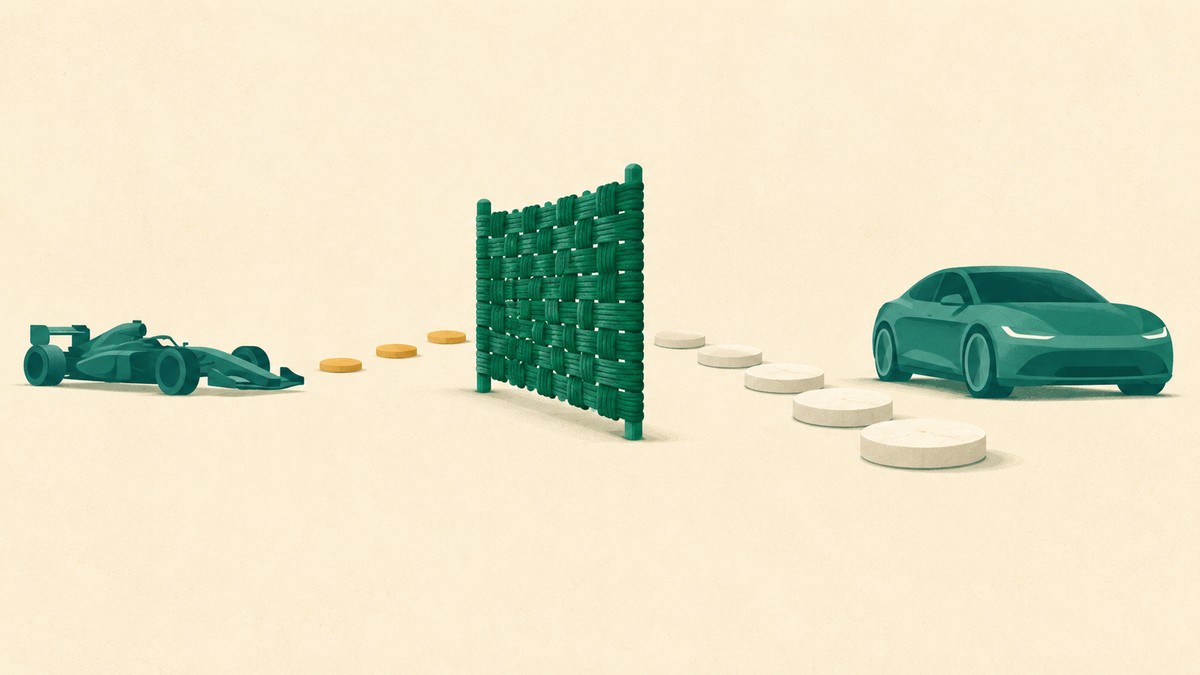
Bcomp supplies flax-fiber composite materials for vehicle parts, including woven reinforcement and lightweight grids. Its move from racing applications toward ordinary road cars shows why a materials founder needs separate commercial clocks for a fast demonstration customer and a large production customer.
The same material can enter those markets through very different development programs. A racing project can reveal technical possibilities quickly. A road-car program may require years before that learning produces visible parts and recurring supply. The founder must finance the interval without treating an impressive prototype as imminent production revenue.
A fast project is useful evidence with a narrow scope
In Professional Engineering's April 2025 report, Bcomp business-development manager Johann Wacht describes the company's fastest motorsport project taking two weeks from initial contact to a race. He contrasts that with three to five years for a comparable automotive development process.
Those are his reported examples and ranges, not guaranteed timetables for every project. Their value is the size of the difference. A supplier can receive an urgent technical request and complete a visible racing application long before a road-car customer is ready to buy at production scale.
The report describes Bcomp's motorsport work and the different manufacturing approaches used at different volumes. The case is therefore about commercial translation, not an assumption that the precise process used for a small racing component can simply be multiplied into mass production.
A founder should ask what the fast project actually proved. It may show an achievable shape, a useful performance result or a working collaboration. It may not prove the cost, supply stability or manufacturing cadence required by another customer.
The material has to travel between operating systems
BMW i Ventures' April 2022 investment account describes Bcomp's ampliTex woven flax fabric and powerRibs reinforcement grid. It also distinguishes externally produced materials from in-house grid production and notes the challenge of variable natural-fiber quality.
BMW i Ventures is an investor, so its favorable account is commercially interested. The useful details concern the operating system: suppliers, external processors, internal production and the consistency a customer needs. A promising material is already moving through several organizations before it reaches a finished vehicle.
Volvo's May 2023 EX30 design announcement, available through its Dutch media site, names flax supplied by Bcomp among the interior materials offered. That is customer-side evidence of an application beyond racing. It does not disclose the price, quantity or margin Bcomp earned on the program.
The English explanation here paraphrases the Dutch announcement. Its international-range caveat matters: described features can be optional and specifications vary by market. This article makes no claim that every EX30 trim in every country currently contains the same material.
Put learning and revenue on separate calendars
Create two rows for each customer program. The learning row records when a test, sample or installation resolves a technical question. The cash row records development payments, equipment spending, initial purchase orders and expected collection. Give each entry an evidence status.
An accepted sample can improve the learning row without advancing the cash row. Conversely, paid development work can fund progress without establishing the future volume order. The distinction prevents a sales presentation from becoming a manufacturing budget accidentally.
| Program event | Learning value | Cash evidence to request |
|---|---|---|
| Visible prototype | Shows a defined application is possible | Who pays for the next iteration? |
| Customer testing | Measures the agreed requirement | Which development costs are reimbursed? |
| Production planning | Identifies process and supply constraints | What commitment supports equipment or tooling? |
| Accepted deliveries | Demonstrates repeatability | When are invoices collected and reorders decided? |
This table is a planning framework, not Bcomp's contractual sequence. A founder should fill it with the program's actual milestones. Leave uncertain dates blank rather than compressing a customer's internal approval process into a convenient quarter-end forecast.
The gap can be larger than the prototype bill
Imagine a hypothetical materials team pursuing one road-car application. Assume it spends US$35,000 a month on incremental engineering, samples and program support for thirty-six months. That totals US$1.26 million. Assume the customer reimburses US$450,000 through development milestones.
The remaining program funding gap is US$810,000 before financing costs, equipment investment, general overhead or any future production contribution. These are invented US-dollar inputs, not Bcomp costs, contract terms or a universal automotive timeline.
Suppose another smaller application generates US$15,000 monthly contribution for twenty-four of those months after its own incremental costs. It contributes US$360,000, reducing the modeled gap to US$450,000. It helps fund the long program. It does not automatically eliminate the need for capital.
Now delay production readiness by six months while the assumed US$35,000 monthly spend continues and no extra reimbursement arrives. That adds US$210,000. The remaining gap rises to US$660,000 even with the smaller application's contribution.
The calculation asks whether the company can survive the calendar. It does not claim a road-car program is unattractive. A long program may support durable recurring business, while a fast racing job may be small and irregular. Compare the entire cash pattern rather than choosing the shortest timetable.
Review the two calendars together each month. A technical success should update the learning record; an agreed payment should update the cash record. If the long program slips, decide which spending can pause and which commitments continue. Make that decision while the company still has time to choose, rather than after the next sample consumes the remaining budget.
A small application should earn its place twice
When choosing a fast project beside a long one, ask two questions. Does it contribute cash after its own development and service work? Does its learning reduce a defined uncertainty in the longer program? A project that does neither may be an expensive distraction even if it creates an impressive photograph.
Keep transferable learning specific. A supply-handling improvement may carry across customers. A geometry developed for one racing team may not. Record what changed, where it was tested and which production question it answers. Do not transfer performance conclusions beyond their tested scope.
Sublime's industrial adoption story shows why a new material needs more than an attractive prototype. Charm's early-purchase case adds the importance of the contract that finances the path to a deliverable. Bcomp's distinct contribution is the mismatch between two customer calendars.
The opened sources do not establish current program profitability or the full cost of Bcomp's expansion. Its visible applications are surviving examples. Failed materials programs and abandoned customer evaluations would produce a less reassuring picture, so use conservative scenarios when applying the mechanism.
To begin, put your shortest and longest customer programs on one calendar. Spend an hour marking what each will teach, what each will pay and what the company must spend before collecting. The race can show that the material works. The road-car program asks whether the supplier can keep working until the customer is ready.
Discussion
Sign in with Google or just a name. No email link, no password to remember.