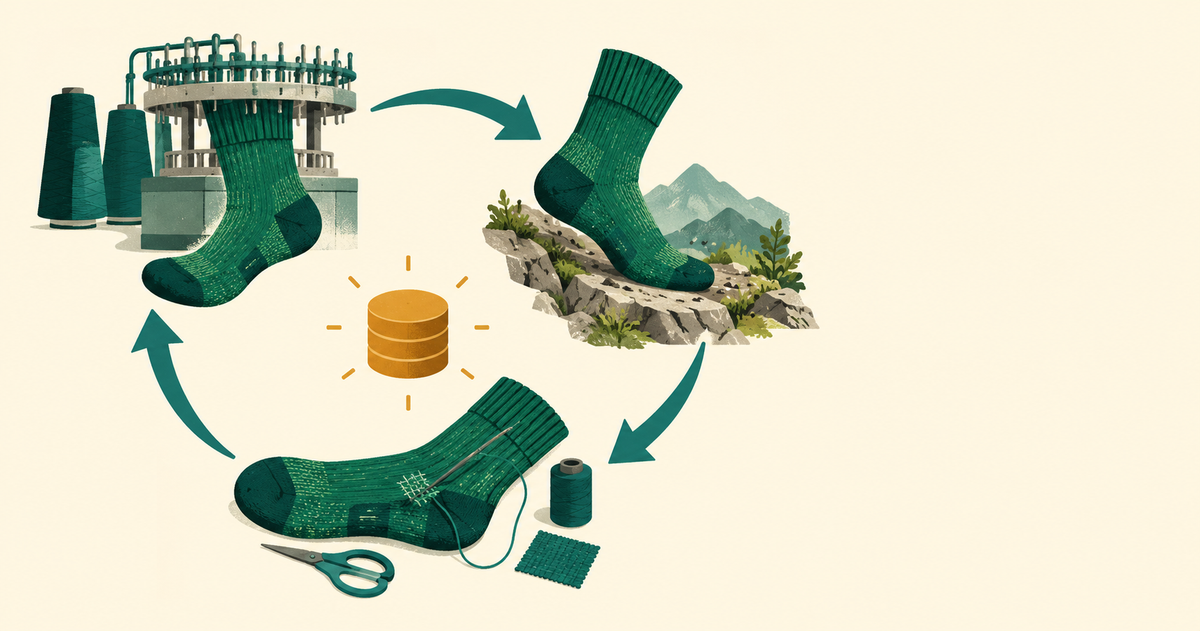
Darn Tough turned a lifetime guarantee into more than a refund policy. It linked the promise to product design, in-house knitting, customer trial, and premium pricing. In 2004 the Vermont manufacturer made 3,500 pairs and gave them to marathon runners, asking the product to prove itself on real feet. A lifetime promise can lower a buyer's fear of paying more, but it also creates a long liability tail. The transferable lesson is not to print "guaranteed for life" on packaging. It is to build the measurement, margin, quality control, and reserve that allow the company to keep the promise when old units come back.
The guarantee arrived during a manufacturing reset
Cabot Hosiery had operated in Northfield, Vermont, since 1978. When large private-label clients moved production overseas in the early 2000s, the family company needed its own brand. A historical Inc. profile reproduced by Wisconsin Business Book describes that pivot: Ric Cabot chose performance, domestic production, and a lifetime guarantee. By 2016, the profile reported a $40 million business selling nearly five million pairs annually. Those are historical reported figures, not current audited results.
Darn Tough's own history says the company gave 3,500 pairs to runners at the 2004 Vermont City Marathon. That sampling tactic matched the claim. Runners could experience fit and durability, while the company put many units into demanding use and made replacement risk observable.
The company says it can stand behind the guarantee because it knits the socks itself. Its manufacturing page says every pair is designed, developed, tested, knit, finished, and packaged at family-owned mills in Northfield and Waterbury, using yarn sourced in the United States and other countries. In-house production does not make defects impossible. It puts process data and corrective action closer together.
A warranty is a pricing input
Suppose a premium sock retails for $25, and the manufacturer's net revenue after wholesale mix and discounts averages an illustrative $15. Material, knitting, finishing, packaging, and outbound freight cost $7, leaving $8 before overhead and warranty.
If 6 percent of sold pairs eventually generate a valid replacement and each replacement costs $8 for product, handling, and shipping, expected warranty cost is $0.48 per original pair:
6% x $8 = $0.48 expected warranty cost.
Contribution after the reserve is $7.52. At a 15 percent replacement rate, the reserve rises to $1.20 and contribution falls to $6.80. If customers replace a pair more than once, or shipping costs rise, the lifetime tail is larger. These figures are illustrative and are not Darn Tough's return rate, price realization, or cost.
The simple average can also hide cohort risk. A weak yarn lot may create a surge three years later. Track claims by product, size, material, machine, production date, and failure mode. The warranty database should be a quality system, not merely a customer-service queue.
Test whether the promise changes behavior
A strong guarantee can improve conversion, permit a higher price, and generate recommendations. It can also attract customers who would have purchased anyway, creating cost without incremental demand. Measure the mechanism.
| Question | Metric | Decision |
|---|---|---|
| Does it reduce purchase fear? | Conversion or retailer close rate with and without prominent guarantee | Keep the message where it changes action |
| Does quality support it? | Claims per 1,000 pairs by cohort | Fix products above threshold |
| Does service retain trust? | Resolution time and repeat purchase after claim | Staff the promise adequately |
| Does abuse dominate? | Rejected and repeat claims with reasons | Clarify terms without punishing normal buyers |
| Can cash support the tail? | Reserve versus projected claims | Adjust price, product, or scope |
The guarantee should be specific about normal wear, misuse, loss, factory seconds, proof of purchase, and shipping. Darn Tough markets an unconditional lifetime guarantee, but founders should not borrow the phrase unless their own terms and economics support the ordinary meaning customers will hear.
Free samples and guarantees solve different doubts
The 3,500 marathon pairs removed trial risk: runners did not need to believe an advertisement. The guarantee removed durability risk after purchase. Together they attacked two barriers, but the free batch also cost real production capacity.
An illustrative 3,500-unit sampling run at $7 delivered cost uses $24,500. If 12 percent of recipients later make a $25 purchase through a direct channel with $15 contribution before acquisition cost, 420 purchases contribute $6,300. The first purchase alone does not repay the samples. The tactic needs repeat buying, retailer attention, word of mouth, or product feedback to close the gap.
This is why a sampling program needs a defined audience and follow-up. Marathon runners were credible users of performance socks. Handing the same batch to random pedestrians would produce less diagnostic wear and weaker recommendations.
What in-house production contributes
Manufacturing control connects a returned hole to stitch density, yarn, sizing, or finishing. A brand using a contract factory can build the same loop if it preserves batch identifiers, inspection data, samples, and supplier accountability. Ownership is not the only route. Traceability is.
Darn Tough's Vermont story also supports the brand, but domestic production by itself does not prove durability or justify price. The customer promise must remain tied to performance. This echoes the landed-cost approach in Trunki's manufacturing decision: count quality, delay, and feedback, not only the factory quote.
A one-hour guarantee stress test
- Export twelve months of returns with SKU, batch, reason, handling minutes, and total replacement cost.
- Calculate claims per 1,000 units and expected cost per original sale.
- Run low, expected, and double-claim scenarios over five years.
- Name the production change triggered by the top two failure modes.
- Read the public promise beside actual service practice and remove any gap.
If no cohort data exists, begin with the next unit. A guarantee without traceability cannot improve the product and will be priced by guesswork. Pair the exercise with the returns policy design to separate change-of-mind returns from failures the product promise should absorb.
Darn Tough's guarantee became credible because it was attached to a narrow product category, manufacturing knowledge, and a public willingness to replace failures. The promise is powerful precisely because it is expensive when quality slips. Founders should treat that expense as a sensor and a liability. If the company cannot measure both, the bold guarantee is marketing borrowed from future cash.
Retail partners need the same clarity. Decide whether a claim is handled in store or by the manufacturer, who pays freight, how the retailer receives credit, and which products are excluded. An easy promise on the package paired with a confused counter experience moves cost onto the channel and weakens trust. Test the claim journey anonymously at least once a quarter.
Finally, compare warranty language across every surface: package, retailer listing, website, receipt, and support reply. Contradictions create avoidable disputes. Give the support team authority to resolve normal claims quickly, but review unusual patterns separately so fraud controls do not turn an ordinary replacement into an interrogation.
A lifetime promise becomes believable when the factory learns from every product that comes back.
Discussion
Sign in with Google or just a name. No email link, no password to remember.