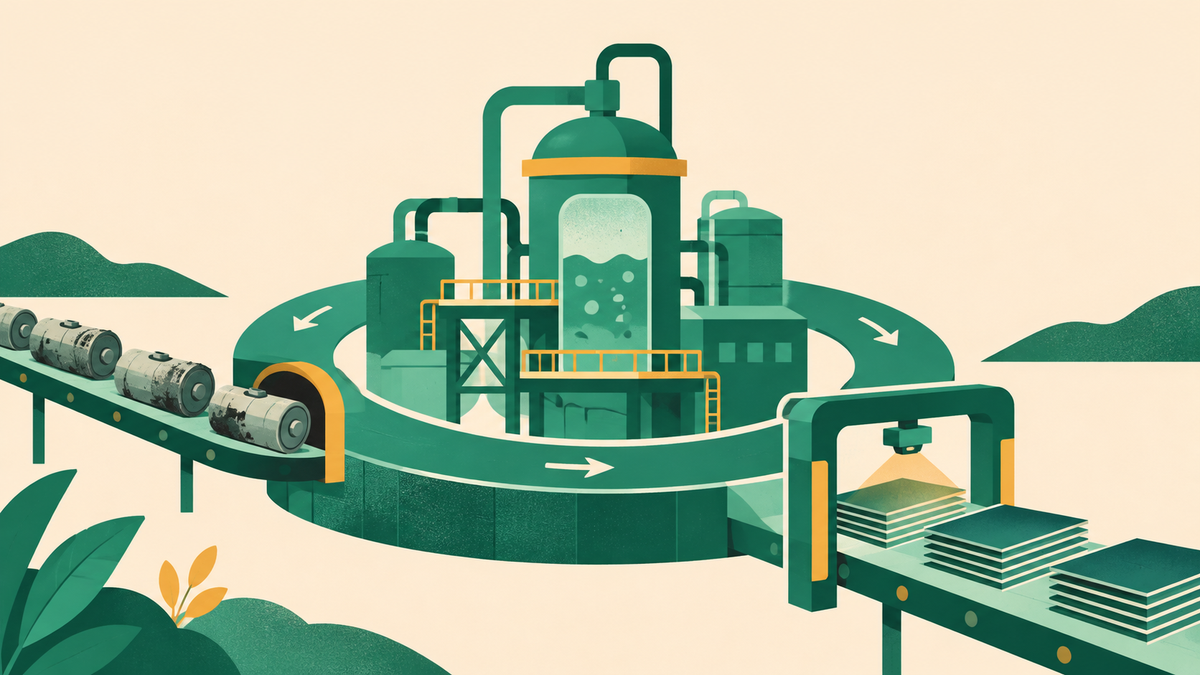
Redwood Materials recycles lithium-ion batteries and manufacturing scrap, then turns recovered inputs into battery materials such as copper foil and cathode active material. The attractive story is circularity. The harder business is qualification: a battery maker needs a material that meets its specification, arrives at scale and performs consistently.
For a founder commercializing recovered material, feedstock is only the first inventory. The saleable product begins after sorting, refining, conversion, quality control and customer acceptance.
The loop contains commercial gates
In its Panasonic partnership announcement, Redwood said recycled scrap from Panasonic's Nevada cell production already entered its system and that Panasonic would source Redwood cathode material for a Kansas plant targeted for 2025. Panasonic's own release described planned use of recycled cathode material and copper foil in specified US facilities.
An Associated Press report on a federal loan commitment described Redwood's Nevada operation, supply contracts and the planned domestic production of both materials. These pages verify the direction and named relationships. They do not publish Redwood's yield, contract prices or current accepted volume.
The distinction matters. A recycler can have abundant incoming batteries while lacking enough feedstock of the right chemistry. It can recover metals while still needing to convert them into the morphology and purity a cell maker accepts. It can produce samples while a customer plant's ramp moves later than expected.
Map two flows, not one
Draw the physical flow above a commercial flow. On the physical line, record collection, discharge, sorting, mechanical processing, refining, material synthesis, packing and delivery. On the commercial line, record supplier agreement, sample specification, customer testing, qualification, forecast, purchase order and accepted shipment.
Connect each physical stage to the commercial evidence that releases the next investment. New refining capacity should not be justified only by tonnes of mixed material collected. It also needs an output route and customer acceptance plan.
| Claim | Minimum useful unit | Missing risk |
|---|---|---|
| Feedstock secured | Tonnes by chemistry and month | Recoverable content varies |
| Recovery demonstrated | Yield by input class | Not yet a qualified product |
| Sample accepted | Named specification and test lot | Repeatability and scale |
| Supply contracted | Volume, window and conditions | Customer ramp and remedies |
| Shipment accepted | Paid, conforming lot | Future demand still varies |
Illustrative arithmetic: capacity is not saleable output
Assume a fictional plant receives 12,000 tonnes of mixed feedstock a year. Suppose 75 percent is processable in the current line, 90 percent of the target material is recovered from that portion, and 92 percent of the recovered intermediate becomes conforming finished material. The usable output basis is 12,000 times 0.75 times 0.90 times 0.92, or 7,452 tonnes before considering the target material's share of the input.
If only 40 percent of the processable feedstock is relevant to the contracted product, the associated output becomes 2,981 tonnes. These are illustrative assumptions, not Redwood data. They show why an announcement expressed in site capacity cannot be inserted directly into a revenue model.
Now add the customer ramp. If the buyer accepts 50 percent of qualified capacity in year one, fixed costs land on half the hoped-for sales. A founder should keep installed, qualified and sold capacity as three separate rows.
Closed-loop language needs a boundary
A loop may mean production scrap returns to a supplier and comes back as material for new cells. It may include consumer batteries from many products. It may be local for one component and global for another. State what crosses the boundary and what does not.
Redwood and Panasonic's releases describe scrap, copper foil and cathode material across named facilities. That is more concrete than saying batteries are simply “recycled into batteries.” A founder can apply the same discipline with a one-sentence material boundary: “We accept X, recover Y, manufacture Z and sell it to customer class Q.”
This boundary also improves customer acquisition. Procurement teams do not buy circularity in the abstract. They buy a conforming material, delivery assurance, documentation and a price, with circular content as an additional attribute. The sales file should lead with the job the product performs.
The next-hour qualification checklist
- Name the exact incoming material classes the process can handle today.
- Record yield and impurity evidence separately for each class.
- Write the output specification and identify who controls it.
- List the customer's sample, audit and production-lot gates.
- Model the customer plant at low, base and delayed ramp.
- Identify where rejected output can go without assuming full price.
This resembles the distinction between a battery-material plant and a battery factory. Units matter because they keep one company's capacity from masquerading as another company's finished output.
Redwood's named partnerships make its path unusually visible, but its unpublished economics limit outside conclusions. The defensible founder lesson is procedural. In circular manufacturing, the input can look like the mission and the factory can look like the achievement. Wealth is created only when recovered matter repeatedly crosses a customer's acceptance gate as a product.
Design a home for material that misses the premium grade
No production model should assume every recovered batch becomes the highest-value output. Define rework, blending, downgrade and disposal routes before the first commercial lot. Attach a price and capacity limit to each route.
Illustratively, if 10,000 tonnes enter final conversion and 92 percent meets the contracted grade, 800 tonnes remain. If half can be reworked at $300 per tonne, that decision adds $120,000 of processing cost before any recovered value. If the rework line can handle only 200 tonnes, the model needs another destination for 200 tonnes even under the assumed split.
This is not a forecast for Redwood. It is a reminder that “yield” is a distribution, not merely a percentage. Quality teams should report the reason for each miss so purchasing can see whether variation began in incoming feedstock, process control or the final specification.
A circular process deserves a circular plan for its own off-spec output. Without one, the sustainability story stops exactly where manufacturing becomes difficult.
Supplier contracts need chemistry visibility as well as volume. Two loads with the same mass may contain different recoverable value and processing risk. Use inbound categories that operations can verify, attach sampling rules and price uncertainty explicitly. If a supplier is paid as though every tonne were equivalent, the recycler can win feedstock volume while losing margin. The purchasing metric should reward usable material delivered to specification, not simply trucks through the gate.
Share the categories with sales. A promised finished volume built on an undifferentiated feedstock forecast is not yet a dependable commitment. Purchasing, process engineering and customer qualification need one common material ledger.
Bcomp's two customer clocks adds the timing problem: technical qualification and production programs can advance on different calendars. A material forecast should show both.
Discussion
Sign in with Google or just a name. No email link, no password to remember.