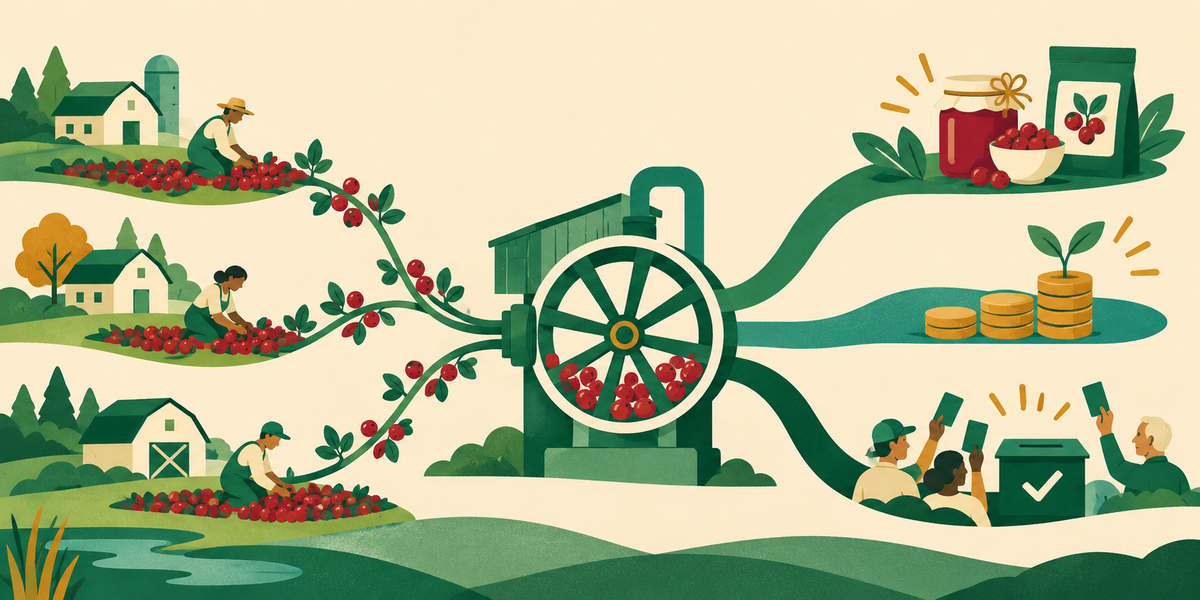
Ocean Spray is a cranberry brand and processing business owned by the farmers in its cooperative, not a public company whose suppliers merely sell it fruit. Around 700 family farmers collectively own the organization, elect its board and depend on it to turn a seasonal crop into juice, sauce and other products.
That structure offers a precise wealth lesson. Ownership can join supply, voting and downstream margin, but those rights come with delivery rules, shared capital needs and exposure to one organization's performance. “Farmer-owned” is an operating system, not a sentimental label.
Three farmers began by combining routes to market
Ocean Spray's official history says three cranberry growers formed the cooperative in 1930 and that it now includes around 700 family farmers. Its 2022 report says farmer-owners are shareholders who elect the board, which oversees the business with senior leadership.
A Time profile described the alignment challenge between hundreds of growers and a large branded company. The report called Ocean Spray worker-owned in one passage, but the primary documents are clearer: its owners are agricultural producers. That correction matters because employees and supplying farmers hold different economic positions.
The cooperative turns a perishable, concentrated harvest into products sold across a longer calendar. Processing and branding can capture value that an individual grower could not easily build alone.
Separate the owner's four accounts
A cooperative member should model four accounts rather than treating all cash as a dividend:
- Farm account: crop revenue minus land, labor, equipment and growing cost.
- Delivery account: volumes, grades and timing accepted by the cooperative.
- Patronage account: allocations or distributions tied to cooperative rules and business results.
- Capital account: money retained, invested or eventually redeemed under the bylaws.
The exact Ocean Spray terms are not established by the public pages used here, so this is a general cooperative worksheet, not a description of every member contract. A prospective member would need current governing documents and professional advice.
Illustrative arithmetic: downstream value still meets farm cost
Suppose a fictional grower delivers 1,000 units of crop and receives an initial $45 per unit, or $45,000. Farm production and delivery cost is $38,000, leaving $7,000 before financing and owner labor adjustments.
Assume the cooperative later allocates another $8 per delivered unit based on annual results. If $5 is paid in cash and $3 retained as member capital, the owner receives $5,000 cash and records $3,000 in the capital account. Current-year cash from crop and patronage is $50,000, not $53,000. Economic allocation and spendable cash are different.
These are illustrative figures, not Ocean Spray payments. They show why a cooperative can create member wealth while retaining part of that value to finance processing, inventory and brand assets.
Ownership does not remove customer discipline
A grower-owned processor still has to make products retailers and consumers buy. If finished-goods demand slows while harvest continues, inventory and pricing pressure travel back through the system. Members may disagree about production, investment and how quickly cash should return.
The board therefore mediates two time horizons. Farms need seasonal cash and confidence that crop has a home. The brand needs long-term investment in plants, product development, sales and marketing. Returning every dollar can weaken the asset that creates future demand; retaining too much can strain the farms that supply it.
This tension resembles LEGO deciding where capital belonged, but cooperative governance gives the suppliers a formal ownership role in that choice.
Use a rights map before calling something ownership
| Right or obligation | Question to verify |
|---|---|
| Vote | Who elects directors, and is voting equal or volume-based? |
| Deliver | What crop must or may the member supply? |
| Receive value | How are prices, patronage and retained capital determined? |
| Exit | When and how can capital be redeemed? |
| Bear loss | Which business and crop risks remain with the member? |
Complete the map from bylaws and contracts, not marketing language. A customer-owned, worker-owned and producer-owned organization may all use “cooperative,” yet the cash flows and control differ.
The concentration test
Membership can deepen a farm's route to market while concentrating risk. The same household may have land, equipment, annual crop sales and retained cooperative capital tied to cranberries and one buyer. Calculate what percentage of household business assets and annual cash flow depend on that system.
A high percentage is not automatically wrong. Specialized farms often create value through concentrated knowledge and infrastructure. The number tells the owner what contingency deserves attention: crop insurance, another outlet, liquidity reserves, succession or a redemption timetable.
What transfers to a smaller producer group
Five makers do not need a national juice company. They can start with one shared bottleneck: cold storage, grading, processing, packaging or sales. Price that service, define quality and voting rules, and test one season before pooling every asset.
Within an hour, each prospective member can write what they contribute, what they expect to receive, which decision they refuse to surrender and how they could leave. Compare the pages before drafting a logo or mission statement. Misalignment visible on paper becomes more expensive inside a plant.
Ocean Spray's longevity does not prove that every agricultural cooperative succeeds or that every farmer receives equal benefit. It demonstrates the shape of a durable asset: producers can own the machinery, brand and market route beyond the farm gate. The wealth is not just a yearly payment. It is a claim on a shared machine that must keep serving both the crop and the customer.
Succession needs a liquidity calendar
A farm may pass to a child while cooperative capital follows separate redemption rules. Put land, equipment, crop contracts, membership rights and retained capital on one timeline. Name who can inherit each item, when cash can be accessed and what approval is required.
Illustratively, a retiring owner may have $200,000 recorded in cooperative capital but receive it over five years under applicable rules. Treating the full amount as closing-day cash could leave a $160,000 first-year gap. This is general arithmetic, not Ocean Spray's redemption schedule.
The calendar also protects the cooperative. Immediate redemption for every retiring member could drain capital from processing and inventory. A long delay protects the shared business but may burden the departing farm. The rule must be understood before succession, not discovered during it.
Ownership creates durable value partly by making capital patient. Good succession turns that patience into an explicit schedule for both the family and the shared enterprise.
A board dashboard should therefore show member health beside company performance. Crop delivered, member concentration, payment timing, retained capital and farm exits belong near finished-goods sales and plant utilization. A branded processor can report strong revenue while particular suppliers face a cash squeeze, or protect farms briefly while weakening the brand asset. The ownership form creates a duty to see both. Alignment is not a permanent condition granted by bylaws; it is a recurring operating task.
Eileen Fisher's partial ownership transition offers a different ownership ledger and reinforces the need to separate control, cash and long-term capital.
Discussion
Sign in with Google or just a name. No email link, no password to remember.