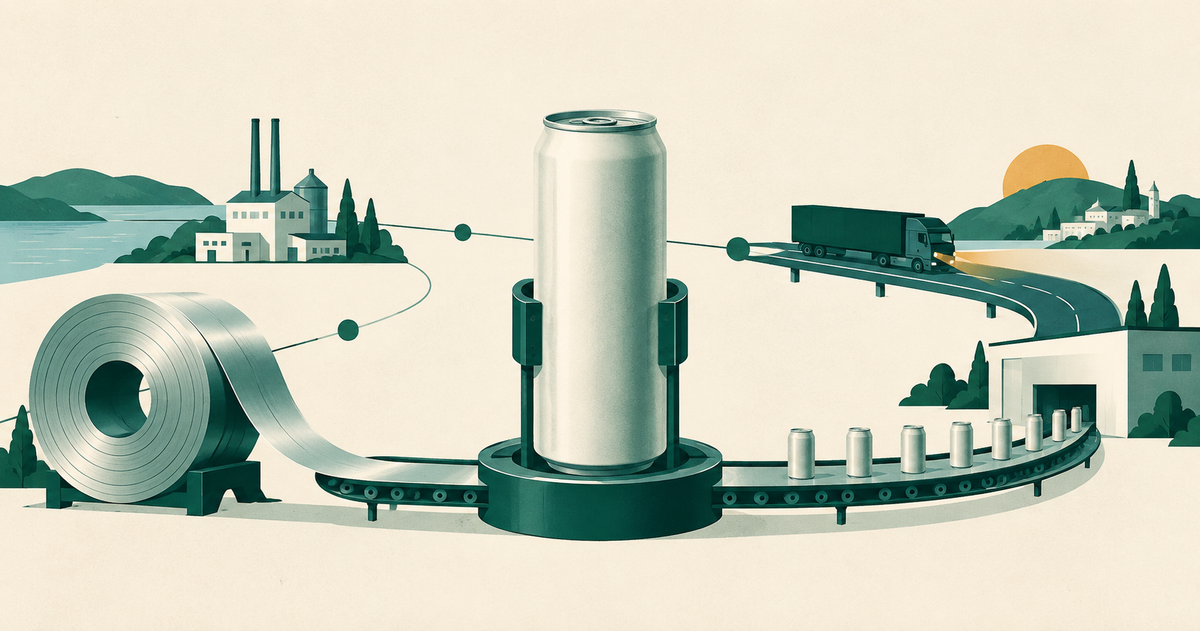
AriZona's 99-cent big can is not a lesson in refusing inflation by force of personality. It is a system built around a price promise: thin cans, high line speed, outsourced production, hybrid distribution, limited advertising expense, and private ownership that lets management accept less margin than a public competitor might demand. The suggested price became part of customer acquisition because buyers recognize it before reading an ad. A smaller manufacturer should not copy 99 cents. It should choose one visible customer promise, calculate the maximum delivered cost that preserves it, and redesign operations around that boundary before printing the promise on the package.
The price became part of the product
Don Vultaggio and John Ferolito came from beverage distribution and introduced AriZona tea in 1992. In a verified Reddit founder AMA, Vultaggio said the company began printing a 99-cent suggested price on packages in 1998 and remained family-owned. A printed price differs from a temporary promotion. It tells shoppers, retailers, distributors, and operators what the brand intends the transaction to feel like.
That consistency produces recognition and goodwill, but retailers are independent and the printed amount is a suggested price. The brand does not control every final sale. The promise is still costly to change because it is physically printed and culturally associated with the product.
A founder considering a visible price promise needs a margin system, not a slogan. Once customers use the number as a trust shortcut, an increase or shrinkage can damage more than volume.
Cost engineering protects the promise
Forbes reported that AriZona worked with manufacturers to make cans thinner, hedged aluminum, used lightweight trucks at night, and combined self-distribution, distributors, and direct shipments to large chains. The company owned one plant and used dozens of independent producers. Forbes estimated a net margin around 15 percent in 2017, based on reporting and company access rather than public audited filings.
Each choice attacks cost without changing the visible promise. A thinner can reduces material. Faster lines spread conversion cost. Regional co-packers reduce freight distance. Direct warehouse shipments remove handling for large accounts. Outsourcing avoids owning every factory while retaining one plant where it offers an advantage.
This is not generic frugality. It is constraint-led design. A cost saving matters if it preserves safety, quality, availability, and the price customers remember.
Turn a price promise into a maximum cost
Assume a product has a $1.00 suggested retail price. The retailer needs 30 cents and the distributor 14 cents. Promotions and damage reserve use 4 cents, leaving 52 cents to the manufacturer. If the manufacturer requires 8 cents of contribution for overhead and profit, the maximum delivered product cost is 44 cents.
$1.00 - $0.30 - $0.14 - $0.04 - $0.08 = $0.44.
If ingredients, package, conversion, and freight total 49 cents, the promise is already broken even if the income statement has not shown it. The company must change cost, channel mix, package, or target margin. Pretending volume will fix negative unit economics makes every new customer expensive.
| Lever | Preserves customer promise? | Hidden risk |
|---|---|---|
| Material reduction | Yes, if performance holds | Damage and quality failures |
| Faster line | Yes | Capital and downtime |
| Regional production | Yes | Consistency across plants |
| Less paid advertising | Yes | Slower entry into new markets |
| Shrink the product | Maybe | Trust loss if concealed |
Distribution experience became an operating moat
A logistics case study from PECO and Bettaway traces the founders' distribution background to buying and selling soda from a van. It describes a long-running outsourced logistics relationship spanning company-owned and contracted manufacturing facilities. As vendor marketing material, it is not independent verification of every scale claim, but it documents the structure and named operating partners.
The founders understood the part many beverage startups discover late: liquid is heavy, retail margins are shared, and small inefficiencies repeat across millions of units. Brand attention cannot rescue a route that loses money after freight and trade deductions.
This is the physical counterpart to Distribution Is the Moat. In beverages, distribution is not only an audience. It is plants, pallets, warehouse paths, retailer terms, and case density.
Private ownership changes the feasible answer
Family ownership lets AriZona choose a stable price even when a short-term margin increase is available. That does not mean private companies ignore economics. It means the owners can value long-term recognition and customer goodwill differently from outside investors seeking a particular return schedule.
A smaller founder should write the ownership implication honestly. Maintaining a price may slow hiring, reduce distributions, or delay projects. If outside capital requires rapid margin expansion, a fixed-price promise can create conflict. The capital structure and customer promise need to agree.
A one-hour promise audit
- Write the one promise customers can verify immediately: price, delivery time, refill life, repairability, or package quantity.
- Build the current delivered-cost waterfall from retail price back to required contribution.
- Circle the two largest controllable cost lines.
- List one change that reduces each without weakening the promise.
- Set a trigger that forces a transparent price or specification review.
Use actual invoices and deductions, not the factory quote. Revisit the landed-cost method in Trunki's manufacturing analysis, and use the returns framework when damage or refunds threaten the cost boundary.
AriZona shows how pricing can acquire customers when the number is memorable and operations defend it. The lesson is not that founders should freeze prices forever. It is that a durable promise needs a designed cost structure, channel knowledge, and owners willing to accept its tradeoffs. Choose the promise carefully, because operational credibility compounds only while the numbers underneath it remain real.
Design an honest escape route
Every fixed promise needs a review rule. Material inflation, safety requirements, or channel fees can move beyond what process improvements recover. Decide in advance which metric triggers a change, such as three consecutive months below a minimum contribution per case. That prevents a founder from preserving a symbolic price by quietly weakening quality or delaying essential maintenance.
When the trigger is reached, compare transparent options: raise price, change package size with prominent labeling, remove an expensive channel, simplify variants, or retire the item. Score each against customer trust and economics. Hidden shrinkage may protect a shelf tag while breaking the underlying promise.
Also measure availability. A low price that causes chronic stockouts does not serve customers. Track fill rate and retailer compliance beside unit margin. AriZona's scale and distribution history make its price feasible in ways a new entrant cannot assume. The small-company version is a promise sized to its actual cost advantage, perhaps a fixed repair price or a refill count rather than the lowest sticker price in the category.
Document the promise in the annual plan, with one owner responsible for the cost waterfall and another empowered to challenge quality compromises. A famous number is useful only when the product behind it remains worth buying.
A memorable price becomes an asset only while the product behind it remains worth choosing.
Discussion
Sign in with Google or just a name. No email link, no password to remember.